Thermage for Face
Thermage FLX uses monopolar radiofrequency to heat the dermis and the fibrous tissue beneath it, causing collagen to contract immediately and remodel over the following months. It is a single treatment with no downtime, and unlike Ultherapy it can be used anywhere on the body. Naficy Rejuvenation Center in Bellevue, Washington performs more than 600 Thermage treatments each year. Full face is $2,500, full face and neck $2,800.
Which should I have — Thermage, Ultherapy, or Fraxel?
These three treat different layers of skin, and that is the whole basis for choosing. Many of our patients use more than one.
| Thermage FLX | Ultherapy | Fraxel | |
|---|---|---|---|
| Energy | Monopolar radiofrequency | Micro-focused ultrasound | Fractional laser light |
| How it heats | Bulk heating of a volume of tissue — dermis and subcutaneous, to roughly 4.3 mm | Focused points at three set depths: 1.5, 3.0 and 4.5 mm, including the SMAS | Columns of energy in the epidermis and superficial dermis |
| Best at | Tightening and smoothing skin across a broad area | Lifting — tightening the foundation layer | Surface — sun damage, pigment, texture |
| Where we use it | All over the body | Mostly face and neck, some chest | Anywhere there is sun damage |
| Comfort | Heat sensation with surface cooling; generally well tolerated | Can be uncomfortable; sedation options offered | Topical numbing |
| Downtime | None | None | About 5–6 days |
| Result appears | Partly immediate, building over 2–6 months | 3–6 months | Days to weeks, building over months |
The practical logic: Thermage for skin that is lax and crepey across a broad area, and for anywhere on the body. Ultherapy where the goal is lift on the face and neck. Fraxel where the problem is what you see on the surface rather than how it sits.
Many patients alternate between Thermage and Ultherapy because they work at different layers. Treating the dermis one year and the foundation the next covers more of the skin than repeating either alone.


What is Thermage and how does it work?
Thermage delivers monopolar radiofrequency energy into the skin. Tissue naturally resists the current, and that resistance generates heat — the same principle as an electric heating element, applied in a controlled way inside the skin.
Two things happen:
- Immediate collagen contraction. Heating collagen fibres to roughly 60–65°C breaks the hydrogen bonds holding them extended, and the fibres shorten. Some tightening is therefore visible straight away.
- Long-term remodelling. The controlled thermal effect triggers new collagen production over the following months, which is where most of the result comes from.
The treatment tip cools the skin surface with a cryogen spray at the same moment it delivers energy. That is what allows heat to build in the dermis while the epidermis stays protected — and it is why there is no downtime.
What is Thermage FLX?
FLX is the current generation of the Thermage platform. Compared with earlier versions it uses a larger tip covering more area per pulse, so treatment is faster, and it incorporates AccuREP technology, which measures the skin's impedance and adjusts energy delivery automatically pulse by pulse.
That matters for two reasons: energy is calibrated to your tissue rather than to a fixed setting, and comfort is meaningfully better than with older Thermage systems. If you had Thermage years ago and found it painful, FLX is a different experience.
What does Thermage treat on the face?
- Lax skin along the jawline and early jowling
- Crepey skin on the cheeks and around the mouth
- Loose skin under the chin and on the neck
- Eyelid skin — one of the few areas Thermage treats where most devices cannot go
- Overall skin texture and firmness

Thermage treatment to eyes. * Individual results may vary.
Can Thermage be used around the eyes?
Yes, and it is one of Thermage's genuine advantages. A dedicated eye tip treats the upper and lower eyelid skin, which is too thin and too close to the globe for most energy devices.
It is well suited to mild crepiness and looseness of the lid skin. It does not remove excess eyelid skin — if you have a fold of skin resting on your lashes, that is upper eyelid surgery, and no amount of tightening will substitute for removing it.
Eye treatment is $1,100 standalone, or $825 added to another Thermage treatment.
Where on the body can Thermage be used?
This is where Thermage differs most from Ultherapy. Because it heats a volume of tissue rather than focused points, it works across large areas — and we use it all over the body.
- Abdomen — loose skin after pregnancy or weight loss
- Upper arms
- Thighs and above the knees
- Buttocks
- Back and flanks
- Cellulite — see Thermage for cellulite
See Thermage for body for detail. Body treatment is $3,000 per area.
An honest limit: Thermage tightens skin, it does not remove it. Significant loose skin after major weight loss needs surgery — a arm lift, tummy tuck, or equivalent. Thermage is for mild to moderate laxity.
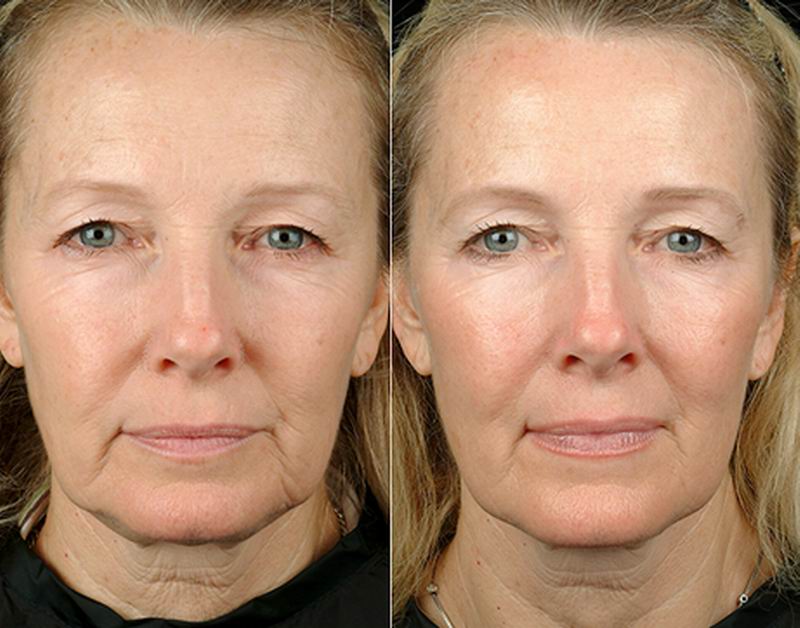
Thermage treatment to face. * Individual results may vary.
How much does Thermage cost?
| Treatment area | Single session |
|---|---|
| Full face | $2,500 |
| Full face + under chin | $2,600 |
| Lower face + full neck | $2,600 |
| Full face + full neck | $2,800 |
| Body, each area | $3,000 |
| Eyes, standalone | $1,100 |
| Eyes, added to another treatment | $825 |
A $500 non-refundable deposit is required for single treatments of $1,000 or more.
Full non-surgical pricing · Current specials · Financing
How many Thermage treatments will I need?
Typically one. Thermage is designed as a single treatment and most patients get their full result from it — which distinguishes it from most energy devices that require a series.
Many patients repeat every one to two years to maintain results as ageing continues. A good number alternate with Ultherapy, treating a different layer each time.
How long does the Thermage procedure take?
Roughly 45 minutes for eyes only, 60 to 90 minutes for a full face, and 90 minutes or more for a body area. There is no recovery period.
When will I see Thermage results?
| Time after treatment | What to expect |
|---|---|
| Immediately | Some tightening is often visible from collagen contraction. Mild redness or swelling settles within hours. Normal activity the same day. |
| Weeks 1–4 | The immediate effect settles and little changes visibly while new collagen forms. |
| Months 2–4 | The real result emerges gradually as collagen remodels. |
| Months 4–6 | Full result. This is when to judge the treatment. |
| 1–2 years | Results maintained, then gradually give way to continued ageing. Most patients repeat around this point. |
Does Thermage hurt?
Most patients tolerate it well. You feel a brief deep heat with each pulse, immediately followed by the cooling spray — a hot-then-cold sensation rather than sustained pain.
FLX is considerably more comfortable than earlier Thermage generations, because AccuREP adjusts energy to your tissue rather than applying a fixed setting. Topical numbing is available, and for anxious patients so are our other comfort options.
Who is a good candidate for Thermage?
- Mild to moderate skin laxity and crepiness — on the face, or anywhere on the body
- Loose or crepey eyelid skin not severe enough for surgery
- Loose abdominal skin after pregnancy or moderate weight loss
- Anyone wanting improvement with no downtime whatsoever
- Realistic expectations, and willingness to wait two to six months
- Thermage works across all skin types, including darker skin — radiofrequency is not absorbed by pigment, so it does not carry the hyperpigmentation risk that limits laser treatment in Fitzpatrick IV to VI
Who is not a good candidate?
- Significant loose skin. Thermage tightens; it does not remove skin. Substantial excess after major weight loss, or heavy jowling, needs surgery.
- You want a lift rather than tightening. Ultherapy reaches the foundation layer; a facelift repositions it.
- Your concern is volume loss. Tightening a deflated face does not fill it — that needs filler, Sculptra, or fat grafting.
- Your concern is surface damage — pigment, sun damage, texture. That is Fraxel or laser resurfacing.
- You have a pacemaker, defibrillator, or other implanted electrical device. Radiofrequency is contraindicated — this is an absolute exclusion, so disclose it.
- Metal implants in the treatment area.
- Pregnancy or breastfeeding.
- Active infection or open wounds in the treatment area.
What are the risks of Thermage?
Common and short-lived: redness and mild swelling for a few hours, and a sensation of warmth or tenderness for a day or two.
Less common:
- Blistering or surface burn — uncommon, and the reason the cooling system and correct settings matter
- Temporary numbness or tingling
- Small depressions or unevenness from excessive energy at one point — rare
- Under-response — some patients simply do not produce enough new collagen. This is the honest limitation of every energy device and cannot be predicted in advance
Rare: scarring, persistent surface irregularity, or fat loss in the treated area from excessive heating.
What can be combined with Thermage?
With Ultherapy: the most common pairing here. Different layers, frequently alternated year to year.
With fillers or Sculptra: Thermage tightens the envelope, volume restores what is underneath.
With Botox: a standard maintenance combination.
With laser resurfacing: Thermage for firmness, laser for the surface.
After surgery: a common way to maintain the result of a facelift or body procedure.
Why have Thermage at a surgical practice?
The judgement matters more than the device. A practice offering only energy treatments will recommend an energy treatment; we perform facelifts and body surgery, so when we say Thermage will give you a worthwhile result, that is not constrained by what we happen to own — and when we say it will not be enough, that is worth hearing before you spend the money.
We perform more than 600 Thermage treatments each year, within a practice led by Sam Naficy, MD, FACS, board-certified by the American Board of Facial Plastic and Reconstructive Surgery, with an on-site Medicare-certified and Washington State–accredited surgery center.
Thermage before and after photos
Before and after photographs of Thermage FLX at Naficy Rejuvenation Center. Results build over two to six months. Individual results vary.
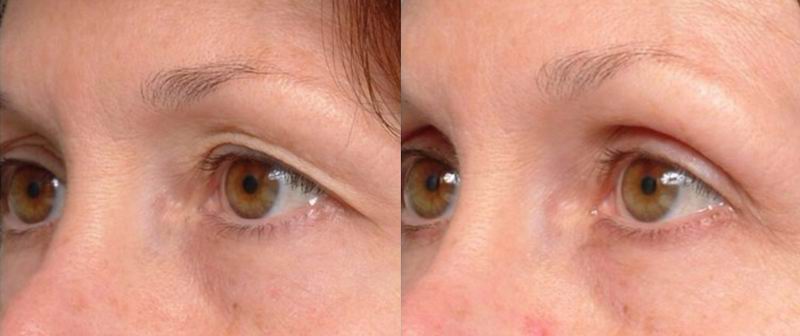
Thermage treatment to eyes. * Individual results may vary.
Frequently asked questions about Thermage
How much does Thermage cost in Seattle?
At our practice, $2,500 for full face, $2,800 for full face and neck, $3,000 per body area, and $1,100 for eyes standalone or $825 as an add-on.
How many Thermage treatments do I need?
Typically one. Most patients repeat every one to two years for maintenance.
How long does Thermage last?
One to two years for most patients. Ageing continues, so maintenance treatments are usual.
When will I see Thermage results?
Some tightening is often visible immediately from collagen contraction, with the real result building over two to six months.
Does Thermage hurt?
Most patients tolerate it well — a brief deep heat with each pulse followed immediately by cooling. FLX is significantly more comfortable than older Thermage systems.
Is Thermage better than Ultherapy?
Neither is better. Thermage heats the dermis in bulk and can be used anywhere on the body; Ultherapy reaches 4.5 mm including the SMAS and is better for lifting the face and neck. Many of our patients alternate between the two.
Is there downtime after Thermage?
None. Normal activity the same day. Mild redness settles within hours.
Can Thermage be used on the eyes?
Yes, with a dedicated eye tip — one of its advantages. It treats crepey lid skin but does not remove excess skin, which requires eyelid surgery.
Can Thermage be used on the body?
Yes — abdomen, arms, thighs, knees, buttocks, back and flanks. This is the main practical difference from Ultherapy.
Does Thermage work on darker skin?
Yes. Radiofrequency is not absorbed by pigment, so Thermage does not carry the hyperpigmentation risk that limits laser treatment in Fitzpatrick IV to VI.
Can I have Thermage with a pacemaker?
No. Radiofrequency is contraindicated with pacemakers, defibrillators and other implanted electrical devices.
Will Thermage fix loose skin after weight loss?
Mild to moderate laxity, yes. Significant excess skin needs surgical removal — Thermage tightens but does not excise.
What is Thermage FLX?
The current generation of the platform, with a larger tip for faster treatment and AccuREP technology that adjusts energy to your skin pulse by pulse, improving both consistency and comfort.
Next steps
A consultation establishes whether tightening will give you what you want, or whether the actual problem is volume, surface damage, or descent needing surgery. Those are four different problems and only one of them is Thermage.
Naficy Rejuvenation Center is located in Bellevue, Washington, and serves patients from Seattle, the Eastside, and throughout the Pacific Northwest.
Schedule an appointment · Ask a question · Non-surgical pricing
Medically reviewed by Sam Naficy, MD, FACS, board-certified by the American Board of Facial Plastic and Reconstructive Surgery.