Lip Lift
A lip lift shortens the skin between the nose and the upper lip, rolling more of the red lip into view. It is a permanent alternative to filler, performed under local anesthesia or IV sedation in about 30 minutes, with sutures removed at 5 to 7 days. Sam Naficy, MD, FACS performs 25 to 30 lip lifts each year in Bellevue, Washington. Fees are $6,500 for a subnasal lip lift, $6,500 for a corner lip lift, and $13,000 for both.


Before and after subnasal (bullhorn) lip lift by Sam Naficy, MD * Individual results may vary.
What is a lip lift?
A lip lift removes a measured strip of skin from the area between the nose and the upper lip, and closes the gap. Shortening that distance lifts the upper lip, exposes more of the red lip, and sharpens the Cupid's bow. Most patients also show more of the upper teeth when smiling.
Because the excised strip is shaped like a set of bull horns or gull wings, the procedure is commonly called a bullhorn lip lift or gullwing lip lift. The medical term is subnasal lip lift, since the incision sits at the base of the nose.
Why the upper lip lengthens with age
Two changes happen at once, and they compound each other.
The distance from the base of the nose to the top of the lip — the philtrum — lengthens over decades as skin loses elasticity and the tissue descends. At the same time the red lip itself thins and deflates, rolling inward.
The result is a longer, flatter space above a thinner lip, and less visible tooth show at rest and when smiling. This is the single change most responsible for making the mouth region look older, and it is why adding volume alone frequently does not fix it: filler expands a lip that is sitting too low, rather than raising it.
What are the types of lip lift?
| Type | What it does | Where the incision sits | Best for |
|---|---|---|---|
| Subnasal (bullhorn / gullwing) | Shortens the philtrum and rolls the upper lip outward, increasing red lip show and tooth show | A single continuous line tucked into the crease at the base of the nose | A long upper lip with a thin, inward-rolled red lip |
| Corner lip lift | Raises the downturned outer corners of the mouth | A small triangle at each corner of the mouth | Corners that turn down and read as a frown at rest |
| Italian lip lift | Same effect as the subnasal lift | Two smaller separate incisions under each nostril rather than one continuous line | A variation on the subnasal approach |
The subnasal and corner lifts address different problems and are frequently performed together, since a long philtrum and downturned corners often occur in the same patient.


Before and after subnasal (bullhorn) lip lift by Sam Naficy, MD * Individual results may vary.
How much skin is removed in a lip lift?
Typically a horizontal crescent 6 to 7 millimetres in height, measured against the length of your own philtrum rather than a fixed formula. This measurement is the whole procedure. Too little and nothing visibly changes; too much and the lip is over-elevated, the nostrils distort, and the teeth show excessively at rest. The margin between a natural result and an operated one is a matter of one or two millimetres.

Before and after corner lip lift and lip augmentation by Sam Naficy, MD * Individual results may vary.

Before and after corner lip lift by Sam Naficy, MD * Individual results may vary.
Who is a good candidate for a lip lift?
- A long philtrum — a long distance between the base of the nose and the top of the upper lip
- Little or no red lip show at rest, with the upper lip rolled inward
- Little tooth show when smiling, or none at rest
- Downturned corners of the mouth, for the corner lift specifically
- Dissatisfaction with filler — either the result looks projected rather than lifted, or the repeat cost has become the objection
- Good general health, no nicotine use, and realistic expectations about a visible scar during the first weeks
Age matters far less than proportion. The relevant measurements are the length of the upper lip and the balance of the mouth against the nose and chin. Lip lifts have been performed in this practice on patients from their twenties into their seventies.
Who is not a good candidate for a lip lift?
- Your philtrum is already short. Shortening it further produces a distorted, over-elevated lip and excessive tooth show at rest. This is the most common reason to decline the procedure.
- You want volume rather than lift. If the lip sits in a good position and is simply thin, filler or fat grafting is the correct answer, not a lip lift.
- You cannot accept a scar under the nose. It is well hidden and fades, but it is a real incision on a visible part of the face, and during the first weeks it is visible.
- You use nicotine in any form. Nicotine impairs healing at the incision and materially worsens the scar. Cessation is required for at least three weeks before and after.
- Significant prior surgery under the nose may limit what can safely be excised.
- You have unrealistic expectations about how much change 6 to 7 millimetres produces.
How is a lip lift performed?
A subnasal lip lift takes approximately 30 minutes. A corner lip lift takes approximately 30 minutes. Performed together, allow about an hour. The procedure can be done under local anesthesia or IV sedation, according to your preference and what else is being done at the same time.
- Marking. The excision is measured and drawn with you sitting upright, since the lip sits differently lying down. This is done before any anesthetic distorts the tissue.
- Excision. The crescent of skin is removed with the upper border tucked precisely into the crease where the nose meets the lip, so the scar falls in a natural shadow line rather than on flat skin.
- Closure with deep muscle anchoring. The lift is anchored to the orbicularis oris muscle beneath the skin rather than to the skin itself. Closure proceeds in layers, so structural tension is carried by the deep tissue. Skin tension is what widens a scar and what can pull on the nostril base, and this step is the difference between a fine line and a visible one.
Sutures are removed at 5 to 7 days.
Why deep muscle anchoring matters
A lip lift is a small operation in a conspicuous place, and the two things that go wrong are a widened scar and distortion of the nostril base. Both come from the same cause: tension carried by the skin. Anchoring the lift to the orbicularis oris muscle transfers that tension to deep tissue that is built to hold it, leaving the skin edges to come together without being pulled. This is why the scar sits as a fine line in the natural shadow beneath the nose, and why the nostrils keep their shape. If you are consulting elsewhere, it is a reasonable question to ask any surgeon how they anchor the closure.
What is lip lift recovery like?
Pain is not severe and is usually controlled with acetaminophen, occasionally with a short course of prescription medication. Swelling, not pain, is what determines how soon you look presentable.
| Time after surgery | What to expect |
|---|---|
| Days 1–2 | Swelling of the upper lip begins. Cold compresses and keeping the head elevated help. Discomfort is mild. |
| Days 3–4 | Swelling and any bruising reach their peak. The lip looks fuller and more elevated than the final result. |
| Days 5–7 | Sutures removed. Swelling begins to settle. |
| Weeks 2–3 | Most swelling resolved. The incision is pink but by around three weeks can usually be covered easily with makeup. |
| Weeks 6–12 | The scar continues to fade and flatten. The lip position settles into its final shape. |
| Months 3–12 | Scar maturation completes. A well-placed lip lift scar becomes difficult to see. |
How does the lip lift scar heal?
This is the question patients ask most, and it is usually answered vaguely. The photographs below show the same procedure at five days, three weeks, eight weeks, and twelve weeks, so you can judge the timeline rather than take a description on trust.
A facial incision that eventually becomes very hard to see was more visible in the early weeks. That is normal and expected — scars look worse before they look better. The scar is placed in the crease where the nose meets the lip, where a natural shadow line already exists, which is why it conceals well once mature.

Before and only 5 days after subnasal (bullhorn) lip lift by Sam Naficy, MD * Individual results may vary.

Before and 5 days after subnasal (bullhorn) lip lift by Sam Naficy, MD * Individual results may vary.

Before and 3 weeks after subnasal (bullhorn) lip lift by Sam Naficy, MD * Individual results may vary.

Before and 8 weeks after subnasal (bullhorn) lip lift by Sam Naficy, MD * Individual results may vary.

Before and 12 weeks after subnasal (bullhorn) lip lift by Sam Naficy, MD * Individual results may vary.
Lip lift vs. filler vs. fat grafting
| Lip lift | Lip filler | Fat grafting to lips | |
|---|---|---|---|
| What it changes | Lip position — shortens the philtrum, rolls the lip outward | Lip volume — projects the existing lip forward | Lip volume, using your own tissue |
| Tooth show | Increases it | No change, and can reduce it | No change |
| Longevity | Permanent | Months; requires repeating indefinitely | The surviving portion is permanent but survival rate is unpredicable in lips and generally lower than in other areas of the face |
| Scar | Yes — at the base of the nose | None | None on the lip |
| Downtime | About a week to look presentable | Minimal | Several days of swelling |
| Reversible | No | Yes, hyaluronic acid can be dissolved | No but fat volume decreases with age |
| Cost over ten years | One fee | Repeated indefinitely | Multiple sessions may be needed to achieve desired volume |
The distinction that matters: a lip lift changes where the lip sits; filler changes how far it projects. Repeatedly adding filler to a lip that is sitting too low produces the projected, heavy upper lip that patients recognise as overfilled. Where the underlying problem is a long philtrum, no amount of volume corrects it.
The two are not mutually exclusive. Lifting the lip into the right position and then adding modest volume often gives a better result than either alone.
How long does a lip lift last?
Permanently. Unlike filler or fat grafting, whose results fade, the skin removed in a lip lift does not come back. Over subsequent decades the area may gradually descend again as part of normal ageing, at which point a touch-up can be performed — but this is a matter of decades, not years.
Can a subnasal lip lift and a corner lip lift be done together?
Yes, and it is common. Patients who need both have them performed in the same sitting, which consolidates the recovery into a single period rather than two. Allow about an hour of operating time for the pair.

Before and after subnasal lip lift and corner lip lift by Sam Naficy, MD * Individual results may vary.

Before and after subnasal lip lift and corner lip lift by Sam Naficy, MD * Individual results may vary.
What procedures are combined with a lip lift?
With fat grafting or filler: lift the lip into position, then add volume. Position first, volume second — in that order.
With rhinoplasty: the base of the nose and the upper lip are anatomically continuous, and rhinoplasty can alter the appearance of the lip. Planning them together avoids working against yourself.
With a facelift: a facelift does not treat the upper lip. Patients who have a lift and remain unhappy with the mouth region are frequently describing a long philtrum that the lift was never going to change.
With laser resurfacing: resurfacing addresses the fine vertical lines around the mouth, which a lip lift does not.
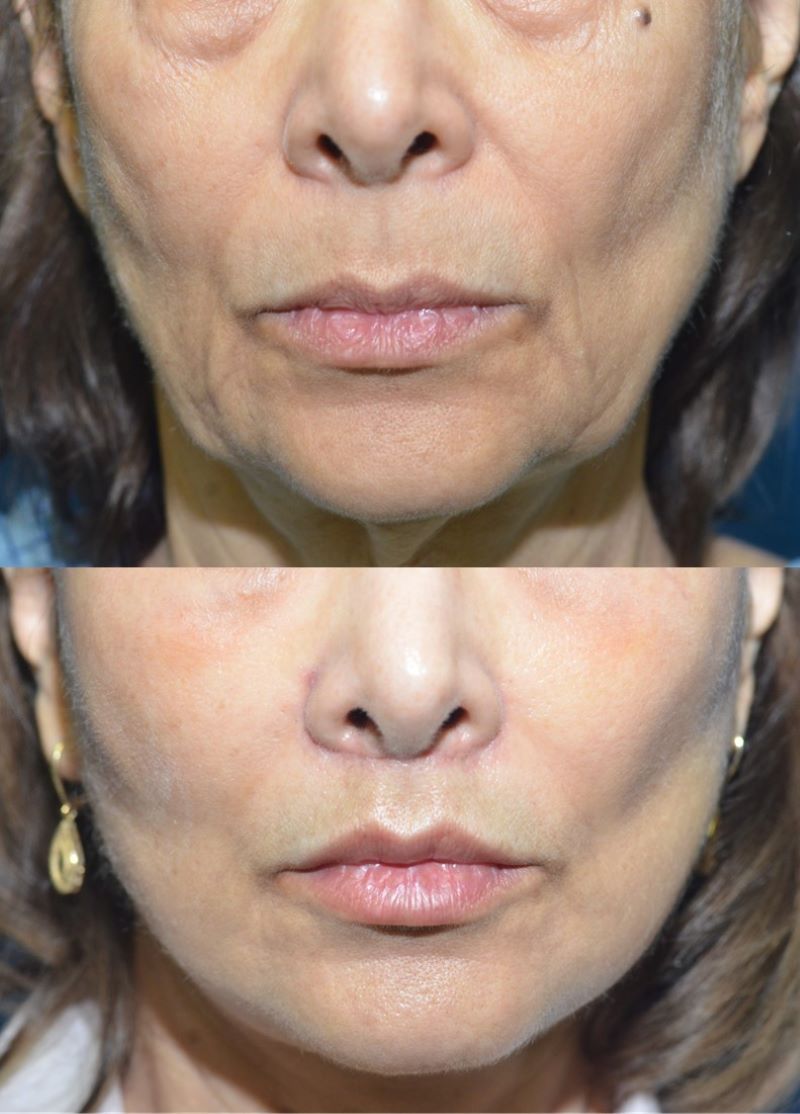
Before and after subnasal lip lift, deep plane facelift, and fat grafting by Sam Naficy, MD * Individual results may vary.
Lip lift in men
Men can be good candidates, and the target is different. The male philtrum is naturally longer, and excessive shortening feminises the face. Excision is more conservative, and the goal is restoring a youthful proportion rather than maximising red lip show. Facial hair also conceals the incision well.
What are the risks of a lip lift?
More common, and usually temporary: swelling peaking at three to four days, bruising, temporary numbness or tightness of the upper lip, and a firm ridge along the incision as it heals.
Less common:
- A visible or widened scar. The principal risk of the procedure. Minimised by precise placement in the crease and layered closure, and worsened considerably by nicotine.
- Over-elevation — too much skin removed, producing excessive tooth show at rest and an unnatural appearance. Difficult to correct, which is why the marking is done conservatively.
- Under-correction, where too little was taken and the change is not visible.
- Distortion of the nostril base or widening of the nostrils, where the excision extends too far.
- Asymmetry between the two sides.
- Prolonged numbness of the upper lip.
- Infection — uncommon in this location, which has an excellent blood supply.
How much does a lip lift cost?
At Naficy Plastic Surgery:
| Procedure | Fee |
|---|---|
| Subnasal (bullhorn) lip lift | $6,500 |
| Corner lip lift | $6,500 |
| Both together | $13,000 |
Fees are itemized in writing at consultation. Financing is available through PatientFi. A lip lift performed for cosmetic reasons is not covered by insurance.
Set against filler, the comparison is straightforward: a lip lift is a single fee for a permanent change in lip position, while filler is a recurring cost for a temporary change in volume. They are not the same result, so the comparison is only useful if a lift is what you actually need.
Fees & payment policies · Financing
Why choose a facial plastic surgeon for a lip lift?
A lip lift is a small operation in which the entire result depends on two decisions: how many millimetres to remove, and exactly where to place the incision. Both are judgement, not technique, and neither can be undone.
Dr. Naficy performs 25 to 30 lip lifts each year. His practice has been devoted exclusively to facial plastic surgery since 2000, and he is certified by the American Board of Facial Plastic and Reconstructive Surgery (ABFPRS). He graduated first in his class from the University of Washington School of Medicine and completed both his residency and fellowship at the University of Michigan. He has been on the clinical faculty of the University of Washington since 1999, has co-authored seven chapters in Principles of Nasal Reconstruction (Springer), and has been recognized in Seattle Magazine's Top Doctors list.
About Dr. Sam Naficy, MD, FACS
What type of anesthesia is used for a lip lift?
A lip lift can be performed under local anesthesia or under IV sedation, depending on your preference and whether other procedures are being performed at the same time. Where sedation is used it is administered by a dedicated anesthesia provider, and your heart rate, blood pressure, breathing, and oxygen levels are monitored throughout.
Surgery is performed in our on-site surgery center, which is Medicare-certified and Washington State–accredited. Our anesthesia team has more than 50 years of combined experience, and all providers also hold appointments at the University of Washington or other regional medical centers.
Anesthesia guidelines [21kb PDF]
Lip lift before and after photos
Before and after photographs of lip lift surgery performed by Dr. Sam Naficy. Some patients had additional procedures; the caption accompanying each photograph describes what was done.

Before and after subnasal (bullhorn) lip lift by Sam Naficy, MD * Individual results may vary.
Frequently asked questions about lip lift surgery
Is a lip lift permanent?
Yes. The skin removed does not return. Over subsequent decades the area may gradually descend again with normal ageing, at which point a touch-up can be performed.
How noticeable is the lip lift scar?
It is placed in the crease at the base of the nose, where a natural shadow already falls. It is pink and visible in the first weeks, can usually be covered with makeup by around three weeks, and continues fading over three to twelve months. The photographs on this page show it at five days, three weeks, eight weeks, and twelve weeks.
How long does a lip lift take?
About 30 minutes for a subnasal lift, about 30 minutes for a corner lift, and about an hour for both together.
Does a lip lift hurt?
Not severely. Acetaminophen is usually sufficient, occasionally with a short course of prescription medication.
When can I go back to work after a lip lift?
Most patients are presentable at about a week, once sutures are out and the peak swelling has settled. The incision is still pink at that stage.
How much does a lip lift cost in Seattle?
At our practice, $6,500 for a subnasal lip lift, $6,500 for a corner lip lift, and $13,000 for both. Financing is available through PatientFi.
What is the difference between a bullhorn lip lift and an Italian lip lift?
The effect is the same. The bullhorn uses a single continuous incision at the base of the nose; the Italian uses two smaller separate incisions under each nostril.
Is there an ideal age for a lip lift?
No. What matters is the length of the philtrum and the proportion of the mouth against the nose and chin, not the number. Lip lifts have been performed in this practice on patients from their twenties into their seventies.
Will a lip lift make my teeth show more?
Yes, that is part of the intended effect. Increased upper tooth show when smiling, and a small amount at rest, is one of the markers of a youthful mouth. Excessive tooth show at rest indicates over-elevation, which is why the excision is measured conservatively.
Can a lip lift be reversed?
No. Skin that has been removed cannot be replaced. This is the reason the marking is done conservatively, and the reason a short philtrum is a contraindication rather than a judgement call.
Should I get a lip lift or lip filler?
If the lip is thin but sitting in a good position, filler. If the distance between nose and lip is long and the red lip has rolled inward, a lip lift — filler will not correct that, and repeated attempts produce an overfilled appearance. Many patients ultimately do both, in that order.
Can men get a lip lift?
Yes, with a more conservative excision. The male philtrum is naturally longer, and over-shortening feminises the face.
Does insurance cover a lip lift?
Not when performed for cosmetic reasons.
When are the sutures removed after a lip lift?
At 5 to 7 days.
What does “board certified” actually mean in facial plastic surgery?
Board certification tells you what a surgeon was trained and examined in. On its own, the phrase “board certified” does not say in which field. Certification exists across many specialties, and a certificate in another specialty is a genuine credential in that specialty. It is simply not the same thing as certification in facial plastic surgery. So the useful follow-up question is always: certified by which board, and in what?
For facial plastic surgery there are two boards to look for, and both publish free public tools that let you verify a surgeon yourself in under a minute.
| Board | What it certifies | Verify a surgeon |
|---|---|---|
| American Board of Facial Plastic and Reconstructive Surgery (ABFPRS) | Facial plastic and reconstructive surgery specifically. Certification requires that the surgeon already hold certification from an American Board of Medical Specialties board in either otolaryngology–head and neck surgery or plastic surgery, pass a two-day examination, and submit for peer review operative reports from a minimum of 100 facial plastic surgery procedures. | ABFPRS Physician Finder |
| American Board of Plastic Surgery (ABPS) | Plastic surgery of the entire body, including the face. ABPS is a member board of the American Board of Medical Specialties. | ABPS Verify Certification |
Why the ABFPRS requirement matters
The detail worth understanding is that ABFPRS certification cannot be the only board a surgeon holds. It is granted on top of an existing ABMS certification in one of the two surgical specialties whose residency training covers facial plastic surgery. An ABFPRS diplomate is double boarded by definition. Those two qualifying pathways — otolaryngology–head and neck surgery, and plastic surgery — are both represented at this practice, and both of our facial surgeons hold certification from two boards rather than one. The 100-case peer review is also specific: the operative reports submitted must be facial plastic surgery, not surgery generally.
What to ask, and how to check
- Which board certified you, and in what specialty? Not simply “are you board certified.”
- Is that board a member of the American Board of Medical Specialties? Boards exist with similar-sounding names that are not ABMS member boards.
- Where do you hold hospital operating privileges, and for this procedure? Hospital privileges are granted by peer review against training.
- How many of these do you perform each year? Certification is a floor, not a measure of current volume.
- Verify it yourself. Both boards above let you search by surgeon name. The ABFPRS states that its website is a primary source of verification.
The surgeons at this practice, and how to verify them
| Surgeon | Board certification | Residency pathway |
|---|---|---|
| Sam Naficy, MD, FACS | American Board of Facial Plastic and Reconstructive Surgery American Board of Otolaryngology – Head and Neck Surgery |
Otolaryngology – head and neck surgery, followed by facial plastic surgery fellowship at the University of Michigan |
| Keith Hurvitz, MD, FACS | American Board of Plastic Surgery American Board of Otolaryngology – Head and Neck Surgery |
Otolaryngology – head and neck surgery residency at USC, followed by a general plastic surgery residency at UC Irvine |
Each of these certifications can be confirmed through the verification links above, or with the certifying boards directly. We would encourage you to check ours, and to check the credentials of any other surgeon you consult.
Next steps
A consultation establishes the one thing that determines whether a lip lift is right for you: the actual length of your philtrum, measured and assessed against the proportions of your nose, mouth, and chin. That measurement is what separates a candidate from someone better served by filler.
Naficy Plastic Surgery & Rejuvenation Center is located in Bellevue, Washington, and serves patients from Seattle, the Eastside, and throughout the Pacific Northwest.
Request a consultation · Ask a question · Out of town patients
Medically reviewed by Sam Naficy, MD, FACS, board-certified by the American Board of Facial Plastic and Reconstructive Surgery.