Sculptra
Sculptra is not a filler. It is a collagen stimulator — poly-L-lactic acid that prompts your own body to rebuild collagen over several months, rather than adding volume on the day. Results appear gradually and last two years or more. Naficy Rejuvenation Center in Bellevue, Washington has been ranked by Galderma, year after year, as the #1 single-location Sculptra provider in Washington State and among the top 10 providers nationwide. Sculptra is $990 per vial, with a 10% multi-vial discount, and a typical plan is three sessions about a month apart.
Why patients travel to us for Sculptra
Sculptra rewards experience more than almost any injectable, because the product does nothing visible on the day it is placed. There is no immediate result to judge, which means the outcome depends entirely on the injector correctly predicting what your face will look like three months later — and on the dilution and placement technique used.
- Ranked by Galderma, the manufacturer of Sculptra, year after year as the #1 single-location Sculptra provider in Washington State, and among the top 10 providers nationwide.
- A Galderma national trainer on staff. Lorin Bates, RN, BSN is a GAIN trainer for Galderma, teaching other practices Sculptra technique and best practice.
- A nodule rate below 1 in 200 under our dilution and post-treatment massage protocol — discussed openly further down this page, because it is the risk that matters with this product.
- A board-certified plastic surgeon on site, unlike medspas offering Sculptra without one.
What is Sculptra?
Sculptra is injectable poly-L-lactic acid (PLLA), a biodegradable material used in medicine for decades — it is one of the materials dissolving sutures are made from.
Once injected, the PLLA particles create a controlled, low-grade stimulus in the deep tissue. Your body responds by laying down new collagen around them. The particles themselves are gradually absorbed and disappear; what remains is your own collagen. That is the essential difference between Sculptra and every hyaluronic acid filler: you are not left with product in your face, you are left with tissue you grew.
How is Sculptra different from a filler?
| Sculptra | Hyaluronic acid filler (Juvéderm, Restylane) | |
|---|---|---|
| Mechanism | Stimulates your body to produce collagen | Adds volume directly as a gel |
| When you see it | Gradually, over 6 weeks to 6 months | Immediately |
| What remains long term | Your own collagen; the product is absorbed | The gel itself, until it degrades |
| Duration | 2+ years | 6–24 months |
| Reversible | No — cannot be dissolved | Yes, with hyaluronidase |
| Treatment pattern | A planned series, typically 3 sessions | Usually a single appointment |
| Best at | Global, diffuse volume loss and overall skin quality | Precise shaping of a specific feature |
| Not suited to | Lips, and detailed sculpting of a single feature | Restoring volume across the whole face economically |
They are complementary rather than competing. A common plan is Sculptra to rebuild the underlying foundation, with a hyaluronic acid filler used afterward for precise shaping where it is needed.
Where on the face can Sculptra be injected?
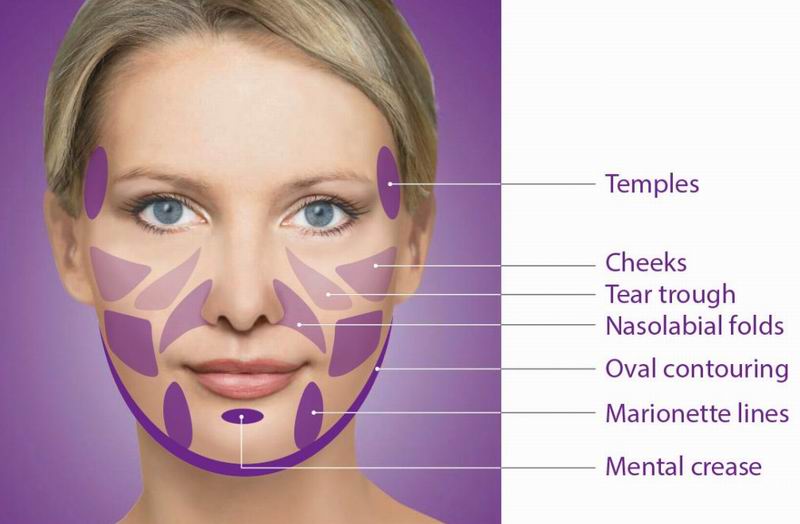
- Temples — one of the most effective areas, and one of the most commonly overlooked
- Cheeks and midface — restoring the foundation that supports the lower face
- Nasolabial folds and marionette lines — softened by rebuilding the support above them
- Jawline — definition and contour
- Chin
- Pre-jowl hollows
- Overall skin thickness and quality, which improves as dermal collagen increases
Sculptra is not used in the lips, and is used with considerable caution or avoided immediately under the eyes. Those areas need a soft, reversible hyaluronic acid product.

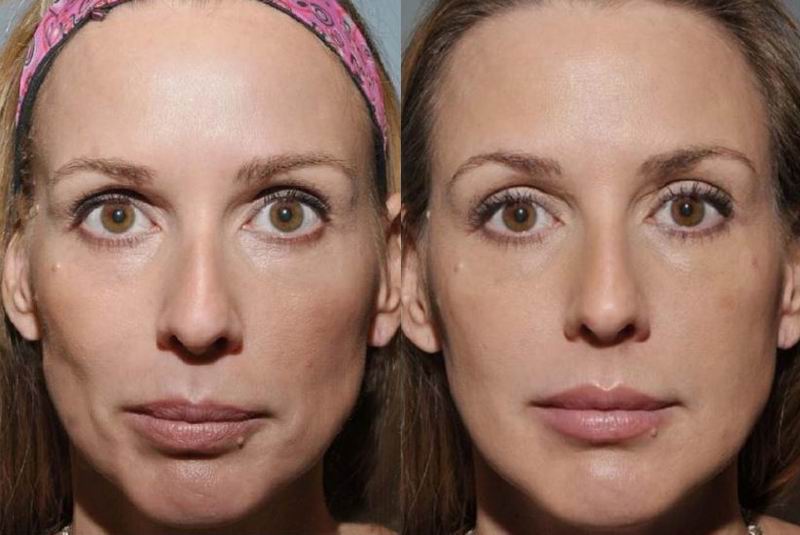
Before and after 3 sessions of Sculptra injections *Individual results may vary.
Can Sculptra be used on the body?
Yes. We treat multiple body and breast sites with Sculptra, and the same principle applies — it rebuilds collagen and improves skin quality rather than filling a defect.
Common body applications include:
- Buttocks — adding volume and improving contour without implants or fat transfer surgery. Frequently searched as a "Sculptra butt lift" or non-surgical BBL
- Décolletage — the chest, where sun damage and crepey texture are common and difficult to treat otherwise
- Crepey skin on the upper arms, above the knees, and elsewhere
- Breast — improving skin quality and upper-pole contour
- Cellulite dimpling and skin laxity in selected areas
An important expectation-setter for buttock treatment: body areas are far larger than the face, so they require substantially more product and more sessions, and the change is a genuine but moderate improvement in contour and skin quality. Sculptra is not equivalent to a surgical BBL or fat transfer in the volume it can add. Anyone promising equivalence is overselling it. Volumes and session counts for body treatment are planned individually at consultation.
How much does Sculptra cost?
| Price | |
|---|---|
| Sculptra, per vial | $990 |
| Multi-vial discount | 10% off |
| Periodic promotion | Buy 4 vials, get 1 free — offered from time to time |
How many vials of Sculptra will I need?
The working rule of thumb for facial treatment is about one vial per decade of age. A patient in their forties typically needs around four vials; a patient in their sixties, around six.
This is a starting point rather than a formula. Leaner faces with more volume loss need more; fuller faces need less. Body treatment requires considerably more.
So a typical facial course for a patient in their forties is roughly four vials at $990, less the 10% multi-vial discount, spread across three sessions. You will be given the full plan and cost in writing before starting, not vial by vial as you go.
Non-surgical pricing · Current specials · Financing
Is Sculptra good value compared with filler?
Over a multi-year horizon, generally yes. Hyaluronic acid filler is a recurring cost every 6 to 18 months indefinitely. Sculptra is a front-loaded course that lasts two years or more and leaves your own collagen behind. The trade-off is that you pay more upfront and wait months to see it.
How many Sculptra sessions will I need?
Typically three sessions, about a month apart. Some patients need two, some need more, depending on the degree of volume loss and how their collagen responds.
The staged approach is deliberate rather than a scheduling convenience. Because each session's collagen response is still developing when the next is given, treating in stages lets your injector assess how your tissue is responding and adjust the remaining plan — which is not possible with a product you place all at once.
When will I see Sculptra results, and how long do they last?
| Time | What is happening |
|---|---|
| Day of treatment | You may look fuller, but this is the fluid the product is mixed in. It is not the result and it disappears within 1–3 days. Expect this, or you will think it has stopped working. |
| Days 1–3 | The fluid absorbs and you return to how you looked before. Mild swelling or bruising settles. |
| Weeks 2–6 | Nothing visible yet. Collagen production is underway beneath the surface. |
| Weeks 6–12 | The first visible change. Gradual, and often noticed by the patient before anyone else. |
| Months 3–6 | The result builds to its peak as collagen matures. |
| 2+ years | Results are maintained. Many patients top up with a vial or two annually rather than repeating the full course. |
The gradualness is, for many patients, the point. Nobody sees a day on which your face changed — which is why Sculptra suits people who want to look progressively better without anyone identifying what was done.
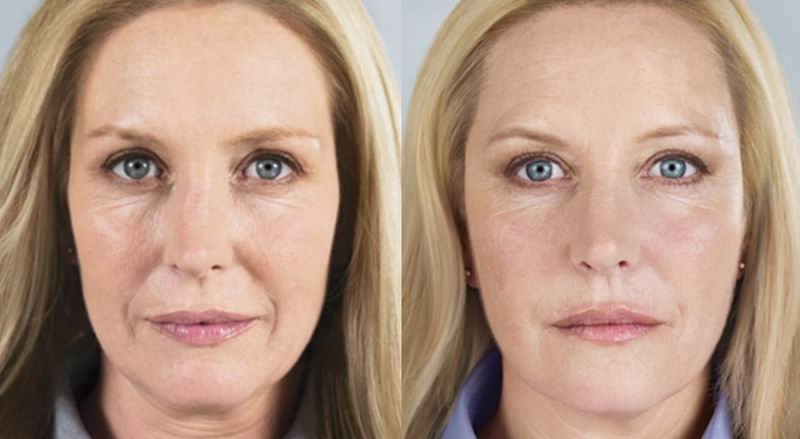
Before and after 3 sessions of Sculptra injections *Individual results may vary.
What are the risks of Sculptra, and what is your nodule rate?
Sculptra has one risk that genuinely distinguishes it from other injectables, and it deserves a direct answer rather than a euphemism.
Nodules and papules
The known complication of Sculptra is the late formation of small firm lumps beneath the skin — papules, or larger nodules. They typically appear months after treatment, and because Sculptra cannot be dissolved, they are managed rather than reversed.
Historically this was a meaningful problem, driven by two things: insufficient dilution of the product, and inadequate post-treatment massage. Both are technique, not chance.
With our dilution protocol and post-treatment massage regimen, our incidence of nodules is less than 1 in 200 treatments.
What that requires from you: massaging the treated areas as instructed after each session. You will be given the specific schedule at your appointment. It is the single thing most within your control that affects both your result and your risk, and patients who skip it are the ones who develop lumps.
Where a papule does occur, it is usually small, felt more than seen, and settles with massage. Larger or persistent nodules can be treated with steroid injection or other measures.
Other risks
Common and short-lived: swelling and bruising at the injection sites, tenderness, and the temporary fullness on the day of treatment described above.
Less common:
- Asymmetry, addressed at the next session in the series
- Under- or over-correction, since the response varies between patients
- Infection — uncommon
- Delayed inflammatory reaction — rare
- Vascular events — very rare, and the reason injector anatomical knowledge matters
The one to understand before you commit: Sculptra is not reversible. There is no enzyme that removes it, unlike hyaluronic acid filler. This is exactly why it should be placed conservatively, in stages, by an injector who does a high volume of it — and it is the strongest argument against having Sculptra at whichever practice happens to be running the cheapest promotion.
Who is a good candidate for Sculptra?
- Diffuse, global volume loss rather than one specific area needing shaping
- Temple, cheek, or overall facial hollowing
- Thinning skin and declining skin quality
- A preference for gradual change nobody can pinpoint
- Willingness to wait months for the result and to commit to a series
- Willingness to perform the post-treatment massage
- Patients on GLP-1 medications who have lost facial volume with weight loss
Who is not a good candidate for Sculptra?
- You want to see a result now, or you have an event in the next three months. Sculptra will not be ready. A hyaluronic acid filler is the right choice.
- You want lip volume. Sculptra is not used in the lips.
- You need one precise feature shaped. That is filler's strength, not Sculptra's.
- Your problem is descent rather than volume. Jowls and a heavy neck need a facelift. Adding volume to a face that needs lifting makes it heavier.
- You will not do the massage. This directly raises your nodule risk.
- Active infection, or a history of keloid or hypertrophic scarring.
- Autoimmune or inflammatory conditions may be a contraindication — disclose them.
- Pregnancy or breastfeeding.
- You are uncomfortable with an irreversible product. A legitimate reason to choose hyaluronic acid instead.
What can be combined with Sculptra?
With Botox: Botox for lines caused by movement, Sculptra for the volume and collagen underneath. The most common pairing.
With hyaluronic acid fillers: Sculptra rebuilds the foundation; filler shapes specific features such as the lips or tear troughs once it has.
With laser resurfacing: Sculptra improves thickness and volume from below, laser treats the surface. Together they address structure and skin.
With a facelift: surgery repositions tissue, Sculptra restores the volume and collagen that surgery does not replace.
With thread lifts: yes, these can be combined. Threads provide a degree of immediate repositioning while Sculptra rebuilds volume over the following months.
Does Sculptra make a facelift harder later?
This is a real question, it is genuinely debated among surgeons, and it deserves a direct answer rather than avoidance — particularly since many patients using Sculptra in their forties will consider surgery in their fifties or sixties.
The concern. Sculptra works by stimulating collagen. The worry some surgeons raise is that this collagen could create denser, less predictable tissue planes, making the dissection of a future facelift more difficult.
What the debate is actually about. It is not really about the product — it is about where the product is placed. A biostimulator placed in the appropriate plane does not interfere with a facelift dissection. One placed too deep, in the plane a surgeon will later need to work through, is a different matter. The variable is injection technique, not the molecule.
Our position, from doing both under one roof. Sculptra here is placed by our injectors, who are trained in which plane to inject and who work inside a surgical practice rather than a standalone medspa. Dr. Naficy performs the deep plane facelifts. That means the same practice sees both ends of the timeline — the injection and, years later, the operation. In his experience:
- He has not encountered dissection difficulty attributable to Sculptra. That includes patients who had it done elsewhere.
- He has encountered it with permanent fillers — products such as Bellafill, which contain a component that is never absorbed. That is a genuine consideration, and it is one of the reasons a permanent filler is a bigger decision than a temporary one.
We would rather draw that distinction than claim no injectable ever causes a problem. One category does; Sculptra, in our hands, has not.
Sculptra and facelift are not in competition
The more useful framing is that collagen built now does one of three things, and all three are good:
- It delays the need for a facelift. Thicker, better-supported skin ages more slowly. Many patients find surgery moves further into the future rather than closer.
- It improves the result when a facelift is eventually performed. A facelift repositions tissue — it does not create tissue. Better collagen and better skin quality give the operation more to work with, and the result looks better for it.
- It helps hold the result afterward. Surgery repositions; it does not stop ageing. Maintaining collagen after a facelift helps preserve the contour longer.
Framed that way, Sculptra is not something to be undone before surgery. It is part of the same long-term plan.
How long before surgery should I stop?
Ideally about three months between the last Sculptra session and a facelift — largely so that the collagen response has settled and the surgeon is operating on a stable, predictable result rather than one still developing.
That said, Dr. Naficy has performed facelifts on patients treated more recently than three months without difficulty. It is a preference for clean planning rather than a hard requirement, and it should not be a source of anxiety if your timing has already overlapped.
The advantage of having both done in one practice is straightforward. Our injectors are trained in which plane to place the product, and they are doing it in a practice where facelifts are performed — so the surgical planes are understood, and the surgeon who would operate is down the hall rather than a stranger years later. A standalone medspa injector has no surgical context to work from, and no feedback loop telling them what a dissection looks like afterward.
Sculptra before and after photos
Before and after photographs of Sculptra treatment at Naficy Rejuvenation Center. Results build over three to six months. Individual results vary.
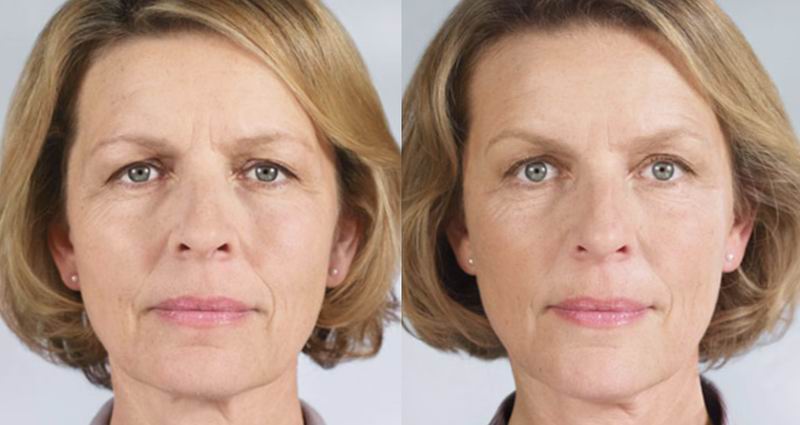
Before and after 3 sessions of Sculptra injections *Individual results may vary.
Frequently asked questions about Sculptra
Does Sculptra make a facelift harder later?
Not in our experience. The concern is debated among surgeons, but it turns on where the product is placed rather than the product itself — a biostimulator in the appropriate plane does not interfere with facelift dissection. Our injectors place Sculptra and are trained in which plane to inject; Dr. Naficy performs the deep plane facelifts. He has not encountered dissection difficulty attributable to Sculptra, including in patients treated elsewhere. He has encountered it with permanent fillers such as Bellafill.
How long before a facelift should I stop Sculptra?
Ideally about three months, so the collagen response has settled and the surgeon is operating on a stable result. Dr. Naficy has performed facelifts on patients treated more recently without difficulty, so it is a planning preference rather than a hard rule.
Will Sculptra delay when I need a facelift?
Frequently, yes. Better collagen and thicker skin age more slowly. Sculptra tends to do one of three things: push surgery further into the future, improve the result when a facelift is eventually done by giving the operation better tissue to work with, or help hold the contour longer afterward.
How much does Sculptra cost in Seattle?
At our practice, $990 per vial, with a 10% multi-vial discount and periodic buy-4-get-1-free promotions. A typical facial course uses about one vial per decade of age, so a patient in their forties needs roughly four vials.
How long does Sculptra take to work?
First visible changes at 6 to 12 weeks, with the full result at 3 to 6 months. You will look fuller on the day of treatment, but that is the mixing fluid and it disappears within 1 to 3 days.
How long does Sculptra last?
Two years or more. Many patients maintain with a vial or two annually rather than repeating the full course.
How many Sculptra sessions do I need?
Typically three, about a month apart.
Is Sculptra a filler?
No. Fillers add volume as a gel. Sculptra is poly-L-lactic acid, which stimulates your own collagen production. The particles are absorbed; the collagen is what remains.
Can Sculptra be dissolved?
No. Unlike hyaluronic acid fillers, there is no enzyme that removes Sculptra. It must be placed conservatively and in stages for that reason.
Does Sculptra cause nodules?
It can. With our dilution protocol and post-treatment massage regimen, our incidence is less than 1 in 200 treatments. Most papules are small, felt rather than seen, and settle with massage; persistent nodules can be treated with steroid injection. Performing the massage as instructed is the most important thing you can do to avoid them.
Does Sculptra hurt?
It is comparable to filler. The product is mixed with lidocaine and topical numbing is used.
Is there downtime after Sculptra?
Minimal. Swelling and occasional bruising for a few days. The main requirement is performing the massage as instructed.
Sculptra vs. Juvéderm or Restylane — which should I choose?
If you need one feature shaped, or want to see the result immediately, or want the option to reverse it, choose a hyaluronic acid filler. If you have diffuse volume loss across the face, want the longest-lasting result, and are willing to wait months, choose Sculptra. Many patients use both.
Can Sculptra be used on the buttocks?
Yes. We treat buttocks and other body sites. Expect a meaningful improvement in contour and skin quality rather than the volume change of a surgical BBL or fat transfer — body areas require considerably more product and more sessions than the face.
Can Sculptra be used on the chest or décolletage?
Yes, and it is one of the better options for crepey chest skin, which responds poorly to most other treatments.
Can Sculptra be used under the eyes or in the lips?
Not in the lips, and only with considerable caution near the eyes. Those areas need a soft, reversible hyaluronic acid product.
Is Sculptra good for weight loss facial volume loss?
Yes. Patients who have lost significant facial volume on GLP-1 medications are well suited to Sculptra, since the loss is typically global rather than confined to one area. Fat grafting is the other option worth comparing, and places more volume in a single session.
Why do I need to massage after Sculptra?
Massage distributes the product evenly through the tissue and is one of the two factors — along with dilution — that determine whether nodules form. You will be given a specific schedule at your appointment. It matters.
Who performs Sculptra injections at your practice?
All of our injectors are highly experienced with Sculptra and have a combined experience of over 50 years injecting the product. Our injector team includes Lorin Bates, RN, BSN, a GAIN trainer for Galderma who teaches Sculptra technique to other practices. The practice has been ranked by Galderma as the #1 single-location Sculptra provider in Washington State and among the top 10 nationwide, with a board-certified plastic surgeon on site.
Next steps
A Sculptra consultation establishes how much volume you have actually lost, how many vials that implies, and — equally important — whether Sculptra is the right product for you at all, or whether what you want would be better served by a hyaluronic acid filler, fat grafting, or surgery.
You will get the full plan and cost in writing before starting, rather than discovering it vial by vial.
Naficy Rejuvenation Center is located in Bellevue, Washington, and serves patients from Seattle, the Eastside, and throughout the Pacific Northwest.
Schedule an appointment · Ask a question · Virtual consultation
Medically reviewed by Sam Naficy, MD, FACS, board-certified by the American Board of Facial Plastic and Reconstructive Surgery.