Neck Liposuction
Neck liposuction removes excess fat from beneath the chin and along the neck through two or three very small hidden incisions. It works in a specific, and fairly narrow, group of patients — those with good skin tone whose fullness is fat sitting above the muscle. It takes about 30 minutes, discomfort is minimal, and most patients are comfortable socially by day 5. Sam Naficy, MD, FACS performs 20 to 25 standalone neck liposuction procedures each year in Bellevue, Washington, and 50 to 60 more as part of a deep plane face and neck lift.
What is neck liposuction?
Excess fat under the chin and in the neck can make an otherwise slim person look heavier, and it is often stubbornly resistant to weight loss. Neck liposuction removes that fat through a small tube passed beneath the skin, entering through incisions of a few millimetres placed under the chin and sometimes behind each earlobe.
It is the least invasive of the neck procedures and, in the right patient, produces a clean result with very little downtime. The qualification matters: only a minority of people seeking neck improvement are good candidates for liposuction alone. Used in the wrong patient, it disappoints, and occasionally makes things look worse.
How does neck liposuction work?
It works in two ways rather than one.
Volume reduction. The fat sitting above the platysma muscle is suctioned away, which directly reduces the fullness under the chin.
Tissue tightening. After the fat is removed, a compression dressing holds the skin against the new contour while it redrapes. The healing response beneath the skin causes a degree of contraction, which tightens the skin and underlying tissue further.
That second mechanism is why skin quality determines whether the procedure works. Skin with good elasticity contracts onto the new contour. Skin that has lost elasticity does not — it simply hangs where the fat used to be, and the result is a neck that looks emptier but no tighter.
Who is a good candidate for neck liposuction?
The ideal candidate meets most of the following:
- Age 40 or younger, or older with unusually good skin quality
- Excellent skin tone and elasticity — skin that will contract onto the new contour
- Skin that is neither too thick nor too heavy
- Excess fat located above the platysma muscle, not beneath it
- No banding or laxity of the neck muscle
- Good bone structure in the lower face, with adequate chin projection
- Stable weight and good general health
This is a genuinely restrictive list, and it is worth being direct about why. Liposuction only removes fat. It does not tighten muscle, it does not remove skin, and it does not reach fat lying beneath the platysma. If any of those are the real problem, removing the superficial fat will not fix the neck.
Who is not a good candidate — and what they need instead
| If this is the problem | Why liposuction will not solve it | What does |
|---|---|---|
| Vertical bands or cords in the neck | Those are the edges of the platysma muscle. Removing fat around them makes them more visible, not less | Deep neck lift with platysmaplasty |
| Fullness beneath the muscle | Liposuction only reaches fat above the platysma. The neck can stay full after every accessible fat cell is gone | Deep neck lift |
| Loose or inelastic skin | Skin that cannot contract will hang once the fat beneath it is removed | Lower face and neck lift |
| Jowling and a blurred jawline | That is descent of facial tissue, not neck fat | Deep plane facelift |
| A recessed chin | The neck looks full because the chin is set back, shortening the chin-to-neck distance | Chin implant, often with liposuction |
| Enlarged submandibular glands | Glandular fullness is not fat and cannot be suctioned | Deep neck lift |
Being told you need a different operation is not a rejection. It is the difference between a result you are pleased with and one you are not.
Neck liposuction vs. Kybella
Both reduce fat under the chin. One is surgical, one is injectable, and we offer both — so the honest comparison matters.
| Neck liposuction | Kybella | |
|---|---|---|
| What it does to the fat | Removes the fat cells from the body | Destroys the fat cells and leaves them in place for the body to clear |
| Swelling and bruising | Typically not a significant issue | Often considerably worse — the body has to break down and remove the destroyed cells, and that inflammatory process is what causes the swelling |
| Sessions needed | One | Usually several, spaced weeks apart |
| Anesthesia | Sedation or general | Topical numbing only; no incisions |
| Area treated | The whole submental and neck region can be contoured | Best for a small, focal area |
| Best suited to | Broader fullness across the chin and neck in a good surgical candidate | A very focal problem area, or someone who will not consider surgery |
The mechanism explains the recovery difference, and it is the part most patients are not told. Liposuction takes the fat out. Kybella kills it and leaves your body to dispose of it, which means an inflammatory clean-up process that produces more swelling and more bruising than the surgical option it is often presented as a gentler alternative to.
Kybella earns its place where the problem is small and well localised. For a broader contour problem, liposuction is one session, less swelling, and a more controlled result.
How is neck liposuction performed?
Neck liposuction takes approximately 30 minutes and is performed under IV sedation or general anesthesia.
- Incisions. One small incision beneath the chin, sometimes with a small incision behind each earlobe, each a few millimetres long and placed where they are not visible.
- Infiltration. Fluid is placed to reduce bleeding and bruising and to make the fat easier to remove.
- Contouring. A fine tube is passed beneath the skin and the fat above the platysma is suctioned away, working evenly to avoid irregularity.
- Assessment. The contour is checked, and where the chin is deficient a chin implant can be placed through the same incision.
- Compression. A pressure dressing is applied to hold the skin against the new contour while it redrapes.
What is neck liposuction recovery like?
Recovery is the shortest of any neck procedure. Pain is minimal, swelling and bruising are typically not a significant issue, and most patients are comfortable in social settings by day 5.
| Time after surgery | What to expect |
|---|---|
| Day 1 | A pressure dressing is worn around the neck. Discomfort is usually mild and readily managed. Rest with the head elevated. |
| Days 2–4 | The pressure dressing comes off and a lighter elastic dressing is worn. Swelling and any bruising are usually modest. |
| Day 5 | Most patients are comfortable in social settings and returning to normal activity. |
| Weeks 2–4 | Residual swelling settles and the contour becomes clear. Light exercise resumes with clearance. |
| Weeks 6–8 | Full activity cleared. Any firmness beneath the skin continues to soften. |
| Months 3–6 | Skin finishes redraping and the final contour settles. |
Patients travelling from out of the area should plan accordingly. See Out of Town Patients.
Neck liposuction with chin augmentation
This is the most effective pairing available for the neck, and the reason is geometric rather than cosmetic. The angle between chin and neck depends on two things: how much fullness sits below the jaw, and how far forward the chin projects. Liposuction addresses the first. A chin implant addresses the second.
Done together, each amplifies the other — and because the implant goes in through the same small incision beneath the chin, adding it requires no additional incision and very little additional operating time. For a patient with both fullness and a recessed chin, doing only the liposuction leaves most of the available improvement on the table.
What other procedures are combined with neck liposuction?
Neck liposuction can be combined with any facial or neck procedure, including a face and neck lift, brow lift, eyelid surgery, rhinoplasty, and laser resurfacing.
In practice, most neck liposuction performed here is done as part of a larger operation rather than on its own — it is a component of the deep plane face and neck lift, where the fat is addressed alongside the muscle and the skin.
What are the risks of neck liposuction?
More common, and usually temporary: swelling, mild bruising, temporary firmness or lumpiness beneath the skin as the tissue heals, and numbness of the treated area.
Less common:
- Contour irregularity — unevenness, rippling, or a residual hollow, more likely in thin patients or where removal is aggressive.
- Under-correction, where fullness remains because part of it was never fat above the muscle.
- Skin that fails to redrape, leaving loose skin where the fat was. This is the outcome the candidacy criteria exist to prevent.
- Asymmetry between the two sides.
- Prolonged swelling or firmness lasting several months.
- Infection — uncommon, treated with antibiotics.
Rare: injury to the marginal mandibular branch of the facial nerve, affecting the lower lip and usually temporary; hematoma; and visible scarring at the small entry incisions.
How much does neck liposuction cost?
At Naficy Plastic Surgery, neck liposuction starts at $5,500. The final fee depends on the extent of the area treated and whether other procedures are performed at the same time.
Where liposuction is combined with a chin implant, a neck lift, or a facelift, the total is lower than having the procedures separately, because operating room and anesthesia fees are shared rather than duplicated.
Fees are itemized in writing at consultation, covering surgeon, anesthesia, facility, and follow-up care. Financing is available through PatientFi. Neck liposuction performed for cosmetic reasons is not covered by insurance.
Fees & payment policies · Financing
Why choose a facial plastic surgeon for neck liposuction?
The technique itself is not the hard part. The hard part is deciding whether liposuction is the right operation at all — and a surgeon who offers neck liposuction as a standalone service has a structural incentive to say yes.
A facial plastic surgeon who also performs deep neck lifts and deep plane facelifts can offer the operation the neck actually needs. That is the more useful assessment, and it is why most of the neck liposuction performed here happens inside a larger procedure.
Dr. Naficy performs 20 to 25 standalone neck liposuction procedures each year, and 50 to 60 more as part of a deep plane face and neck lift. His practice has been devoted exclusively to facial plastic surgery since 2000. He is certified by the American Board of Facial Plastic and Reconstructive Surgery (ABFPRS), graduated first in his class from the University of Washington School of Medicine, and completed both his residency and fellowship at the University of Michigan. Dr. Naficy has been recognized in Seattle Magazine's Top Doctors list.
About Dr. Sam Naficy, MD, FACS
What type of anesthesia is used?
Neck liposuction is performed under IV sedation or general anesthesia, administered by a dedicated anesthesia provider who will discuss which is appropriate for your health status and the planned procedure. Heart rate, blood pressure, breathing, and oxygen levels are monitored continuously.
Surgery is performed in our on-site surgery center, which is Medicare-certified and Washington State–accredited. Our anesthesia team has more than 50 years of combined experience, and all providers also hold appointments at the University of Washington or other regional medical centers.
Anesthesia guidelines [21kb PDF]
Neck liposuction before and after photos
Representative before and after images of neck liposuction performed by Dr. Sam Naficy. Some patients had more than one procedure; the caption accompanying each photograph describes the details.
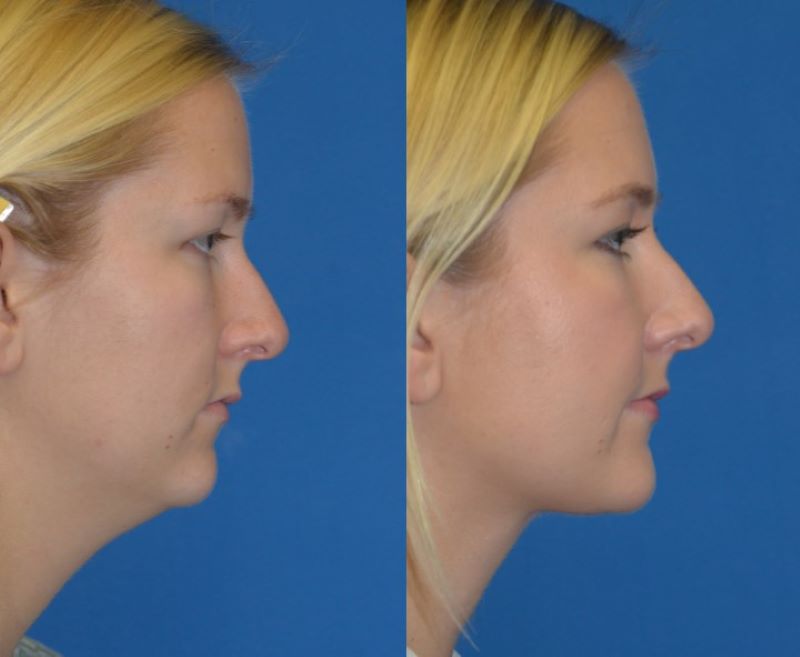
Neck liposuction by Seattle facial plastic surgeon Sam Naficy, MD. * Individual results may vary.
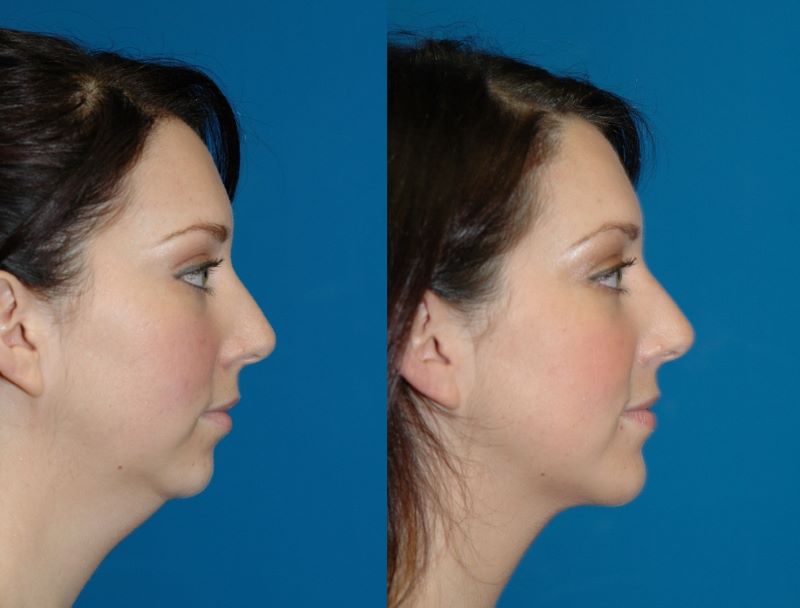
Neck liposuction and chin implant by Seattle facial plastic surgeon Sam Naficy, MD. * Individual results may vary.
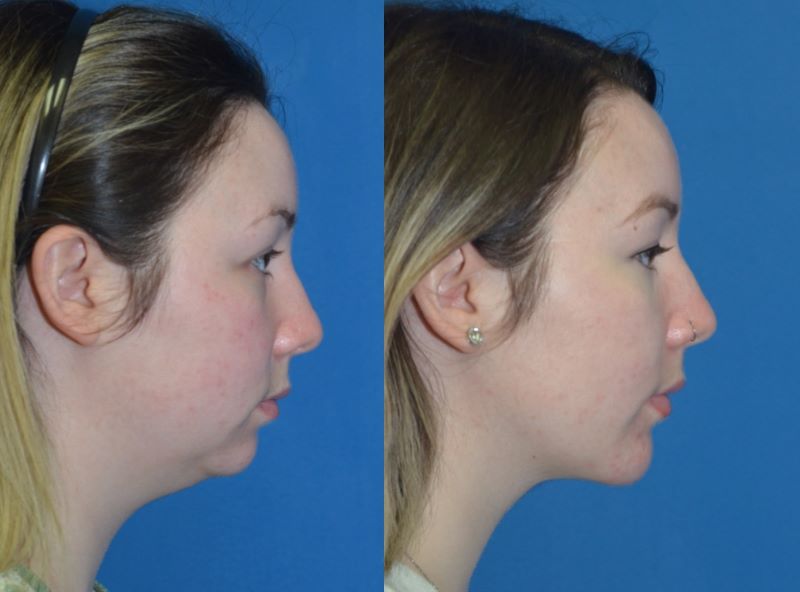
Neck liposuction and chin implant by Seattle facial plastic surgeon Sam Naficy, MD. * Individual results may vary.
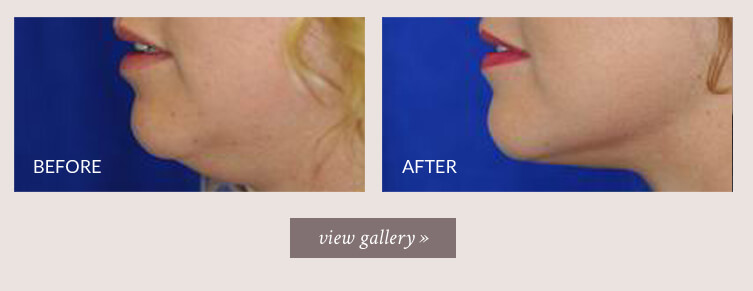
* Individual results may vary.
Frequently asked questions
Am I a candidate if I am over 40?
Possibly, if your skin quality is unusually good. Age matters because skin elasticity does — the procedure relies on skin contracting onto the new contour. Where elasticity has been lost, a deep neck lift or a lower face and neck lift gives a better result.
Will the fat come back?
The fat cells removed do not return. Significant weight gain can enlarge the fat cells that remain, so a stable weight preserves the result.
Where are the scars?
One small incision under the chin, sometimes with one behind each earlobe. Each is a few millimetres and placed where it is not visible.
How is this different from a deep neck lift?
Liposuction removes fat above the muscle only. A deep neck lift also reaches fat beneath the muscle, tightens the platysma, and can reduce enlarged salivary glands. If your neck has banding or deep fullness, liposuction alone will not correct it.
Should I try Kybella first?
If the problem is small and focal, Kybella is reasonable. For broader fullness, liposuction is one session with less swelling — Kybella destroys fat cells and leaves your body to clear them, which produces more inflammation than the surgery it is often positioned against.
Will I need a compression garment?
A pressure dressing is worn for the first day, then a lighter elastic dressing for a few more days.
Can it be combined with a chin implant?
Yes, and it frequently should be. Both go through the same incision, and correcting chin projection alongside the fullness produces a considerably sharper jaw-to-neck angle.
Is it covered by insurance?
No. Neck liposuction performed for cosmetic reasons is not covered.
I am interested. What do I do next?
If you are considering neck liposuction, we encourage you to complete the Surgical Consultation Intake Form. Profile photographs are particularly useful. Dr. Naficy will assess where the fullness actually sits, the quality of your skin, whether the platysma is involved, and your chin projection — then tell you honestly whether liposuction is the right operation or whether something else would serve you better.
Naficy Plastic Surgery & Rejuvenation Center — 1110 112th Ave. NE, Suite 150, Bellevue, WA 98004 · (425) 450-0880. Serving Bellevue, Seattle, Kirkland, Redmond, Medina, Mercer Island, and the greater Puget Sound region.
This page is for general education and does not constitute medical advice. Individual results vary. Written and medically reviewed by Sam Naficy, MD, FACS. Last reviewed August 2026.
What does “board certified” actually mean in facial plastic surgery?
Board certification tells you what a surgeon was trained and examined in. On its own, the phrase “board certified” does not say in which field. Certification exists across many specialties, and a certificate in another specialty is a genuine credential in that specialty. It is simply not the same thing as certification in facial plastic surgery. So the useful follow-up question is always: certified by which board, and in what?
For facial plastic surgery there are two boards to look for, and both publish free public tools that let you verify a surgeon yourself in under a minute.
| Board | What it certifies | Verify a surgeon |
|---|---|---|
| American Board of Facial Plastic and Reconstructive Surgery (ABFPRS) | Facial plastic and reconstructive surgery specifically. Certification requires that the surgeon already hold certification from an American Board of Medical Specialties board in either otolaryngology–head and neck surgery or plastic surgery, pass a two-day examination, and submit for peer review operative reports from a minimum of 100 facial plastic surgery procedures. | ABFPRS Physician Finder |
| American Board of Plastic Surgery (ABPS) | Plastic surgery of the entire body, including the face. ABPS is a member board of the American Board of Medical Specialties. | ABPS Verify Certification |
Why the ABFPRS requirement matters
The detail worth understanding is that ABFPRS certification cannot be the only board a surgeon holds. It is granted on top of an existing ABMS certification in one of the two surgical specialties whose residency training covers facial plastic surgery. An ABFPRS diplomate is double boarded by definition. Those two qualifying pathways — otolaryngology–head and neck surgery, and plastic surgery — are both represented at this practice, and both of our facial surgeons hold certification from two boards rather than one. The 100-case peer review is also specific: the operative reports submitted must be facial plastic surgery, not surgery generally.
What to ask, and how to check
- Which board certified you, and in what specialty? Not simply “are you board certified.”
- Is that board a member of the American Board of Medical Specialties? Boards exist with similar-sounding names that are not ABMS member boards.
- Where do you hold hospital operating privileges, and for this procedure? Hospital privileges are granted by peer review against training.
- How many of these do you perform each year? Certification is a floor, not a measure of current volume.
- Verify it yourself. Both boards above let you search by surgeon name. The ABFPRS states that its website is a primary source of verification.
The surgeons at this practice, and how to verify them
| Surgeon | Board certification | Residency pathway |
|---|---|---|
| Sam Naficy, MD, FACS | American Board of Facial Plastic and Reconstructive Surgery American Board of Otolaryngology – Head and Neck Surgery |
Otolaryngology – head and neck surgery, followed by facial plastic surgery fellowship at the University of Michigan |
| Keith Hurvitz, MD, FACS | American Board of Plastic Surgery American Board of Otolaryngology – Head and Neck Surgery |
Otolaryngology – head and neck surgery residency at USC, followed by a general plastic surgery residency at UC Irvine |
Each of these certifications can be confirmed through the verification links above, or with the certifying boards directly. We would encourage you to check ours, and to check the credentials of any other surgeon you consult.