Asian Rhinoplasty
Asian rhinoplasty is usually an operation of augmentation rather than reduction — building up a low bridge and a tip that lacks support and definition. The goal is an attractive Asian nose, not a Caucasian nose on an Asian face. Sam Naficy, MD, FACS performs 60 to 80 Asian rhinoplasty procedures each year in Bellevue, Washington, using the patient's own cartilage rather than synthetic implants, producing natural and long lasting results. Surgery takes 2 to 4 hours, an external splint is worn 5 to 7 days, and most patients return to work at about one week.
What is Asian rhinoplasty?
Asian rhinoplasty refers to the set of techniques used to reshape the Asian nose, which differs anatomically from the Caucasian nose in ways that change what the operation has to accomplish. With few exceptions, Asian patients require augmentation — adding structural support to the bridge and tip — where Caucasian patients more often require reduction of the bridge.
The goal is not to Westernize the nose. It is to create a nose that is balanced and defined while remaining recognizably the patient's own, in keeping with their face and ethnicity.
How does the Asian nose differ anatomically?
| Typical Asian nose | Typical Caucasian nose | What surgery usually requires | |
|---|---|---|---|
| Bridge height | Low, flat, lacking definition | Higher, often with a hump | Augmentation rather than reduction |
| Tip projection | Less projected, rounder, often droops | More projected, more defined | Structural grafting to build support |
| Tip cartilage | Weaker | Stronger | Cartilage added, not trimmed |
| Skin thickness | Often thicker | Often thinner | Stronger framework needed to show through |
| Nasal base | Wider relative to nasal height | Narrower | Alar reduction in selected cases |
| Nasolabial angle | Sharper | More open | Rotation and lengthening where indicated |
These differences matter because the standard Caucasian tip techniques — trimming and suturing existing cartilage — work poorly on a nose whose cartilage is already weak and whose skin is thick. Trimming a weak tip makes it weaker. Asian tip surgery builds a taller, better-supported tip, which reads as narrower because it projects rather than because tissue was removed.
The bridge in Asian rhinoplasty
A low, flat bridge is the single most common concern. It creates an unfavourable profile in which the upper half of the nose looks weak relative to the tip, and on front view it fails to cast the shadows that define the sidewalls of the nose.
There are four ways to augment the bridge.
| Option | What it is | Best for | Main drawback |
|---|---|---|---|
| Injectable filler | Non-surgical, temporary augmentation | Small amounts of augmentation; trying the look before committing | Temporary; No structural support; carries a rare but serious risk of vascular occlusion in the nose |
| Your own cartilage (septum, ear, rib) | Living tissue harvested during surgery | Nearly all patients — the approach used here | Requires a donor site; rib adds chest soreness for a few weeks |
| MTF donor cartilage | Processed human donor rib cartilage, supplied freeze-dried | Patients who want structural augmentation without a second surgical site | Added cost for the graft material |
| Silicone or Gore-Tex implant | Synthetic implant placed over the bridge | Widely used in Asia; performed here only at specific patient request | Measurably higher rates of infection, extrusion, and reoperation — see below |
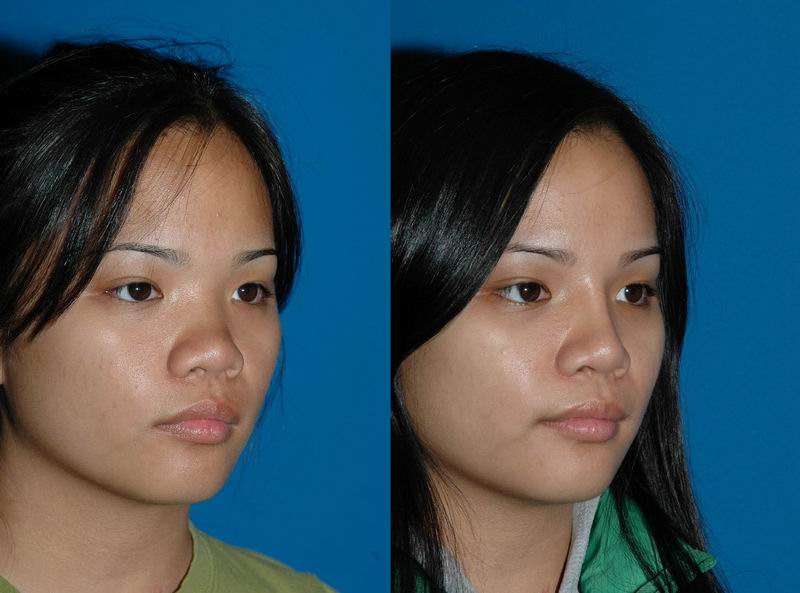
Asian Rhinoplasty using rib cartilage graft by Seattle facial plastic surgeon Dr. Sam Naficy. * Individual results may vary.
Cartilage grafts vs. synthetic implants: what the evidence shows
Silicone implant augmentation is the most widely performed technique in Asia. It is quick, inexpensive, and requires no donor site. Dr. Naficy uses the patient's own cartilage instead, and performs implant augmentation only on very rare occasions when a patient specifically requests it after discussing the trade-offs.
The reason is the published complication data. In the largest multi-surgeon series of silicone augmentation rhinoplasty in Asian patients, from Chang Gung Memorial Hospital:
- 16% overall complication rate
- 5.3% infection
- 2.8% extrusion — the implant working its way out through the skin, most often through the nasal tip
- 5.0% deviation of the implant
- 8% required reoperation
Larger implants carried higher infection and extrusion rates. Gore-Tex (PTFE) performs somewhat better — roughly 4.2% complications and 2.1% infection in a series of 853 patients — but still required removal in about 2.2% of cases. Gore-Tex has also not been sold into the plastic surgery market since the end of 2006.
Bergeron L, Chen PK. Asian Rhinoplasty Techniques. Semin Plast Surg. 2009;23(1):16–21. PMC2884896
An implant is a permanent foreign body sitting under thin nasal skin. Cartilage taken from the patient integrates, resists infection, and does not extrude. For a nose that needs to last decades, that difference compounds.
Where only a small amount of augmentation is needed, septal or ear cartilage is usually sufficient. For significant augmentation — a substantially higher bridge, a lengthened nose, or correction of a previous implant problem — rib cartilage or MTF donor cartilage provides the volume and strength required.
The tip in Asian rhinoplasty
Asian noses tend to have weaker tip cartilage and thicker overlying skin. The result is a tip that lacks definition and tends to droop, and one that resists the techniques used on Caucasian noses.
Trimming and suturing existing cartilage — the standard Caucasian approach — does not work well here, because there is not enough cartilage strength to reshape and the thick skin conceals whatever definition is created. Dr. Naficy instead uses grafting techniques that build tip support and make the tip taller. A taller tip reads as narrower and more defined, without removing tissue the nose cannot spare.
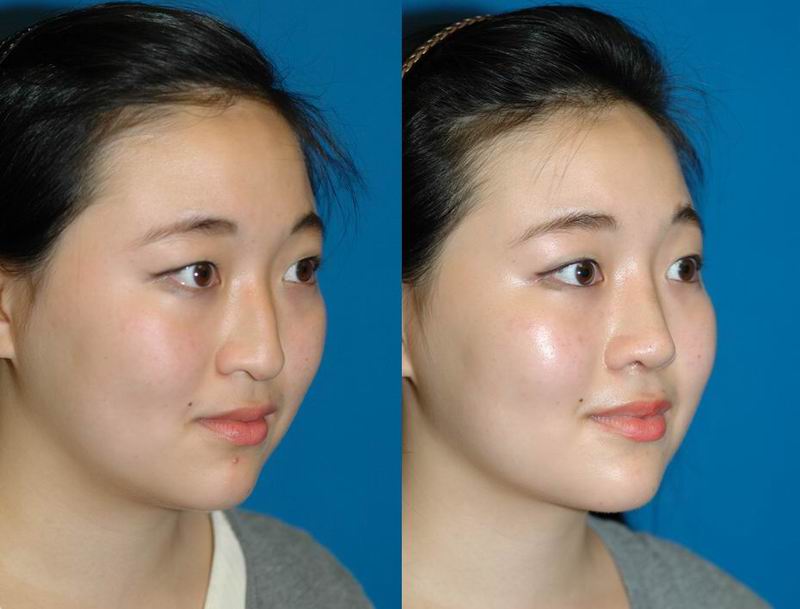
Asian Rhinoplasty by Seattle facial plastic surgeon Dr. Sam Naficy. * Individual results may vary.
Who is a good candidate for Asian rhinoplasty?
- A low or flat bridge lacking definition, a poorly defined tip, or both
- Facial growth complete — generally age 15 to 16 in women and 16 to 17 in men
- Good general health, with no uncontrolled medical conditions
- A clear sense of what you want changed, and a goal of refining your own features rather than adopting someone else's
- Realistic expectations about timeline — thicker skin takes longer to show its result
Who is not a good candidate?
- You want to look Caucasian. That is not the goal of this operation, and pursuing it produces a nose that does not fit the face.
- Facial growth is not complete.
- You use nicotine in any form. Complete cessation is required for at least three weeks before and after surgery.
- You have an active infection around an existing nasal implant. The implant must be removed and the nose allowed to heal before reconstruction — see below.
- Uncontrolled hypertension, poorly controlled diabetes, or a bleeding disorder.
How is Asian rhinoplasty performed?
Asian rhinoplasty takes 2 to 4 hours and is performed under general anesthesia or IV sedation. An open approach is used in most cases, because augmentation and structural grafting require the framework to be seen directly.
- Incisions. Inside the nostrils, joined by a small incision across the columella.
- Graft harvest. Cartilage is taken from the septum where available; from the ear for tip and rim grafts; from the rib where significant volume or strength is needed. MTF donor cartilage is an option where a second surgical site is undesirable.
- Bridge augmentation. Not always necessary. Cartilage is shaped and secured along the dorsum to raise the bridge and create definition. At times diced cartilage wrapped in fascia is used for a smoother contour.
- Tip reconstruction. Structural grafts build tip support and projection, making the tip taller and narrower.
- Alar reduction where nostril width requires it.
- Airway. Septal deviation and nasal valve collapse are corrected where present.
- Closure and splinting. An external splint is worn 5 to 7 days. No packing is placed inside the nose.
What is Asian rhinoplasty recovery like?
Most patients return to work at about one week, once the splint comes off. Thicker skin means definition emerges more gradually than in a thin-skinned nose.
| Time after surgery | What to expect |
|---|---|
| Days 1–3 | External splint in place. Swelling and any bruising around the eyes peak around day 3. No packing, so you can breathe through your nose. If rib cartilage was harvested, the chest is sore. |
| Days 4–7 | Bruising fades. Splint and external sutures removed between days 5 and 7. |
| Week 1–2 | Most patients return to work and social activity. Residual bruising covers easily. |
| Weeks 3–6 | Obvious swelling settles. Light exercise resumes with clearance. OK to wear glasses with tape on the bridge. |
| Months 2–6 | The nose looks normal to others. Bridge definition is visible; tip definition continues to emerge. |
| Months 6–18 | Final refinement. Thick skin holds swelling in the tip longest; the result is assessed at one year or somewhat later. |
Patients travelling from out of the area remain locally for about one week. See Out of Town Patients.
What to do if you have an infected nasal implant
If you have a silicone or other synthetic implant in your nose and are seeing signs of infection or extrusion, the implant needs to come out. Waiting makes the eventual reconstruction harder, because ongoing infection destroys the tissue that will later be needed to rebuild the nose.
Signs that warrant prompt evaluation:
- Redness over the bridge or tip that does not settle
- Swelling, tenderness, or persistent pain
- Drainage from the nose or from the skin over the implant
- Thinning, shininess, or discoloration of the skin over the implant
- The implant becoming visible through the skin, or beginning to work its way out (extrusion)
Extrusion most often occurs through the nasal tip, and less commonly along the back of the columella. Published series report extrusion in roughly 2.8% of silicone implant cases.
What happens next. The implant is surgically removed and the nose is allowed to settle and heal. Reconstruction using your own cartilage is generally undertaken 2 to 3 months later, once the inflammation has resolved and the tissues have recovered. Attempting to rebuild at the same time as removing an infected implant risks losing the new graft to the same infection.
Reconstruction after implant loss is a grafting problem rather than a cosmetic reduction. Dr. Naficy co-authored the chapters on Cartilage Grafts, Bone Grafts, and Structural Support in Principles of Nasal Reconstruction (Springer, 2nd edition).
If you are experiencing these symptoms, contact us at (425) 450-0880 rather than waiting for a routine consultation slot.
What are the risks of Asian rhinoplasty?
More common, and usually temporary: swelling that persists longer in thicker skin, bruising around the eyes, nasal congestion during healing, numbness of the tip, and firmness at graft sites.
Less common:
- Graft warping or shifting. Rib cartilage in particular can curve over time, though technique reduces this.
- Graft resorption — some grafted cartilage is reabsorbed, which can partially reduce the augmentation.
- Under-correction in thick skin. Heavy skin conceals definition; this is the most common source of disappointment and the reason a strong framework matters.
- Contour irregularity or asymmetry as swelling resolves.
- Donor site problems — soreness, scar, and rarely contour change at the ear or chest.
- Bleeding in the early days after surgery.
- Nasal obstruction if structural support is compromised.
- Infection — uncommon with the patient's own cartilage, and substantially less common than with synthetic implants.
Rare: septal perforation, altered sense of smell, anesthesia complications, and the need for revision surgery.
How much does Asian rhinoplasty cost?
At Naficy Plastic Surgery, Asian rhinoplasty ranges from $20,000 to $40,000. The range reflects the extent of augmentation required and the graft source — septal and ear cartilage are harvested within the procedure, while rib harvest or MTF donor cartilage adds operative time or material cost.
Fees are itemized in writing at consultation, covering surgeon, anesthesia, facility, and follow-up care. Financing is available through PatientFi.
Quotes for Asian rhinoplasty vary widely because the operations differ fundamentally. A silicone implant placed through a small incision and a structural cartilage augmentation are not the same procedure, do not carry the same complication profile, and do not last the same length of time. Ask what material will be used and why.
Fees & payment policies · Financing
Why choose a specialist for Asian rhinoplasty?
Asian rhinoplasty is a different operation from Western rhinoplasty, and experience with one does not transfer automatically to the other. A surgeon whose practice is built on reduction rhinoplasty is applying trimming techniques to a nose that needs building.
Dr. Naficy performs 60 to 80 Asian rhinoplasty procedures each year, within a total rhinoplasty volume of 150 to 180 annually. For context, the American Society of Plastic Surgeons reports 48,423 rhinoplasty procedures of all kinds performed by its 9,000+ member surgeons in 2024 — an average of five to six per surgeon per year.
His practice has been devoted exclusively to facial plastic surgery since 2000. He is certified by both the American Board of Facial Plastic and Reconstructive Surgery (ABFPRS), and the American Board of Otolaryngology-Head & Neck Surgery (ABO). He graduated first in his class from the University of Washington School of Medicine, and completed both his residency and fellowship at the University of Michigan. Dr. Naficy has been recognized in Seattle Magazine's Top Doctors list.
Published work on nasal grafting and reconstruction:
- Co-author of seven chapters in Principles of Nasal Reconstruction (Springer, 2nd edition), including Structural Support, Cartilage Grafts, Bone Grafts, and Complications and Management. View on Springer
- Naficy S, Baker SR. Lengthening the short nose. Arch Otolaryngol Head Neck Surg. 1998;124(7):809–13 — an algorithm for the five principal grafting techniques used to lengthen a short nose, directly relevant to the short, under-projected nose common in Asian rhinoplasty. PMID 9677119
When choosing a surgeon, ask how many Asian rhinoplasties they perform each year, what graft material they use and why, and ask to see before-and-after photographs of Asian patients specifically.
About Dr. Sam Naficy, MD, FACS
What type of anesthesia is used?
Asian rhinoplasty is performed under general anesthesia or IV sedation, administered by a dedicated anesthesia provider who will discuss which is appropriate for your health status and planned procedure. Where rib cartilage is harvested, general anesthesia is typically used.
Surgery is performed in our on-site surgery center, which is Medicare-certified and Washington State–accredited. Our anesthesia team has more than 50 years of combined experience, and all providers also hold appointments at the University of Washington or other regional medical centers.
Anesthesia guidelines [21kb PDF] · Post-operative care instructions [18kb PDF]
Asian rhinoplasty before and after photos
Representative before and after images of Asian rhinoplasty procedures performed by Dr. Sam Naficy. The caption accompanying each photograph describes the graft material used.
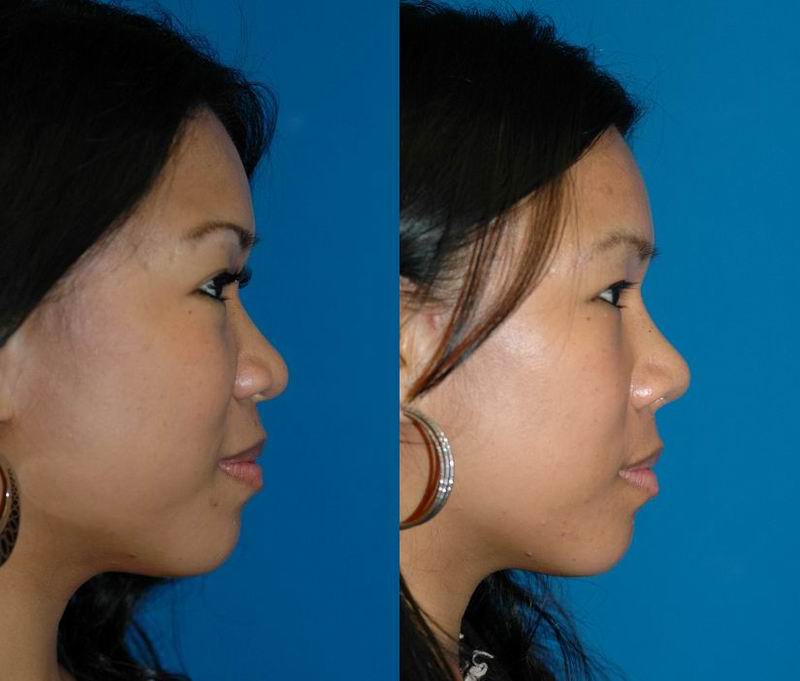
Asian Rhinoplasty with rib cartilage graft by Seattle facial plastic surgeon Dr. Sam Naficy. * Individual results may vary.
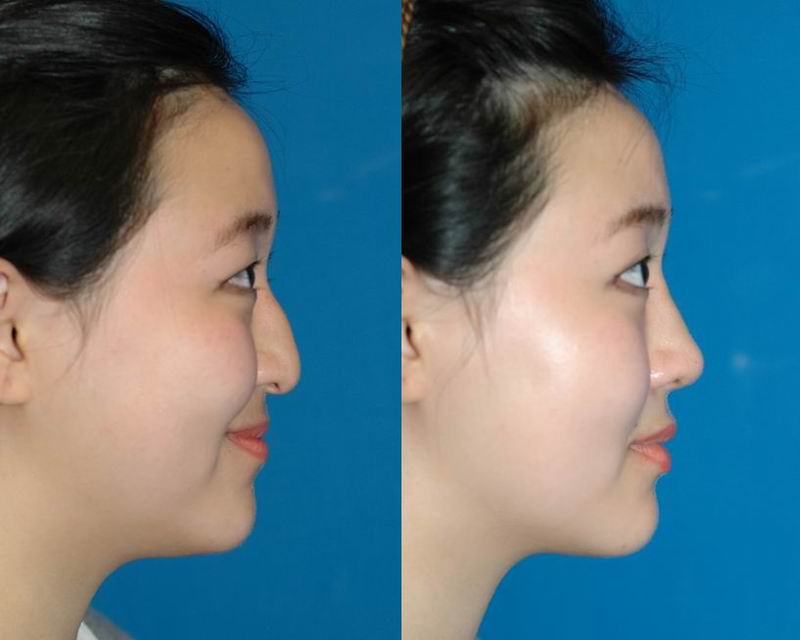
Asian Rhinoplasty with septal cartilage graft by Seattle facial plastic surgeon Dr. Sam Naficy. * Individual results may vary.
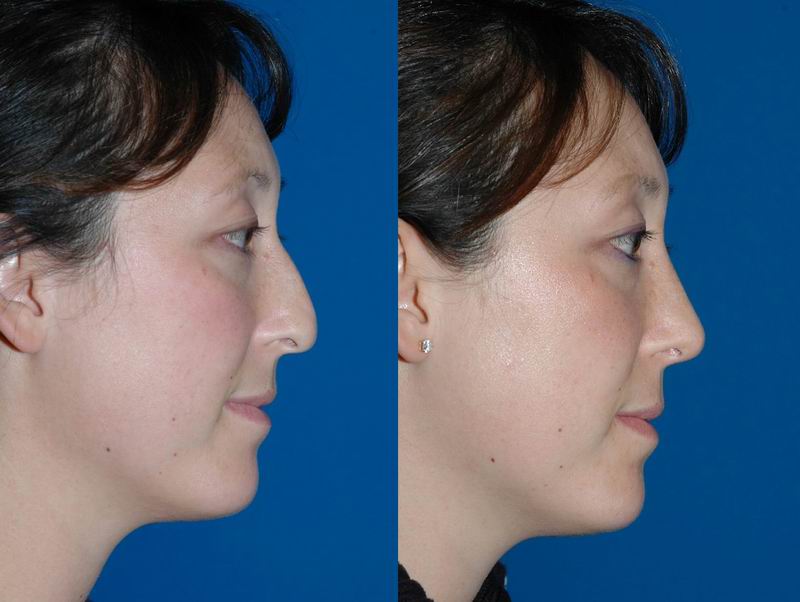
Asian Rhinoplasty with septal cartilage graft by Seattle facial plastic surgeon Dr. Sam Naficy. * Individual results may vary.
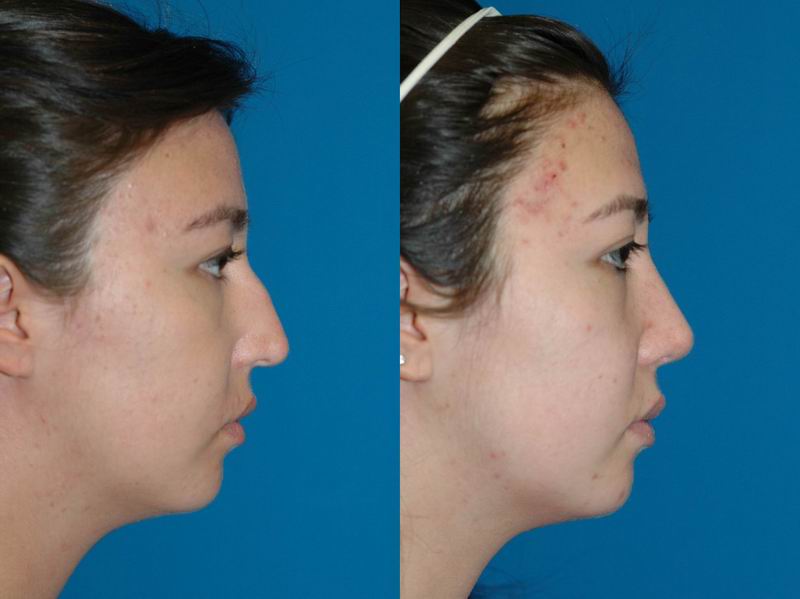
Asian Rhinoplasty with septal cartilage graft by Seattle facial plastic surgeon Dr. Sam Naficy. * Individual results may vary.
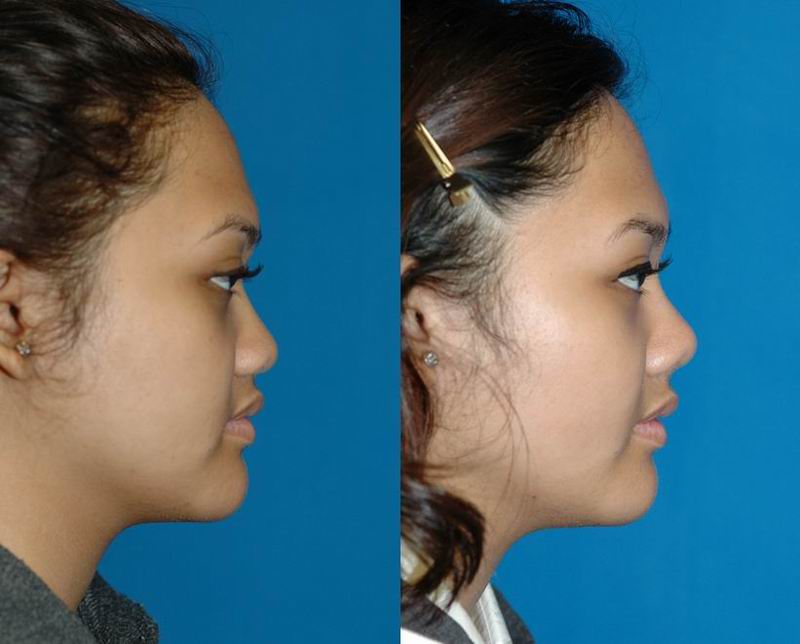
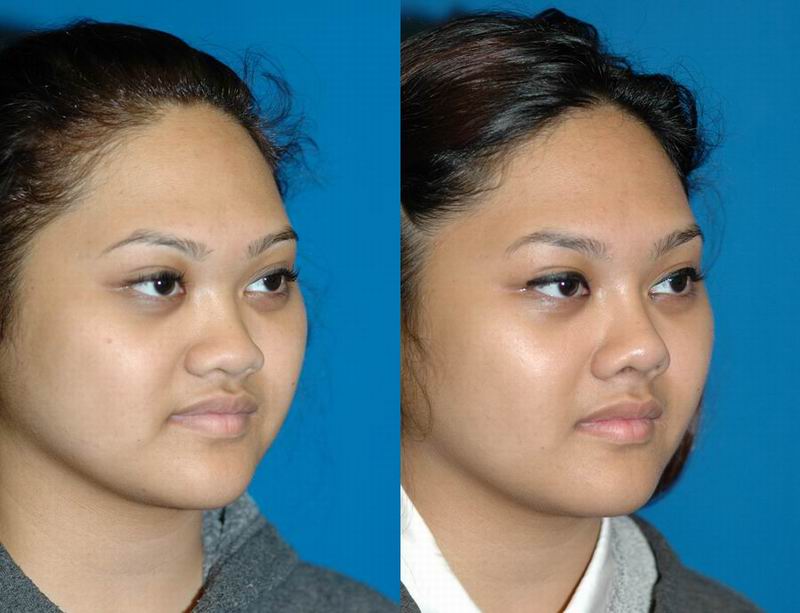
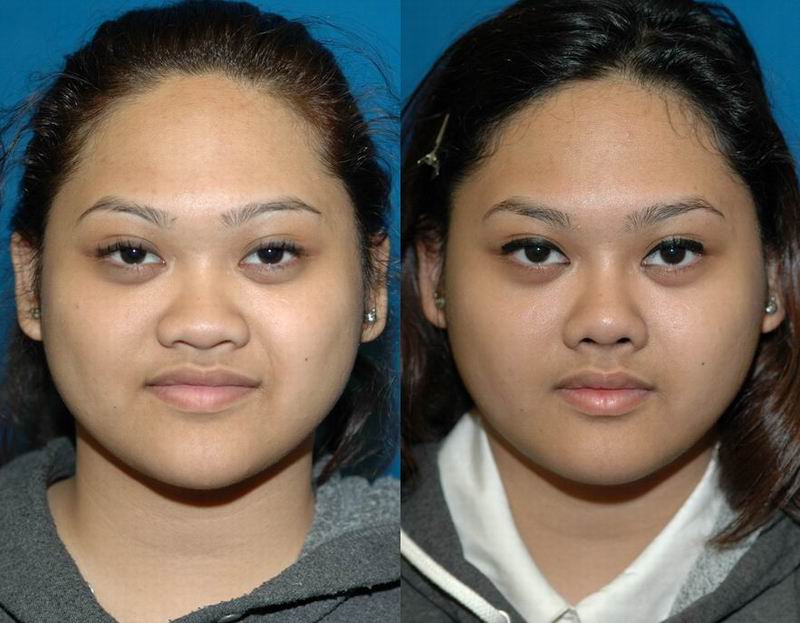
Asian Rhinoplasty with rib cartilage graft by Seattle facial plastic surgeon Dr. Sam Naficy. * Individual results may vary.
Frequently asked questions
Will Asian rhinoplasty make me look Western?
No, and it should not. The goal is a balanced, defined Asian nose that suits your face. Over-narrowing or over-rotating an Asian nose produces a result that looks operated on and out of keeping with the rest of the face.
Do I need an implant to raise my bridge?
No. Your own cartilage — from the septum, ear, or rib — achieves the same augmentation without a permanent foreign body under thin nasal skin, and with markedly lower rates of infection and extrusion.
Will I need rib cartilage?
Only where substantial augmentation is needed. Septal cartilage is the first choice; ear cartilage suits tip and rim grafts. Rib is required when the bridge needs significant height, the nose needs lengthening, or a previous implant has to be replaced. MTF donor cartilage is an alternative that avoids a second surgical site.
Can I have my silicone implant replaced with cartilage?
Yes. Where the implant is infected, it is removed first and reconstruction follows 2 to 3 months later. Where it is not infected, removal and cartilage reconstruction can sometimes be done in one operation.
Why does my tip still look swollen months later?
Thicker skin holds swelling in the tip longer. Bridge definition appears within weeks; tip definition emerges over many months and can take beyond a year.
Can filler raise my bridge instead?
Filler can add modest height temporarily and is a reasonable way to preview the look. It cannot build tip support, and injecting filler into the nose carries a rare but serious risk of vascular occlusion.
Will my nostrils be narrowed?
Only if nostril width is one of your concerns. Alar reduction is a separate manoeuvre and is not automatic.
How soon can I fly?
Patients travelling from out of the area typically remain locally for about one week, until the splint is removed and the first follow-up is complete.
I am interested. What do I do next?
If you are considering Asian rhinoplasty, we encourage you to complete the Surgical Consultation Intake Form. If you have had previous nasal surgery, bringing your operative report and pre-surgery photographs is genuinely useful. Dr. Naficy will evaluate your anatomy, discuss which graft material suits your nose, tell you whether you are a suitable candidate, and inform you of the potential risks.
Naficy Plastic Surgery & Rejuvenation Center — 1110 112th Ave. NE, Suite 150, Bellevue, WA 98004 · (425) 450-0880. Serving Bellevue, Seattle, and the greater Puget Sound region, with patients travelling nationally and internationally.
This page is for general education and does not constitute medical advice. Individual results vary. Written and medically reviewed by Sam Naficy, MD, FACS. Last reviewed August 2026.
What does “board certified” actually mean in facial plastic surgery?
Board certification tells you what a surgeon was trained and examined in. On its own, the phrase “board certified” does not say in which field. Certification exists across many specialties, and a certificate in another specialty is a genuine credential in that specialty. It is simply not the same thing as certification in facial plastic surgery. So the useful follow-up question is always: certified by which board, and in what?
For facial plastic surgery there are two boards to look for, and both publish free public tools that let you verify a surgeon yourself in under a minute.
| Board | What it certifies | Verify a surgeon |
|---|---|---|
| American Board of Facial Plastic and Reconstructive Surgery (ABFPRS) | Facial plastic and reconstructive surgery specifically. Certification requires that the surgeon already hold certification from an American Board of Medical Specialties board in either otolaryngology–head and neck surgery or plastic surgery, pass a two-day examination, and submit for peer review operative reports from a minimum of 100 facial plastic surgery procedures. | ABFPRS Physician Finder |
| American Board of Plastic Surgery (ABPS) | Plastic surgery of the entire body, including the face. ABPS is a member board of the American Board of Medical Specialties. | ABPS Verify Certification |
Why the ABFPRS requirement matters
The detail worth understanding is that ABFPRS certification cannot be the only board a surgeon holds. It is granted on top of an existing ABMS certification in one of the two surgical specialties whose residency training covers facial plastic surgery. An ABFPRS diplomate is double boarded by definition. Those two qualifying pathways — otolaryngology–head and neck surgery, and plastic surgery — are both represented at this practice, and both of our facial surgeons hold certification from two boards rather than one. The 100-case peer review is also specific: the operative reports submitted must be facial plastic surgery, not surgery generally.
What to ask, and how to check
- Which board certified you, and in what specialty? Not simply “are you board certified.”
- Is that board a member of the American Board of Medical Specialties? Boards exist with similar-sounding names that are not ABMS member boards.
- Where do you hold hospital operating privileges, and for this procedure? Hospital privileges are granted by peer review against training.
- How many of these do you perform each year? Certification is a floor, not a measure of current volume.
- Verify it yourself. Both boards above let you search by surgeon name. The ABFPRS states that its website is a primary source of verification.
The surgeons at this practice, and how to verify them
| Surgeon | Board certification | Residency pathway |
|---|---|---|
| Sam Naficy, MD, FACS | American Board of Facial Plastic and Reconstructive Surgery American Board of Otolaryngology – Head and Neck Surgery |
Otolaryngology – head and neck surgery, followed by facial plastic surgery fellowship at the University of Michigan |
| Keith Hurvitz, MD, FACS | American Board of Plastic Surgery American Board of Otolaryngology – Head and Neck Surgery |
Otolaryngology – head and neck surgery residency at USC, followed by a general plastic surgery residency at UC Irvine |
Each of these certifications can be confirmed through the verification links above, or with the certifying boards directly. We would encourage you to check ours, and to check the credentials of any other surgeon you consult.