Lower Eyelid Lift
Lower blepharoplasty corrects the bulging fat of the lower eyelid. It is performed in most cases through the inside of the eyelid — the transconjunctival approach — which leaves no external scar and, critically, does not disturb the structures that hold the lower lid against the eye. The operation takes about 30 minutes. Where the lid is lax, canthal tightening is added through a small incision at the outer corner. Sam Naficy, MD, FACS performs 75 to 90 lower eyelid procedures each year in Bellevue, Washington.
If you are trying to understand why bags form and what the complete correction involves, start with Eye Bag Surgery. This page covers the operation itself.
What is lower blepharoplasty?
Lower blepharoplasty — lower eyelid surgery, or a lower eyelid lift — addresses the fat that has prolapsed forward into the lower lid, producing the bulge that sits directly beneath the lash line.
It is among the most technically demanding procedures in facial surgery, and not because the manoeuvres are difficult. The lower eyelid is the least forgiving structure on the face: the tissue is thinner than anywhere else, there is essentially no margin for over-correction, and the two most common poor outcomes — a hollow lower lid and a lid pulled away from the eye — are considerably harder to fix than the bags they replaced.
Transconjunctival vs. external approach
There are two routes to the lower eyelid fat, and the choice has consequences well beyond where the scar sits.
| Transconjunctival | External (subciliary) | |
|---|---|---|
| Where the incision sits | Inside the lower eyelid, on the conjunctival surface | Outside, just beneath the lash line |
| Visible scar | None | A fine line beneath the lashes, usually inconspicuous once healed |
| Lid support structures | Left undisturbed | Divided and repaired — the muscle and septum are crossed to reach the fat |
| Risk of lid pulling down | Substantially lower | Higher, because scar contracture in the divided layers can retract the lid |
| Skin removal | Not possible through this route — and generally not desirable | Possible, and this is its main indication |
| Used here | In most circumstances | Rarely, in selected cases |
Why the transconjunctival approach is the default. The external approach requires crossing the orbicularis muscle and the orbital septum — the layers that hold the lower lid up against the globe. Those layers are repaired, but they heal with scar, and scar contracts. That is the mechanism behind lower lid retraction and ectropion after lower blepharoplasty. Going in from behind avoids the problem entirely by never crossing those structures.
It also removes the temptation to excise skin. As covered on the Eye Bag Surgery page, loose lower eyelid skin has lost collagen and elasticity rather than gained surface area, and cutting it out pulls the lid downward. Skin quality is better treated with laser resurfacing, which restores elasticity rather than shortening the lid.
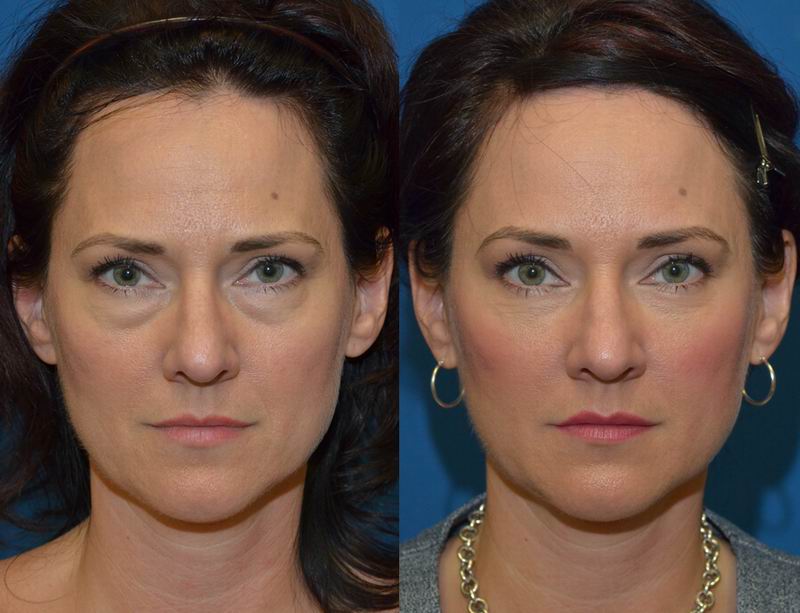
Before & After Lower blepharoplasty (lower eyelid lift) and fat grafting by Sam Naficy, MD. * Individual results may vary.
What happens to the fat?
Not all of it is removed. Simply taking out the bulging fat is what produces the hollow, skeletonised lower lid that can look older than the bags did. The fat is instead managed in three ways within the same operation, in different areas of the same eyelid:
- Redistribution. Where the tear trough is hollow immediately below the bulge, fat is released and repositioned into that hollow rather than discarded — using the excess to fill the deficiency it sits above.
- Removal. Where there is a genuine surplus that cannot be usefully repositioned, a conservative amount is reduced.
- Addition. Where volume has been lost in the upper cheek and along the orbital rim, fat grafting adds volume from elsewhere on the body.
Most patients need some combination of all three across different zones of the lower lid. Judging which zone needs which is the substance of the operation, and it is why lower blepharoplasty is not a single manoeuvre.
Lower lid support: why some patients need canthal tightening
The lower eyelid is held against the eye by tendons at its inner and outer corners. With age, and in some people constitutionally, that support slackens. A lax lid tolerates surgery poorly — it is the group in whom the lid is most likely to sit low or pull away afterward.
Two simple tests establish this at consultation:
- The snap-back test. The lower lid is drawn downward and released. A well-supported lid snaps back against the eye immediately. A lax lid returns slowly, or only after a blink.
- The distraction test. The lid is pulled gently away from the eye. A well-supported lid barely moves. A lax lid can be drawn several millimetres forward.
Where these show meaningful laxity, canthal tightening is performed alongside the blepharoplasty, through a small incision at the outer corner of the eyelid. The lid is re-tensioned and secured so that it sits properly against the globe.
This is not an upsell and it is not universal — many patients do not need it. But operating on a lax lower lid without addressing the laxity is one of the more predictable routes to a poor outcome, and it is worth asking any surgeon whether they have tested for it.
Who is a good candidate for lower blepharoplasty?
- Bulging or puffiness of the lower eyelids that persists regardless of sleep or hydration
- Shadowing beneath the bags caused by contour rather than pigment
- Good general health, no uncontrolled dry eye, and realistic expectations
- Adequate lower lid support — or a willingness to have canthal tightening added where it is not
Who is not a good candidate?
- Your puffiness is fluid rather than fat. Morning puffiness that resolves through the day is fluid, often related to allergy, sleep position, salt, or thyroid function.
- Your dark circles are pigment rather than shadow. Pull the skin gently taut; if the darkness persists, it is pigment and contour surgery will not change it.
- Significant untreated dry eye, which lower eyelid surgery can worsen.
- Marked lower lid laxity without willingness to address it, which raises the risk of lid malposition considerably.
- You use nicotine in any form. Complete cessation is required for at least three weeks before and after surgery.
- Uncontrolled hypertension, poorly controlled diabetes, or a bleeding disorder.
How is lower blepharoplasty performed?
Lower blepharoplasty takes approximately 30 minutes on its own, and is performed under IV sedation or general anesthesia.
- Access. A small incision is made on the inside of the lower eyelid. Nothing is cut on the outer surface.
- Fat management. The prolapsed fat is exposed and then redistributed, reduced, or both, according to what each zone of the lid requires.
- Tear trough correction. Where a hollow sits below the bulge, fat is repositioned into it, or grafted fat is added.
- Canthal tightening, where the snap-back and distraction tests indicated laxity, through a small incision at the outer corner.
- Skin treatment. Where skin quality is a concern, laser resurfacing is performed rather than skin excision.
- Closure. The internal incision typically requires no sutures, or dissolving ones.
What is recovery like after lower blepharoplasty?
Most patients return to work in 5 to 7 days. Adding laser resurfacing extends this to 8 to 10 days. Discomfort is minimal — typically described as an irritated eye rather than pain.
| Time after surgery | What to expect |
|---|---|
| Days 1–2 | Swelling and bruising, peaking early. Cool compresses and head elevation. Vision may be blurry from ointment. If canthal tightening was performed, the outer corner feels tight. |
| Days 3–5 | Swelling settles noticeably; bruising begins to fade and turn yellow. |
| Days 5–7 | Most patients return to work, using concealer over residual bruising. |
| Weeks 2–4 | Bruising resolved. Light exercise resumes with clearance. Repositioned or grafted fat still slightly overfilled — this settles. |
| Weeks 6–8 | Full activity cleared. Any tightness at the outer corner continues to soften. |
| Months 3–12 | Fat settles to final volume and contour smooths. Final result assessed at one year. |
Patients travelling from out of the area should plan accordingly. See Out of Town Patients.
Revision lower blepharoplasty
Revision lower eyelid surgery is performed in our practice, including correction of problems created by previous lower blepharoplasty elsewhere.
The problems that most often bring patients in:
- Lower lid retraction — the lid sitting too low, exposing white below the iris, giving a startled or hollow-eyed appearance
- Ectropion — the lid margin turning outward and away from the eye, often with watering and irritation
- Rounding of the eye, where the outer corner has been pulled downward and the almond shape lost
- A hollow, skeletonised lower lid from over-removal of fat
- Residual or recurrent bulging where the original surgery was too conservative
The first three share a cause: too much skin removed, support structures divided and left unrepaired, or lid laxity that was never addressed. Correction usually means adding tissue back rather than removing more — releasing scar, restoring support at the outer corner, and in some cases grafting to replace what was taken.
Revision lower lid surgery is more demanding than the original operation and the results are less predictable, which is a reason to get the first one right. If you are considering a first lower blepharoplasty, ask the surgeon which approach they use and whether they test lid support.
Published evidence: midface fat grafting and lower eyelid position
Dr. Naficy published a peer-reviewed study of this specific mechanism. In 70 consecutive patients who underwent midface volume augmentation with autologous fat, masked investigators measured lower eyelid position before and after surgery. Adding volume to the upper cheek produced a mean improvement of 0.5 mm in margin–reflex distance 2 and a 0.5 mm reduction in scleral show, and the effect was still present at a mean follow-up of 316 days. Minor complications, chiefly firmness beneath the skin, occurred in 7% and resolved with massage.
The clinical implication is that restoring midface volume raises the lower lid, and is therefore a useful adjunct in patients with mild lower eyelid retraction — including retraction created by previous surgery elsewhere.
Naficy S, et al. Effect of midface volume augmentation with autologous fat on lower eyelid position. PubMed, PMID 24814272.
See also: facial fat grafting.
What procedures are combined with lower blepharoplasty?
Lower blepharoplasty is frequently combined with upper eyelid surgery, fat grafting, laser resurfacing, a brow lift, or a face and neck lift. The three-part combination used to treat eye bags — blepharoplasty, fat grafting, and laser — is described in full on the Eye Bag Surgery page.
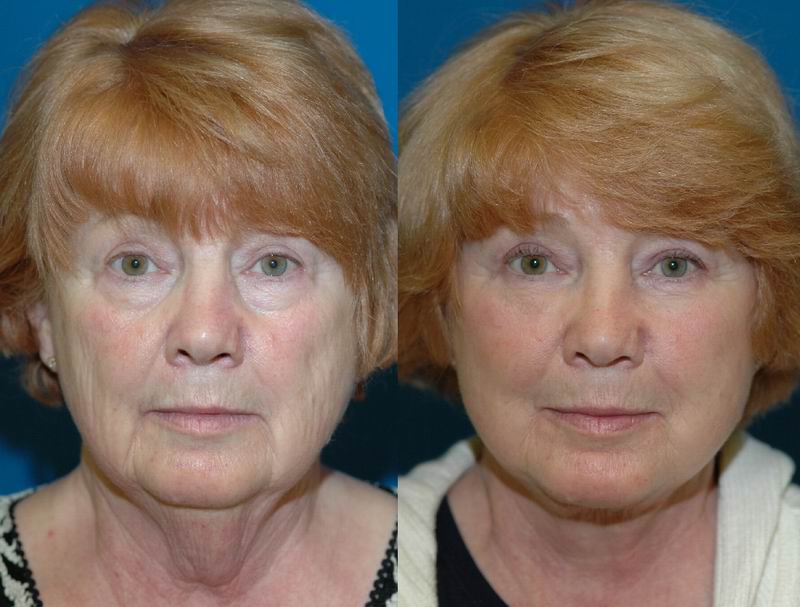
Before & After Lower blepharoplasty (lower eyelid lift), fat grafting, and face and neck lift by Sam Naficy, MD. * Individual results may vary.
What are the risks of lower blepharoplasty?
More common, and usually temporary: swelling and bruising, dryness or grittiness, blurred vision from ointment, temporary asymmetry in swelling, and tightness at the outer corner where canthal work was performed.
Less common:
- Lower lid malposition — retraction or ectropion. The transconjunctival approach and canthal support where indicated reduce this substantially, but the risk is not zero, and it is highest in patients with pre-existing laxity.
- Over-removal of fat, producing a hollow lower lid that can look older than the original bulge.
- Under-correction, or asymmetry between sides.
- Irregularity of repositioned or grafted fat, and partial resorption of grafts over time.
- Chemosis — swelling of the conjunctiva, which resolves but can be persistent and irritating for some weeks.
- Dry eye that persists or is unmasked by surgery.
Rare: infection, hematoma, and vision change. Loss of vision after eyelid surgery is extremely rare and is the reason post-operative bleeding is treated as urgent.
How much does lower blepharoplasty cost?
At Naficy Plastic Surgery, lower blepharoplasty on its own is approximately $6,000 — the same as upper eyelid surgery. Adding fat grafting, laser resurfacing, or canthal tightening increases the total, and the full three-part combination used to treat eye bags is approximately $17,000; see Eye Bag Surgery.
Combining procedures in one operation costs less than staging them separately, because anesthesia and facility time are shared.
Fees are itemized in writing at consultation, covering surgeon, anesthesia, facility, and follow-up care. Financing is available through PatientFi. Lower eyelid surgery performed for cosmetic reasons is not covered by insurance.
Fees & payment policies · Financing
Why choose a facial plastic surgeon for lower eyelid surgery?
Lower blepharoplasty is the procedure where the gap between a good and a poor result is widest, and where a poor result is hardest to undo. The decisions that matter are made before and during the operation: which approach, how much fat to reposition rather than remove, whether the lid needs support, and whether to leave the skin alone.
Dr. Naficy performs 75 to 90 lower eyelid procedures each year. His practice has been devoted exclusively to facial plastic surgery since 2000. He is certified by the American Board of Facial Plastic and Reconstructive Surgery (ABFPRS), graduated first in his class from the University of Washington School of Medicine, and completed both his residency and fellowship at the University of Michigan. Dr. Naficy has been recognized in Seattle Magazine's Top Doctors list.
Our practice also includes Dr. Bryan Sires, who performs oculoplastic and functional eyelid surgery.
About Dr. Sam Naficy, MD, FACS
What type of anesthesia is used?
Lower blepharoplasty is performed under IV sedation or general anesthesia, administered by a dedicated anesthesia provider who will discuss which is appropriate for your health status and the planned procedure. Heart rate, blood pressure, breathing, and oxygen levels are monitored continuously.
Surgery is performed in our on-site surgery center, which is Medicare-certified and Washington State–accredited. Our anesthesia team has more than 50 years of combined experience, and all providers also hold appointments at the University of Washington or other regional medical centers.
Anesthesia guidelines [21kb PDF] · Post-operative care instructions [12kb PDF]
Lower eyelid surgery before and after photos
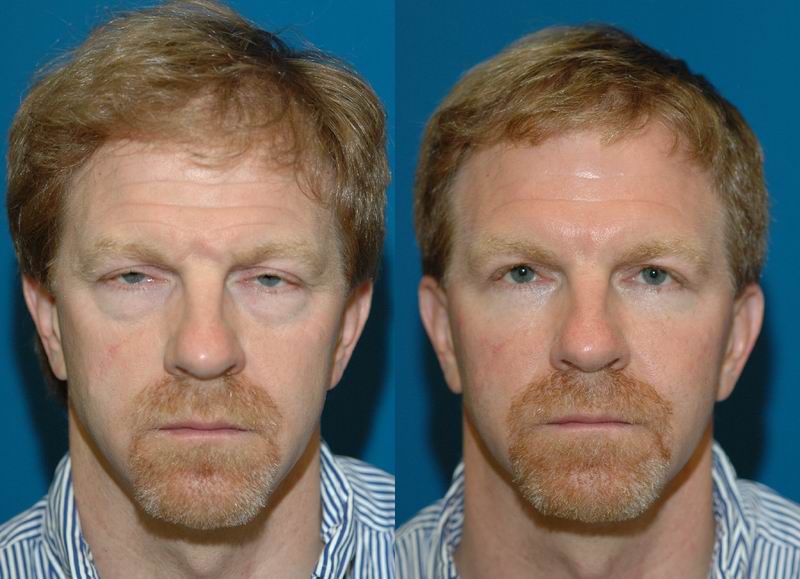
Representative before and after images of lower eyelid procedures performed by Dr. Sam Naficy. Some patients had more than one procedure; the caption accompanying each photograph describes the details.
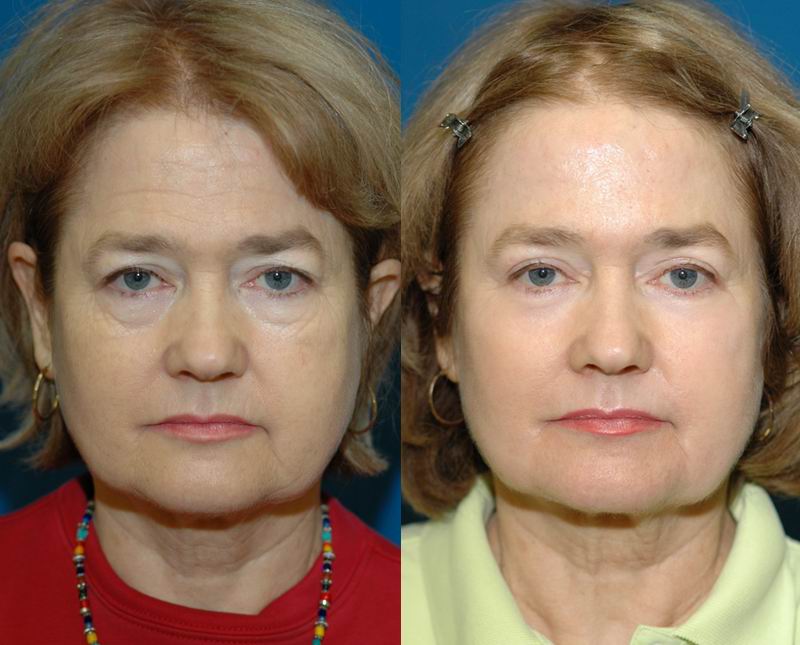
Before & After Lower blepharoplasty (lower eyelid lift) with laser resurfacing, fat grafting, and upper blepharoplasty by Sam Naficy, MD. * Individual results may vary.
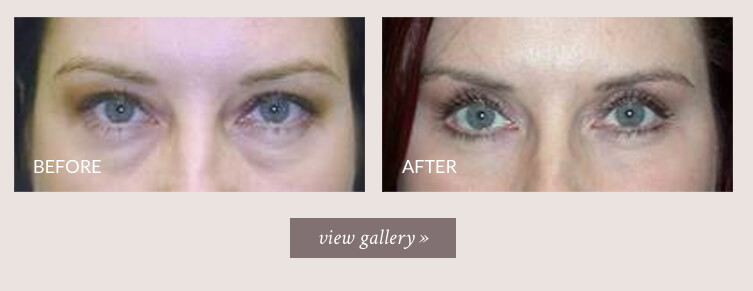
* Individual results may vary.
Frequently asked questions
Will there be a visible scar?
Not with the transconjunctival approach, which is used in most cases — the incision is inside the eyelid. Where canthal tightening is needed, there is a small incision at the outer corner that sits in a natural crease.
Will my eyelid skin be removed?
Generally no. Loose lower eyelid skin has lost elasticity rather than gained surface area, and removing it risks pulling the lid down. Skin quality is treated with laser resurfacing instead.
What is canthal tightening and will I need it?
It re-tensions the tendon supporting the outer corner of the lower lid. It is added when the snap-back and distraction tests show meaningful laxity. Many patients do not need it.
Why would fat be moved rather than removed?
Because the hollow beneath the bulge usually needs filling. Repositioning the fat into the tear trough corrects the bulge and the hollow in one move, rather than deepening the hollow by removing everything.
Can you fix a previous lower eyelid surgery?
Yes. Revision lower blepharoplasty is performed here, including correction of lid retraction, ectropion, eye rounding, and hollowing from over-removal.
How long until I look presentable?
Five to seven days, or eight to ten if laser resurfacing is included.
Will the bags come back?
The fat that is removed does not return. Ageing continues in the surrounding tissues, but the correction is long lasting.
Is it covered by insurance?
No. Lower eyelid surgery is cosmetic. Upper eyelid surgery can rarely qualify where visual obstruction is severe — see Upper Eyelid Lift.
What does “board certified” actually mean for eyelid surgery?
Board certification tells you what a surgeon was trained and examined in. On its own, the phrase “board certified” does not say in which field. Certification exists across many specialties, and a certificate in another specialty is a genuine credential in that specialty. It is simply not the same thing as certification in a specialty that trains surgeons to operate on the eyelids. So the useful follow-up question is always: certified by which board, and in what?
Eyelid surgery is unusual in one respect. Three different specialty pathways legitimately lead to operating on the eyelid, and each publishes a free public tool that lets you verify a surgeon yourself in under a minute.
| Board | What it certifies | Verify a surgeon |
|---|---|---|
| American Board of Facial Plastic and Reconstructive Surgery (ABFPRS) | Facial plastic and reconstructive surgery specifically. Certification requires that the surgeon already hold certification from an American Board of Medical Specialties board in either otolaryngology–head and neck surgery or plastic surgery, pass a two-day examination, and submit for peer review operative reports from a minimum of 100 facial plastic surgery procedures. | ABFPRS Physician Finder |
| American Board of Plastic Surgery (ABPS) | Plastic surgery of the entire body, including the face and eyelids. ABPS is a member board of the American Board of Medical Specialties. | ABPS Verify Certification |
| American Board of Ophthalmology (ABOp) | Ophthalmology — the eye and its surrounding structures, including the eyelids, orbit and tear drainage system. ABOp is a member board of the American Board of Medical Specialties. Surgeons who subspecialise in eyelid and orbital surgery complete an additional oculoplastic (ophthalmic plastic and reconstructive surgery) fellowship after their ophthalmology residency. | ABOp Physician Search |
Why three pathways, and why it matters here
The eyelid sits at the boundary of three specialties, and the reason is anatomical rather than political. A cosmetic upper blepharoplasty, a ptosis repair that restores a drooping lid to its proper height, and reconstruction of the orbit or tear drainage system are different problems that happen to occupy the same few millimetres of tissue. Training that prepares a surgeon well for one does not automatically prepare them for another.
Two details are worth knowing. ABFPRS certification cannot be the only board a surgeon holds — it is granted on top of an existing ABMS certification in otolaryngology–head and neck surgery or plastic surgery, so an ABFPRS diplomate is double boarded by definition. And oculoplastic surgery is a fellowship, not a separate board; an oculoplastic surgeon is certified in ophthalmology and has completed dedicated subspecialty training in eyelid and orbital surgery on top of it. Asking which fellowship, and where, is a fair question.
What to ask, and how to check
- Which board certified you, and in what specialty? Not simply “are you board certified.”
- Is that board a member of the American Board of Medical Specialties? Boards exist with similar-sounding names that are not ABMS member boards.
- Did you complete a fellowship, and in what? For eyelid surgery this is often more informative than the board alone.
- Where do you hold hospital operating privileges, and for this procedure? Hospital privileges are granted by peer review against training.
- How many of these do you perform each year? Certification is a floor, not a measure of current volume.
- Verify it yourself. All three boards above let you search by surgeon name. The ABFPRS states that its website is a primary source of verification.
The surgeons at this practice, and how to verify them
| Surgeon | Board certification | Training pathway |
|---|---|---|
| Sam Naficy, MD, FACS | American Board of Facial Plastic and Reconstructive Surgery American Board of Otolaryngology – Head and Neck Surgery |
Otolaryngology – head and neck surgery, followed by facial plastic surgery fellowship at the University of Michigan |
| Keith Hurvitz, MD, FACS | American Board of Plastic Surgery American Board of Otolaryngology – Head and Neck Surgery |
Otolaryngology – head and neck surgery residency at USC, followed by a general plastic surgery residency at UC Irvine |
| Bryan Sires, MD, PhD, FACS | American Board of Ophthalmology | Ophthalmology, followed by an Ophthalmic Plastic and Reconstructive Surgery fellowship at the University of Wisconsin–Madison. Director of the Oculoplastic Surgery Fellowship at the University of Washington. |
All three perform upper and lower blepharoplasty and brow lift here. Dr. Sires additionally handles functional and reconstructive oculoplastic work, including ptosis repair and orbital and lacrimal surgery. Each of these certifications can be confirmed through the verification links above, or with the certifying boards directly. We would encourage you to check ours, and to check the credentials of any other surgeon you consult.
I am interested. What do I do next?
If you are considering lower eyelid surgery, we encourage you to complete the Surgical Consultation Intake Form. Dr. Naficy will assess the fat, the hollow beneath it, skin quality, and lower lid support, then recommend the approach that fits and inform you of the potential risks. If you have had previous lower eyelid surgery, bring the operative report and photographs from before that surgery.
Naficy Plastic Surgery & Rejuvenation Center — 1110 112th Ave. NE, Suite 150, Bellevue, WA 98004 · (425) 450-0880. Serving Bellevue, Seattle, Kirkland, Redmond, Medina, Mercer Island, and the greater Puget Sound region.
This page is for general education and does not constitute medical advice. Individual results vary. Written and medically reviewed by Sam Naficy, MD, FACS. Last reviewed August 2026.