Brow and Forehead Lift
A brow lift repositions a heavy or descended brow, opening the upper third of the face and reducing the hooding that makes eyes look tired. The technique matters more than the name: some brow lifts raise the hairline, and one lowers it. Sam Naficy, MD, FACS performs 90 to 100 brow lifts each year in Bellevue, Washington. Surgery takes 45 minutes to 1.5 hours depending on technique, and most patients return to desk work in 7 to 10 days.
What is a brow lift?
A brow lift — also called a forehead lift — raises the eyebrows and smooths the forehead by repositioning the tissue of the upper face. A facelift improves jowling and the neck; it does nothing for the brow. The upper third of the face is a separate operation.
The most common misconception is that a brow lift produces a surprised, over-elevated look. That is a result of lifting too much, or lifting the centre of the brow rather than the outer third where descent actually occurs. Done correctly, the change reads as looking rested rather than as having had surgery.
How does the upper face age?
The brow and forehead are often the first areas to show age, and the changes compound one another:
- The brow descends, particularly at the outer third, producing a heavy or angry appearance
- Descended brow tissue crowds the upper eyelid, creating hooding that looks like excess eyelid skin
- Horizontal forehead lines deepen from years of raising the brow to compensate
- Vertical frown lines form between the brows
- Volume is lost above and beneath the brow, flattening its contour
The second point is the one that most often causes a wrong operation. A patient who has upper eyelid surgery when the real problem is a descended brow gets a result that looks incompletely corrected — because the weight sitting on the eyelid was never addressed.
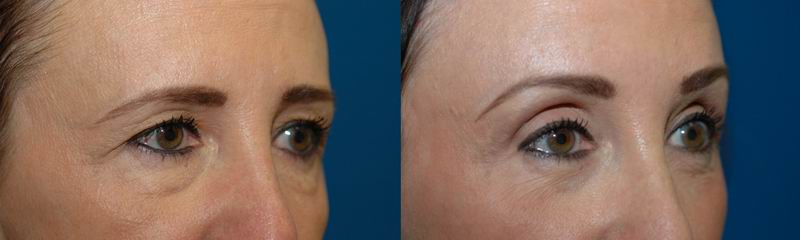
Before & after brow lift (forehead lift) and upper blepharoplasty by Sam Naficy, MD * Individual results may vary
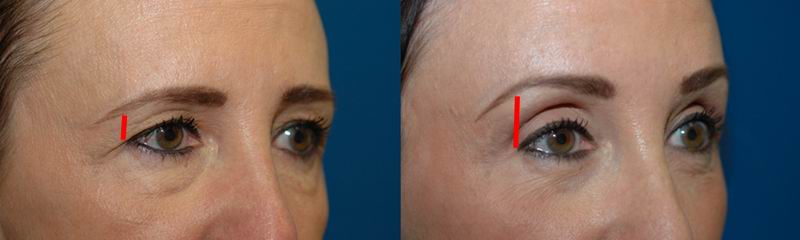
Brow lift techniques compared
Five techniques are used to lift the brow. They differ in where the incision sits, how much lift they produce, and — critically — what they do to your hairline.
| Technique | Incision | Effect on hairline | Degree of lift | Best suited to |
|---|---|---|---|---|
| Pretrichial / trichophytic (hairline) | Along the front hairline | Lowers the hairline — shortens a high forehead | Substantial, well controlled | High forehead, significant brow descent. The technique used most often here |
| Endoscopic | Several short incisions behind the hairline | Raises it slightly | Moderate, subtle | Normal or low hairline, modest descent, and most male patients |
| Coronal | Across the top of the scalp, behind the hairline | Raises the hairline | Substantial | Low hairline with dense hair; largely superseded by the techniques above |
| Mid-forehead | Within a deep existing forehead crease | None to slighly lower | Moderate to substantial | Men with deep forehead lines, receding hair, or thinning hair |
| Direct brow | Immediately above the eyebrow | None to slighly lower | Precise, localised | Marked asymmetry, brow paralysis, older patients with heavy brows and deep lines |
Choosing between them depends on hairline position and height, hair density and style, forehead length, how much lift is needed, whether the brows are asymmetric, and whether you are willing to trade a scar position for a hairline change.
Which brow lift technique does Dr. Naficy use most often?
The pretrichial, or hairline, brow lift. It places the incision along the front hairline rather than behind it, which produces two advantages at once: a strong, precisely controlled lift, and a forehead that becomes shorter rather than longer.
That second point is why it is the default here. Every technique that places the incision behind the hairline — endoscopic and coronal — pulls the hairline backward to some degree and lengthens the forehead. For a patient who already feels their forehead is high, that is the wrong direction. The hairline technique moves it the other way.
The endoscopic approach remains the better choice where a patient has a low hairline, needs only a modest lift, or wants the most subtle possible change — which is why it is used for most men.
Who is a good candidate for a brow lift?
- A heavy, low, or descended brow, particularly at the outer third
- Hooding of the upper eyelid that is caused by brow position rather than eyelid skin alone
- Deep horizontal forehead lines from constantly raising the brow
- A tired or angry resting expression that does not match how you feel
- Good general health and realistic expectations
A simple test. Look in a mirror and gently lift the outer end of your brow with a fingertip. If that opens the eye and removes the heaviness, brow position is contributing and an eyelid procedure alone will under-correct.
Who is not a good candidate?
- Your brow position is normal and the problem is genuinely excess eyelid skin. An upper eyelid lift is the right operation, and lifting a normal brow over-elevates it.
- You want a dramatic arch. Over-elevation is what produces the surprised look people fear.
- Significant hair loss or very thin hair may rule out techniques that place incisions in the scalp, though the mid-forehead and direct approaches remain available.
- Uncontrolled hypertension, poorly controlled diabetes, or a bleeding disorder.
How is a brow lift performed?
Operative time depends on technique. An endoscopic brow lift takes about 45 minutes. A pretrichial (hairline) brow lift takes about 1.5 hours. Both are performed under general anesthesia or IV sedation.
Pretrichial (hairline) technique:
- An incision is made along the front hairline, beveled so that hair grows through the healed scar and camouflages it.
- The forehead tissue is elevated in a plane beneath the skin and muscle.
- The muscles responsible for frown lines between the brows are released or weakened where indicated.
- The brow is repositioned to the desired height, with the outer third lifted more than the centre to avoid a surprised appearance.
- Excess forehead skin is trimmed, which shortens the forehead and lowers the hairline.
- Closure is layered, with tension held by the deep layer so the scar heals as a fine line.
Endoscopic technique: several short incisions are placed behind the hairline. A camera passed beneath the forehead tissue allows the entire forehead to be released and repositioned, and the lift is secured internally. No skin is removed, so the hairline moves slightly backward rather than forward.
What is brow lift recovery like?
Most patients return to a desk job in 7 to 10 days. There is usually a sensation of tightness across the head in the first week.
| Time after surgery | What to expect |
|---|---|
| Days 1–3 | Tightness across the forehead and scalp. Swelling and bruising build and may settle into the upper eyelids. Rest with the head elevated. Discomfort is usually mild and often managed with acetaminophen. |
| Days 4–7 | Swelling and bruising begin to fade. Sutures or staples are typically removed within the first week to ten days. Hair may be washed as directed. |
| Days 7–10 | Most patients return to a desk job. Any residual bruising is usually easy to cover. |
| Weeks 2–4 | Brow position begins to look natural rather than surprised — brows always sit high initially and settle. Light exercise resumes with clearance. |
| Weeks 6–8 | Full strenuous activity generally cleared. The incision line continues to fade. |
| Months 3–12 | Scalp sensation returns, the scar matures, and brow position settles into its final result. |
Patients travelling from out of the area remain locally for 7 to 8 days. See Out of Town Patients.
One expectation worth setting. The brows sit noticeably high for the first few weeks. This is normal and intentional — they descend slightly as swelling resolves and tissue settles. Judging brow position at two weeks is judging swelling.
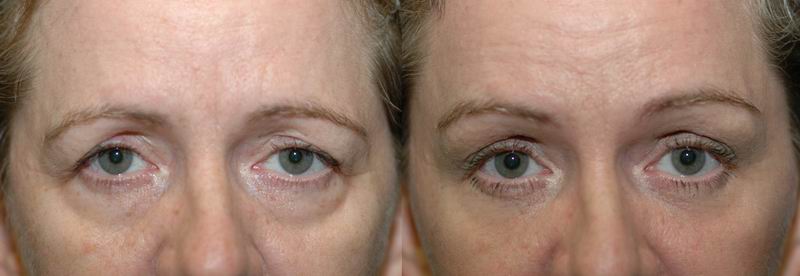
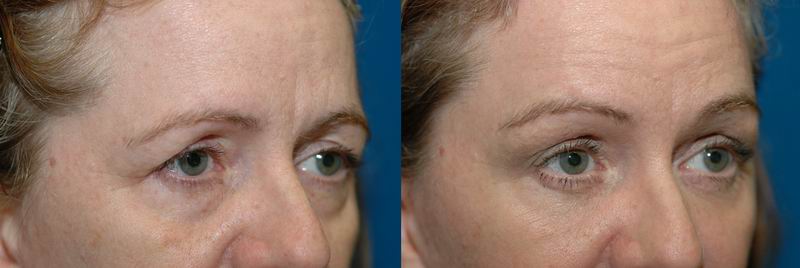
Brow lift (forehead lift), lower blepharoplasty, and fat grafting by Sam Naficy, MD * Individual results may vary.
Will my scalp be numb after a brow lift?
Yes, and you should expect it. Numbness of the scalp behind the incision is normal after a brow lift — the small sensory nerves that supply the scalp are interrupted when the forehead tissue is elevated, and they regenerate slowly.
In most patients sensation returns by 3 to 6 months. In some it takes up to a year. It is not a complication and it is not a sign that anything has gone wrong. Patients who are not told about it in advance often find it alarming, which is the only real reason it causes distress.
During that period the numb area may feel odd when brushing or washing hair, and some patients notice intermittent itching or tingling as the nerves recover — a sign of regeneration rather than a problem.
Will a brow lift change my hairline?
It depends entirely on which technique is used, and for many patients this is the deciding factor.
- Pretrichial (hairline) brow lift — lowers the hairline. Skin is removed from the forehead in front of the hairline, so the forehead becomes shorter. This is an advantage for anyone who feels their forehead is high.
- Endoscopic brow lift — raises it slightly. The lift is achieved by moving scalp backward, so the forehead lengthens modestly.
- Coronal brow lift — raises it more. This is the main reason it has largely been replaced.
- Mid-forehead and direct brow lifts — minmal effect but makes forehead appear shorter. Both place the incision below the hairline entirely.
If you have a high forehead, a technique that raises the hairline further will produce a result you are unhappy with even if the brow position itself is perfect. Raise this at consultation.
What are the risks of a brow lift?
More common, and usually temporary:
- Scalp numbness behind the incision, resolving over 3 to 6 months and occasionally up to a year
- Tightness across the forehead and scalp in the early weeks
- Swelling and bruising, which often settle into the upper eyelids
- Itching or tingling as sensory nerves regenerate
Less common:
- Asymmetry. Brows are asymmetric in most people before surgery and some difference persists after.
- Over-elevation producing a surprised appearance, most often from lifting the centre of the brow rather than the outer third.
- Under-correction or gradual relapse of brow position over years.
- Visible scarring or a widened scar, more likely in smokers.
- Hair loss along the incision — usually temporary, occasionally permanent in a narrow band.
- Hairline change in the unwanted direction if the technique is poorly matched to the patient.
- Injury to the frontal branch of the facial nerve, causing weakness of brow elevation on one side. Usually temporary; permanent injury is rare.
Rare: hematoma, infection, and the need for revision.
Risk is reduced by matching technique to hairline and hair density, careful nerve-plane dissection, complete nicotine cessation, and lifting the outer brow more than the centre.
How much does a brow lift cost?
At Naficy Plastic Surgery, brow lift surgery ranges from $10,000 to $18,000. Where forehead reduction is combined with the brow lift, fees fall toward the higher end of that range, since the operation is longer and more involved.
Cost depends on the technique selected, whether forehead shortening is included, and whether eyelid surgery, fat grafting, or laser resurfacing are combined in the same anesthetic. Combining procedures generally costs less than staging them separately, because anesthesia and facility time are shared.
Fees are itemized in writing at consultation, covering surgeon, anesthesia, facility, and follow-up care. Financing is available through PatientFi.
Fees & payment policies · Financing
What procedures are combined with a brow lift?
A brow lift can be performed alone, but it is frequently combined — the upper face rarely ages in isolation. Common combinations include upper and lower eyelid surgery, facial fat grafting, laser resurfacing, forehead reduction, and face and neck lift.
Brow lift together with eyelid surgery
This is the most common combination, and the reason is anatomical. Hooding of the upper lid is often caused partly by descended brow tissue and partly by excess eyelid skin. Correcting only one leaves the other visible.
Judging which is dominant is the central decision. Removing eyelid skin when the brow is the problem produces an under-corrected result and can pull the brow down further. Lifting the brow when the problem is genuinely eyelid skin over-elevates it. Frequently both are needed, and doing them together allows the amount of eyelid skin removed to be judged with the brow already in its new position.
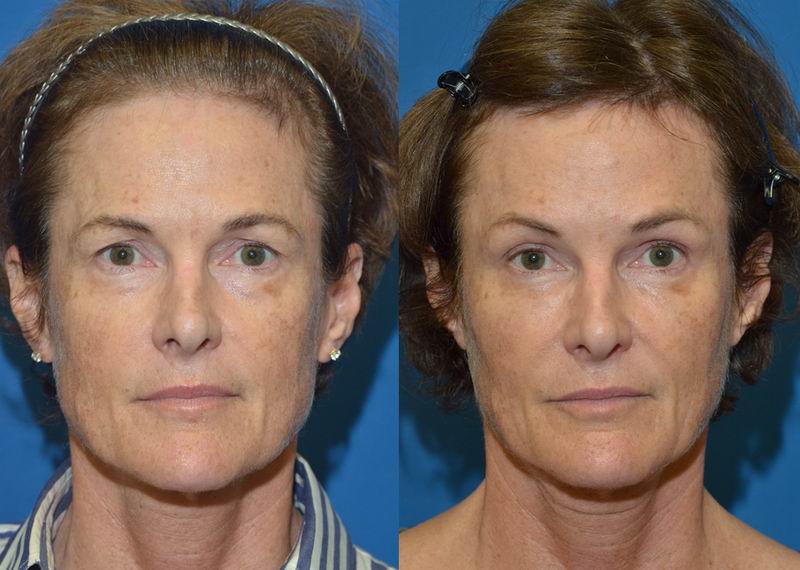
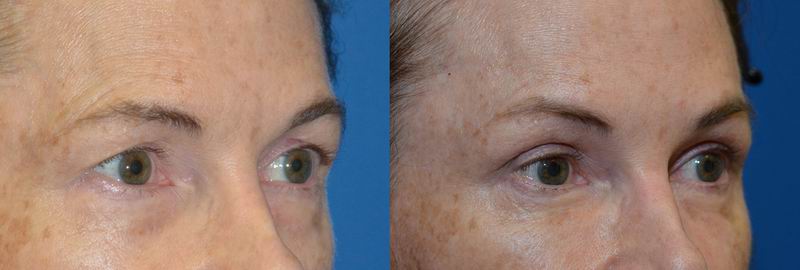
Brow lift (forehead lift) and upper blepharoplasty by Sam Naficy, MD * Individual results may vary.
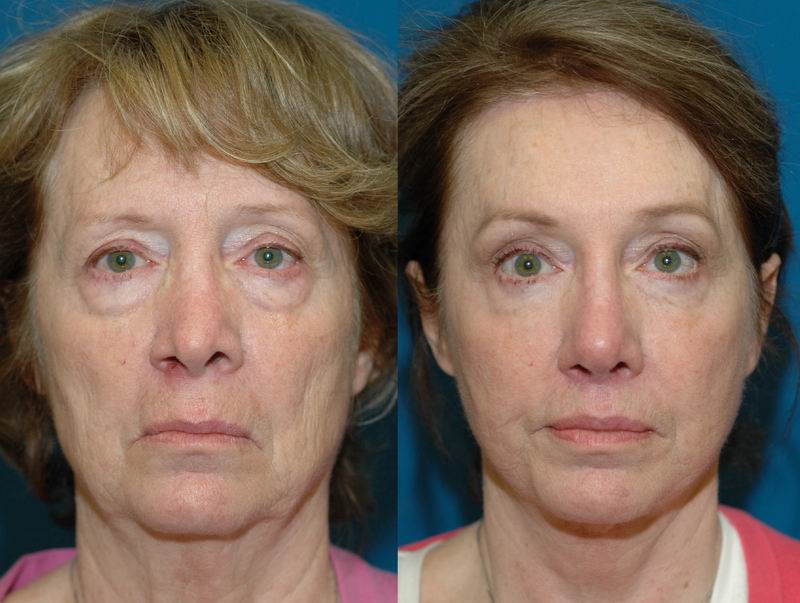
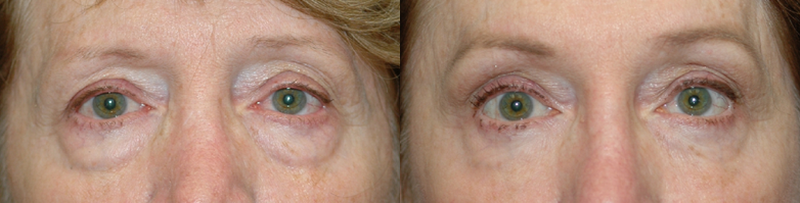
Brow lift (forehead lift), lower blepharoplasty, fat grafting, face & neck lift by Sam Naficy, MD * Individual results may vary.
Brow lift and fat grafting
Brow lift and facial fat grafting combine well because they address different components of the same problem. A brow lift repositions tissue; it does not replace volume lost above and beneath the brow, in the temples, or in the upper cheek. Restoring that volume gives the repositioned brow a fuller contour to sit on, and a hollow temple beside a lifted brow looks incongruous.
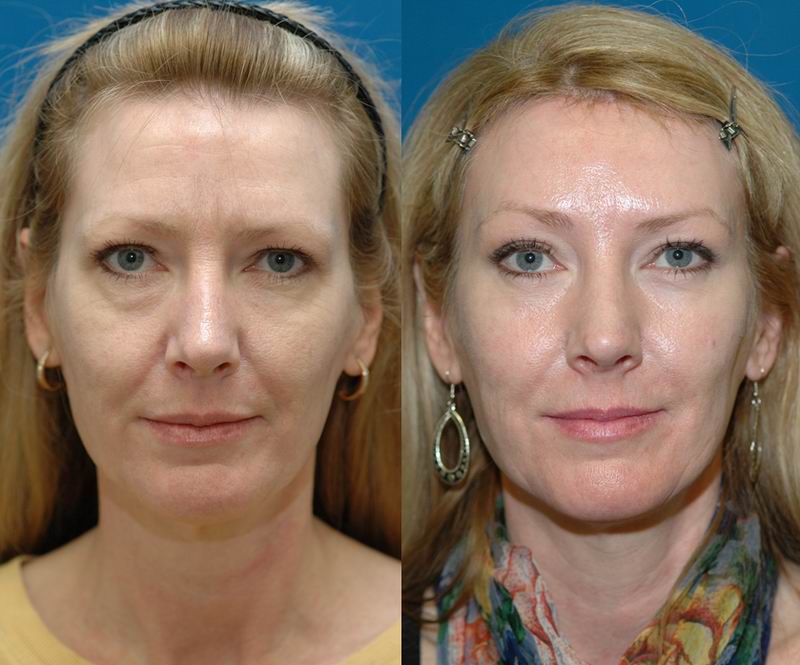
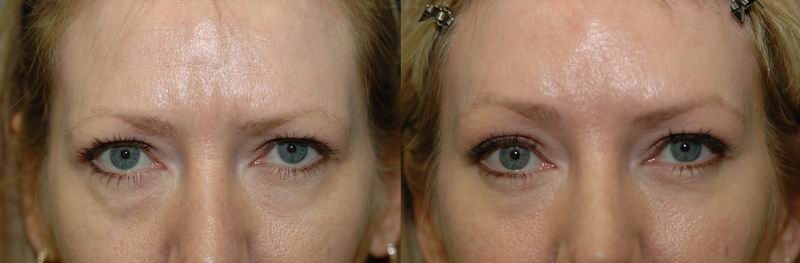
Brow lift (forehead lift) and fat grafting by Sam Naficy, MD * Individual results may vary.
Brow lift and laser resurfacing
A brow lift repositions the forehead but does not change skin quality. Laser resurfacing treats the etched horizontal lines and fine wrinkling that remain after the brow is lifted, and the two are commonly performed in the same anesthetic.
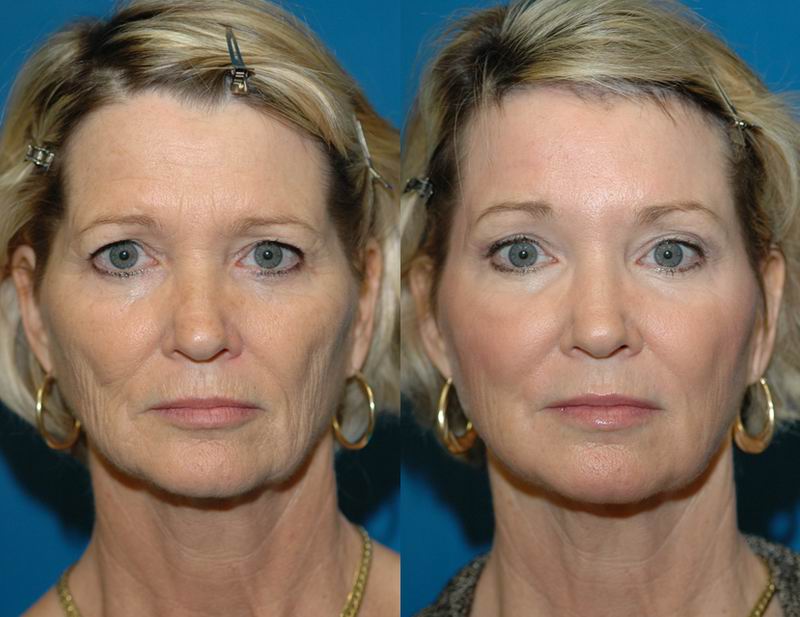
Brow lift (forehead lift), fat grafting, and laser resurfacing of the full face by Sam Naficy, MD * Individual results may vary.
Forehead reduction with a brow lift
Brow lift surgery can be performed in a way that also shortens a high forehead. The pretrichial technique places the incision along the front hairline, so trimming excess forehead skin both lifts the brow and brings the hairline forward. For a patient bothered by both a heavy brow and a long forehead, one operation addresses both.
The forehead can be shortened by roughly 1 to 2 centimetres in most patients, depending on scalp laxity. The incision is beveled so that hair grows through the healed scar, which is what makes it inconspicuous along the hairline.
Forehead shortening can also be performed without a brow lift where brow position is normal. Full detail: Forehead Reduction.
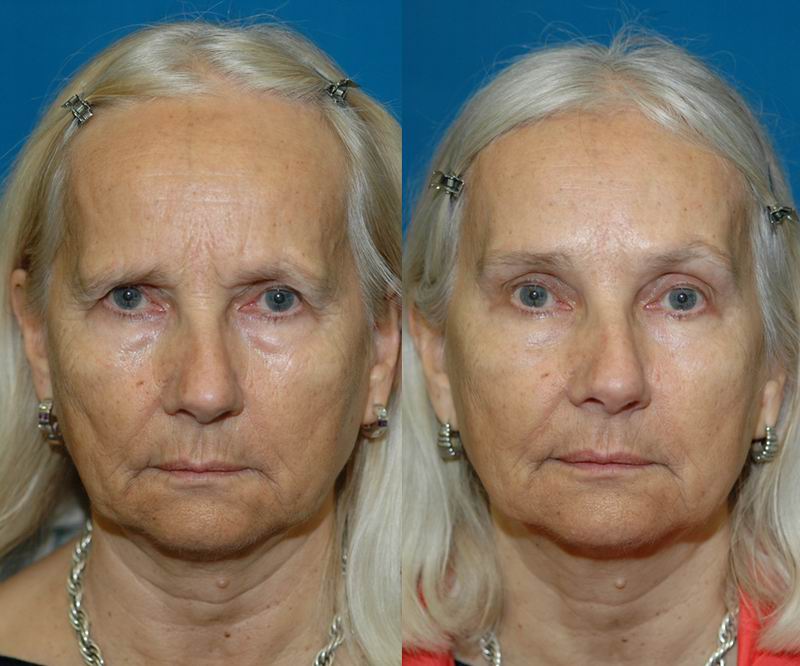
Brow lift (forehead lift) and forehead reduction by Sam Naficy, MD * Individual results may vary.
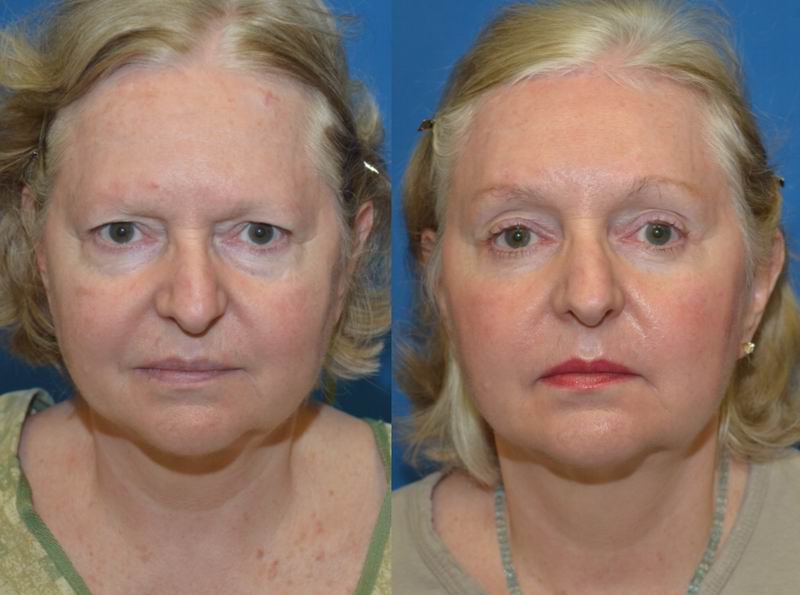
Brow lift (forehead lift) and forehead reduction by Sam Naficy, MD * Individual results may vary.
Brow lifts in men
Male brow lifts differ in both goal and technique. The male brow sits lower and flatter than the female brow, and over-elevating or arching it feminizes the face. The aim is to remove heaviness without changing brow shape.
The endoscopic brow lift is used most often in men, because it produces a subtle lift and places incisions behind the hairline. The mid-forehead lift is the second option, taking advantage of deep existing horizontal forehead creases to hide the incision — particularly useful in men with receding or thinning hair, where scalp incisions are harder to conceal.
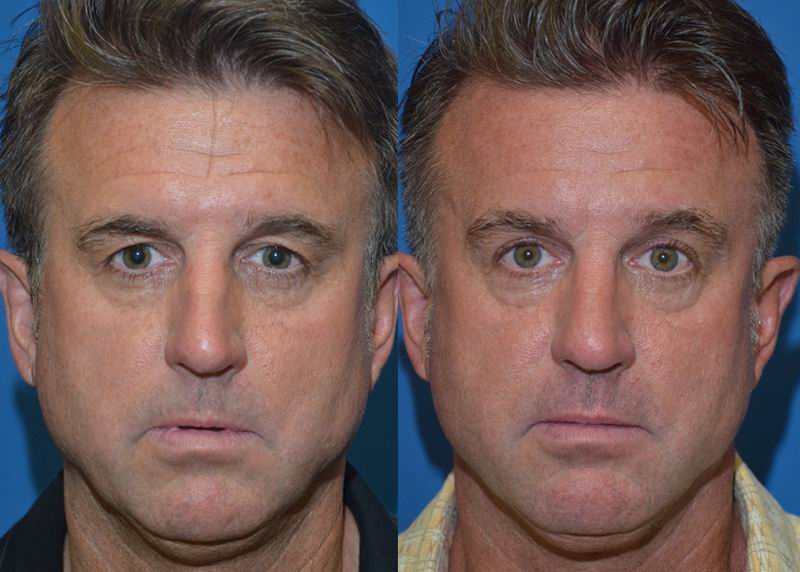
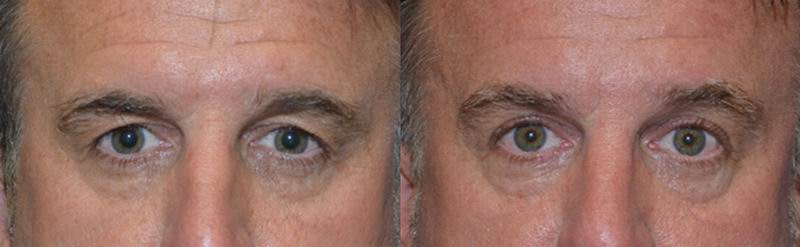
Endoscopic Brow lift (endoscopic forehead lift) and upper eyelid lift by Sam Naficy, MD * Individual results may vary.
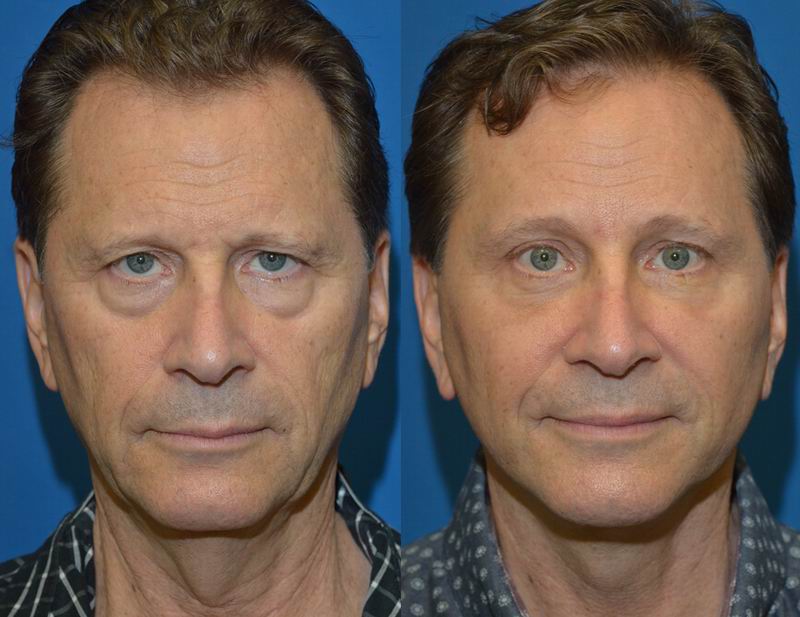
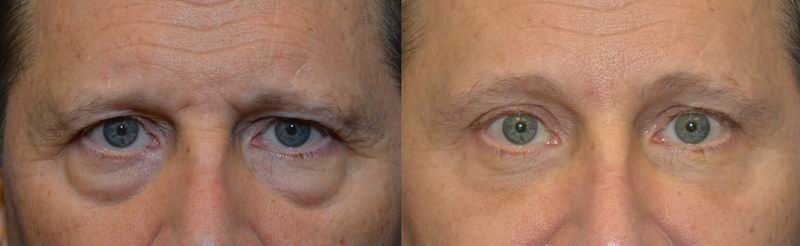
Endoscopic Brow lift (endoscopic forehead lift), upper and lower eyelid lift, and face/neck lift by Sam Naficy, MD * Individual results may vary.
Why choose a facial plastic surgeon for a brow lift?
The brow is unforgiving. Millimetres change expression, the outer third and the centre must be lifted by different amounts, and the technique has to be matched to a patient's hairline rather than to the surgeon's preference. Most of the poor brow lift results people fear come from applying one technique to every forehead.
Dr. Naficy performs 90 to 100 brow lifts each year. His practice has been devoted exclusively to facial plastic surgery since 2000. He is certified by the American Board of Facial Plastic and Reconstructive Surgery (ABFPRS), graduated first in his class from the University of Washington School of Medicine, and completed both his residency and fellowship at the University of Michigan. Dr. Naficy has been recognized in Seattle Magazine's Top Doctors list.
When choosing a surgeon, ask which technique they recommend for your hairline and why, what it will do to your forehead length, and ask to see before-and-after photographs of patients whose hairline resembles yours.
About Dr. Sam Naficy, MD, FACS
What type of anesthesia is used?
Brow lift surgery is performed under general anesthesia or IV sedation, administered by a dedicated anesthesia provider who will discuss which is appropriate for your health status and the planned procedure.
Surgery is performed in our on-site surgery center, which is Medicare-certified and Washington State–accredited. Our anesthesia team has more than 50 years of combined experience, and all providers also hold appointments at the University of Washington or other regional medical centers.
Anesthesia guidelines [21kb PDF] · Post-operative care instructions [17kb PDF]
Brow lift before and after photos
Representative before and after images of brow lift procedures performed by Dr. Sam Naficy. Some patients had more than one procedure performed; the caption accompanying each photograph describes the details.
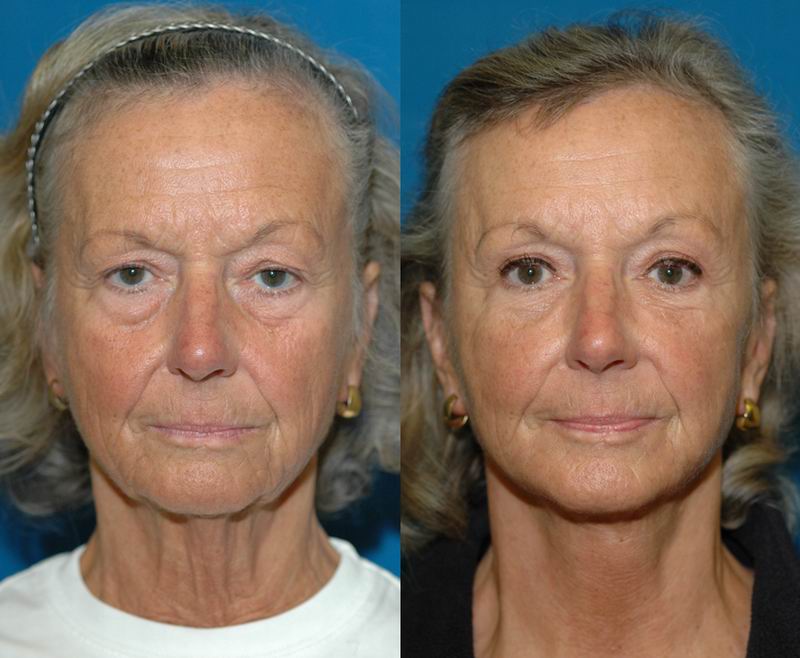
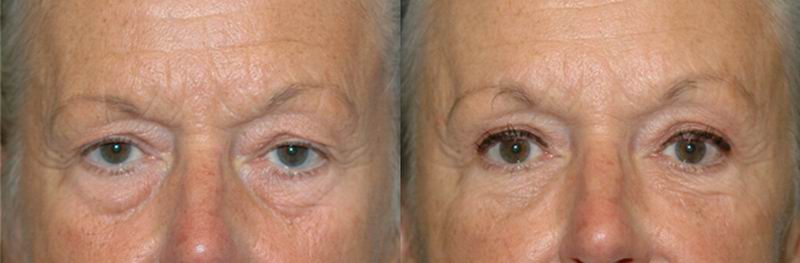
Brow lift (forehead lift), upper blepharoplasty, lower blepharoplasty, fat grafting, face & neck lift by Sam Naficy, MD * Individual results may vary.
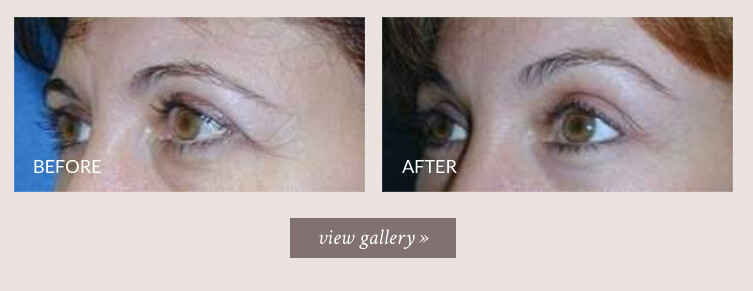
* Individual results may vary.
Frequently asked questions
Will a brow lift make me look surprised?
Not when the outer third of the brow is lifted more than the centre, which is where descent actually occurs. The surprised look comes from over-elevating the middle of the brow. Brows do sit high for the first few weeks and then settle.
Do I need a brow lift or an upper eyelid lift?
Lift the outer end of your brow gently with a fingertip in a mirror. If that removes the heaviness and opens the eye, brow position is contributing and eyelid surgery alone will under-correct. Often both are needed.
How long will my scalp be numb?
Numbness behind the incision is normal. Most patients regain sensation by 3 to 6 months; in some it takes up to a year.
Will my hairline move?
The hairline technique lowers it and shortens the forehead. Endoscopic and coronal techniques raise it slightly. Mid-forehead and direct lifts leave it unchanged. This is often the deciding factor.
Where will the scar be?
Along the front hairline for a pretrichial lift, beveled so hair grows through it; behind the hairline for endoscopic; in a forehead crease for mid-forehead; just above the brow for a direct lift.
How long does a brow lift last?
Generally 10 years or more. Aging continues from the new baseline, so you keep the benefit relative to not having had it.
Can Botox do the same thing?
Botox produces a small amount of lift by relaxing the muscles that pull the brow down, and it softens frown and forehead lines. It cannot reposition a genuinely descended brow or remove excess forehead skin. It is a reasonable first step for a mild case.
Can I have a brow lift with a facelift?
Yes, and it is common. A facelift addresses the lower face and neck and does nothing for the brow, so combining them treats the whole face in one anesthetic.
When can I wash my hair?
Usually within the first several days, as directed. Specific timing is covered in your post-operative instructions.
What does “board certified” actually mean for eyelid surgery?
Board certification tells you what a surgeon was trained and examined in. On its own, the phrase “board certified” does not say in which field. Certification exists across many specialties, and a certificate in another specialty is a genuine credential in that specialty. It is simply not the same thing as certification in a specialty that trains surgeons to operate on the eyelids. So the useful follow-up question is always: certified by which board, and in what?
Eyelid surgery is unusual in one respect. Three different specialty pathways legitimately lead to operating on the eyelid, and each publishes a free public tool that lets you verify a surgeon yourself in under a minute.
| Board | What it certifies | Verify a surgeon |
|---|---|---|
| American Board of Facial Plastic and Reconstructive Surgery (ABFPRS) | Facial plastic and reconstructive surgery specifically. Certification requires that the surgeon already hold certification from an American Board of Medical Specialties board in either otolaryngology–head and neck surgery or plastic surgery, pass a two-day examination, and submit for peer review operative reports from a minimum of 100 facial plastic surgery procedures. | ABFPRS Physician Finder |
| American Board of Plastic Surgery (ABPS) | Plastic surgery of the entire body, including the face and eyelids. ABPS is a member board of the American Board of Medical Specialties. | ABPS Verify Certification |
| American Board of Ophthalmology (ABOp) | Ophthalmology — the eye and its surrounding structures, including the eyelids, orbit and tear drainage system. ABOp is a member board of the American Board of Medical Specialties. Surgeons who subspecialise in eyelid and orbital surgery complete an additional oculoplastic (ophthalmic plastic and reconstructive surgery) fellowship after their ophthalmology residency. | ABOp Physician Search |
Why three pathways, and why it matters here
The eyelid sits at the boundary of three specialties, and the reason is anatomical rather than political. A cosmetic upper blepharoplasty, a ptosis repair that restores a drooping lid to its proper height, and reconstruction of the orbit or tear drainage system are different problems that happen to occupy the same few millimetres of tissue. Training that prepares a surgeon well for one does not automatically prepare them for another.
Two details are worth knowing. ABFPRS certification cannot be the only board a surgeon holds — it is granted on top of an existing ABMS certification in otolaryngology–head and neck surgery or plastic surgery, so an ABFPRS diplomate is double boarded by definition. And oculoplastic surgery is a fellowship, not a separate board; an oculoplastic surgeon is certified in ophthalmology and has completed dedicated subspecialty training in eyelid and orbital surgery on top of it. Asking which fellowship, and where, is a fair question.
What to ask, and how to check
- Which board certified you, and in what specialty? Not simply “are you board certified.”
- Is that board a member of the American Board of Medical Specialties? Boards exist with similar-sounding names that are not ABMS member boards.
- Did you complete a fellowship, and in what? For eyelid surgery this is often more informative than the board alone.
- Where do you hold hospital operating privileges, and for this procedure? Hospital privileges are granted by peer review against training.
- How many of these do you perform each year? Certification is a floor, not a measure of current volume.
- Verify it yourself. All three boards above let you search by surgeon name. The ABFPRS states that its website is a primary source of verification.
The surgeons at this practice, and how to verify them
| Surgeon | Board certification | Training pathway |
|---|---|---|
| Sam Naficy, MD, FACS | American Board of Facial Plastic and Reconstructive Surgery American Board of Otolaryngology – Head and Neck Surgery |
Otolaryngology – head and neck surgery, followed by facial plastic surgery fellowship at the University of Michigan |
| Keith Hurvitz, MD, FACS | American Board of Plastic Surgery American Board of Otolaryngology – Head and Neck Surgery |
Otolaryngology – head and neck surgery residency at USC, followed by a general plastic surgery residency at UC Irvine |
| Bryan Sires, MD, PhD, FACS | American Board of Ophthalmology | Ophthalmology, followed by an Ophthalmic Plastic and Reconstructive Surgery fellowship at the University of Wisconsin–Madison. Director of the Oculoplastic Surgery Fellowship at the University of Washington. |
All three perform upper and lower blepharoplasty and brow lift here. Dr. Sires additionally handles functional and reconstructive oculoplastic work, including ptosis repair and orbital and lacrimal surgery. Each of these certifications can be confirmed through the verification links above, or with the certifying boards directly. We would encourage you to check ours, and to check the credentials of any other surgeon you consult.
I am interested. What do I do next?
If you are considering a brow lift, we encourage you to complete the Surgical Consultation Intake Form. Dr. Naficy will assess your brow position, hairline, and forehead length, recommend the technique that suits your anatomy, tell you whether you are a suitable candidate, and inform you of the potential risks.
Naficy Plastic Surgery & Rejuvenation Center — 1110 112th Ave. NE, Suite 150, Bellevue, WA 98004 · (425) 450-0880. Serving Bellevue, Seattle, Kirkland, Redmond, Medina, Mercer Island, and the greater Puget Sound region.
This page is for general education and does not constitute medical advice. Individual results vary. Written and medically reviewed by Sam Naficy, MD, FACS. Last reviewed August 2026.