Laser Resurfacing
Laser resurfacing removes damaged surface skin and heats the collagen beneath it, so the skin heals tighter, smoother, and more evenly pigmented. Depth is the variable that matters: deeper treatment gives more correction and more downtime, from about 5 days for non-ablative fractional treatment to 7 to 14 days for fully ablative CO2. Sam Naficy, MD, FACS performs 100 to 125 laser resurfacing procedures each year in Bellevue, Washington, both on their own and combined with facial surgery. Fees range from $3,000 for a single area to $6,000 for the full face.
What is laser resurfacing?
Laser resurfacing uses a controlled beam of light energy, absorbed by water in the skin, to remove the outer damaged layer and deliver heat to the dermis below. Two things then happen: the surface is replaced by new skin as it heals, and the heated collagen contracts and is remodelled over the following months.
That second effect is why results continue improving for three to six months after the skin has healed. The immediate change is the surface; the longer change is the collagen.
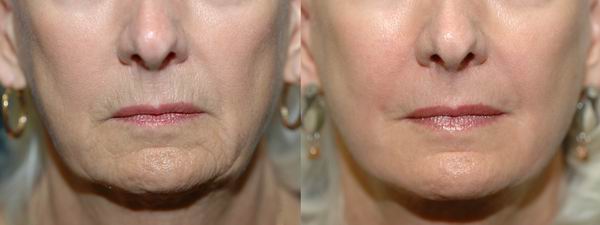
Before and After ablative CO2 Laser Resurfacing. * Individual results may vary.
Why does skin wrinkle with age?
Skin is largely water, collagen, and elastin. Collagen provides structure, elastin provides recoil. Both decline with age and are degraded far faster by ultraviolet exposure — which is why sun-exposed skin ages visibly sooner than skin that has been covered.
As collagen thins, the skin loses its scaffold. Fine lines appear, texture roughens, and pigment becomes patchy as damaged melanocytes distribute unevenly. Laser resurfacing works on this specific problem: the quality and surface of the skin. It does not lift tissue that has descended, and it does not replace volume that has been lost.
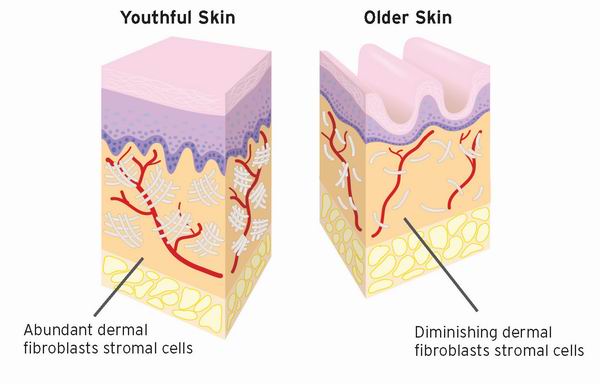
Older skin lacks the abundant healthy collagen of younger skin
What does laser resurfacing treat — and what does it not?
It treats well:
- Fine lines and wrinkles, particularly the vertical lines around the mouth and the fine lines beneath the eyes
- Sun damage and irregular pigmentation
- Rough or coarse skin texture
- Acne scarring, by stimulating a new layer of collagen
- Overall dullness and uneven tone
It does not treat:
- Descended tissue. Jowls, a heavy neck, and a fallen midface are position problems. A facelift addresses them; no laser does.
- Lost volume. Hollow temples and flat cheeks need fat grafting or filler.
- Deep static folds caused by underlying anatomy rather than skin quality.
- Excess eyelid skin. Laser tightens skin modestly; it does not remove it. That is eyelid surgery.
This distinction is the most common source of disappointment. Resurfacing improves the envelope. It does not reposition what is underneath it.
What is ablative vs. non-ablative laser resurfacing?
Ablative lasers vaporize the outer layer of skin. The surface is removed and must heal over, which is what produces both the greater correction and the longer downtime.
Non-ablative lasers pass through the surface without removing it, depositing heat in the dermis below. The skin surface stays intact, so recovery is shorter, but each session achieves less and more sessions are typically needed.
What is fractional laser resurfacing?
Fractional treatment does not treat the whole surface. It delivers the energy in a grid of narrow columns, leaving untreated skin between them. Those untreated bridges act as reservoirs of healthy tissue that speed the healing of the treated columns.
The trade-off is direct: fractional treatment heals considerably faster than fully ablative treatment, and achieves less per session. Either can be the right choice, depending on how much correction is needed and how much downtime is acceptable.
Which type of laser resurfacing is right for me?
Four approaches are used in this practice. They differ mainly in depth, and therefore in how much they correct and how long you are down.
| Approach | How it works | Downtime | Correction per session | Best suited to |
|---|---|---|---|---|
| Fully ablative CO2 | Vaporizes the entire surface layer; the deepest treatment available | 7–14 days | Greatest | Significant sun damage, deep perioral lines, marked textural change — where one decisive treatment is preferred over several |
| Fractional CO2 | Ablative, delivered in a grid of columns with untreated skin between | 6–8 days | Substantial | Most patients seeking meaningful correction with a shorter recovery |
| Erbium (Er:YAG) | Ablative, with less residual heat than CO2; depth is highly adjustable | 6 days to 2 weeks, depending on depth | Adjustable, from light to substantial | Patients where the depth needs to be tuned precisely, or where less thermal effect is preferred |
| Fraxel (non-ablative, fractional) | Heats the dermis without removing the surface | 5–6 days | Least per session; usually a series | Tone, texture, mild pigmentation, and acne scarring where downtime must be minimal |
There is no universally best laser. The decision comes from how much correction your skin needs, your skin type, and how many days you can be out of circulation. Deeper is not better — deeper is more correction and more recovery, and the right answer is the shallowest treatment that achieves your goal.
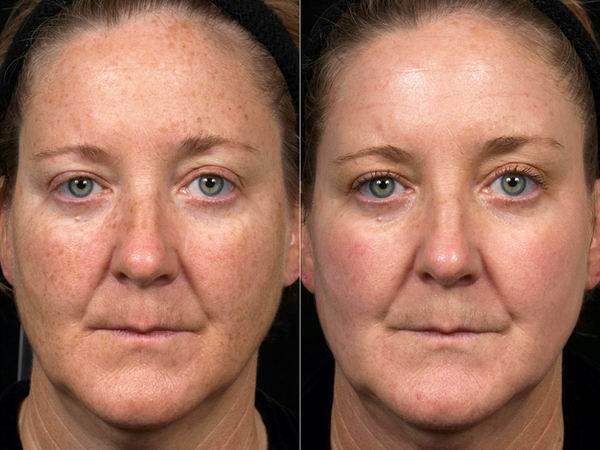
Before and After Fraxel Laser Treatment. * Individual results may vary.
Who is a good candidate for laser resurfacing?
- Fine lines, sun damage, uneven pigmentation, rough texture, or acne scarring
- Skin quality is the dominant concern, rather than descent or volume loss
- Realistic expectations, and willingness to accept the downtime the chosen depth requires
- No active infection in the treatment area, and no nicotine use
- Willingness to commit to sun protection afterward — new skin is vulnerable, and unprotected exposure undoes the result
Does laser resurfacing work on darker skin tones?
Skin type governs risk here more than any other factor, and it should be addressed directly rather than glossed over.
The risk in darker skin is post-inflammatory hyperpigmentation — the treated area healing darker than the surrounding skin. Melanocytes in more pigmented skin respond to the inflammation of laser injury by producing more pigment. This can be temporary, but it can also persist for months, and in some cases it is permanent.
- Fitzpatrick I–III (fair to medium): the most straightforward candidates, with the full range of options available.
- Fitzpatrick IV: treated with caution — shallower settings, conservative parameters, and pre-treatment where appropriate.
- Fitzpatrick V–VI: rarely treated in this practice. The pigmentation risk is high enough that alternatives are usually the better recommendation.
Recent tanning is a separate issue from baseline skin type. Actively tanned skin behaves like a darker type and should not be treated; the tan must be allowed to fade first.
Who is not a good candidate for laser resurfacing?
- Your concern is sagging rather than skin quality. Laser will not lift.
- Fitzpatrick V–VI skin, or a recent tan.
- Active acne or a skin infection in the treatment area.
- Isotretinoin use within the past six to twelve months, which impairs the skin's ability to heal.
- A history of keloid or hypertrophic scarring.
- You use nicotine in any form. Nicotine impairs healing of resurfaced skin.
- You cannot commit to sun avoidance during the healing period.
- You cannot accommodate the downtime that the depth you need requires. Choosing a shallower treatment for scheduling reasons and expecting a deep result is the most common route to disappointment.
How is laser resurfacing performed?
Treatment is performed in our on-site surgery center. The skin is cleansed and the eyes protected, and the laser is passed over the treatment area with settings selected for depth, skin type, and region — the eyelid skin, for instance, is treated more conservatively than the cheek.
Treatment time depends on the area: a single region such as the skin around the mouth takes considerably less time than a full face.
What type of anesthesia is used for laser resurfacing?
Anesthesia follows depth.
- Superficial and non-ablative treatment — topical and local anesthesia is generally sufficient.
- Moderate-depth treatment — IV sedation, administered by a dedicated anesthesia provider.
- Deep ablative treatment — general anesthesia.
- Combined with facial surgery — governed by the anesthesia for the larger operation.
Our surgery center is Medicare-certified and Washington State–accredited. Our anesthesia team has more than 50 years of combined experience, and all providers also hold appointments at the University of Washington or other regional medical centers.
Anesthesia guidelines [21kb PDF]
What is laser resurfacing recovery like?
Recovery follows a consistent sequence regardless of modality; only the duration changes.
| Stage | What happens |
|---|---|
| Days 1–3 | The skin is red, swollen, and weeping or crusting in proportion to the depth treated. Ointment and frequent gentle cleansing. This is the demanding part of the recovery. |
| Days 4–7 | Peeling and flaking as the new surface emerges. Swelling settles. For non-ablative and lighter treatments, this is close to the end. |
| Days 7–14 | New skin is present but bright pink. For fully ablative treatment, this is when the surface finishes replacing itself. |
| Weeks 2–8 | Pinkness fades gradually. Makeup can be worn once the surface is intact. The deeper the treatment, the longer the pinkness lasts. |
| Months 3–6 | Collagen remodelling continues and the result keeps improving after the visible healing is complete. |
By modality: fully ablative CO2, 7 to 14 days; fractional CO2, 6 to 8 days; Erbium, 6 days to 2 weeks depending on the depth of the peel; Fraxel, 5 to 6 days.
Sun protection is not optional afterward. Newly resurfaced skin has lost its accumulated protection and burns readily, and ultraviolet exposure during healing is the most reliable way to produce the pigmentation problem the treatment was meant to fix.
What procedures are combined with laser resurfacing?
Resurfacing is frequently performed at the same time as facial surgery, since surgery repositions tissue and laser treats the skin covering it — different problems, addressed in one recovery.
With facelift or neck lift: the lift repositions; the laser improves the surface. A lift on sun-damaged skin still leaves sun-damaged skin.
With eyelid surgery: surgery removes excess lid skin, laser treats the fine crepey lines that remain.
With fat grafting: volume beneath, surface above. A common pairing in this practice.
With lip lift: the lift raises the lip; resurfacing treats the vertical lines above it.
What are the risks of laser resurfacing?
Expected, and part of normal healing: redness, swelling, weeping or crusting, peeling, and prolonged pinkness in proportion to the depth treated.
Less common:
- Post-inflammatory hyperpigmentation — the treated area healing darker. The principal risk in Fitzpatrick IV and above, and the reason skin type governs the treatment plan.
- Hypopigmentation — the treated area healing lighter than the surrounding skin. More associated with deep fully ablative treatment, and it can be permanent.
- A visible line of demarcation where treated skin meets untreated skin, which is why treatment is planned to natural boundaries.
- Reactivation of herpes simplex (cold sores). Antiviral prophylaxis is used where indicated.
- Infection, bacterial or fungal, in skin that has lost its surface barrier.
- Prolonged redness beyond the expected period.
- Acne or milia during healing.
- Scarring — uncommon, and associated with treatment that is too deep for the site or with impaired healing.
- Ectropion — downward pull of the lower eyelid where the lid skin is treated aggressively in a patient with pre-existing laxity.
How much does laser resurfacing cost?
At Naficy Plastic Surgery, laser resurfacing ranges from $3,000 for a single area — the skin around the mouth, for example — to $6,000 for the full face. Where resurfacing is added to another operation, operating room and anesthesia costs are shared with the primary procedure.
Fees are itemized in writing at consultation. Financing is available through PatientFi. Laser resurfacing performed for cosmetic reasons is not covered by insurance.
Fees & payment policies · Financing
Why choose a facial plastic surgeon for laser resurfacing?
The laser is a tool; the settings are the procedure. Depth, density, and the number of passes are chosen for each region of the face and each skin type, and the difference between an excellent result and a pigmentation problem is a matter of judgement made before the first pass.
The second reason is diagnostic. Many patients seeking resurfacing actually need repositioning or volume, and a practice that only offers lasers will only recommend lasers.
Dr. Naficy performs 100 to 125 laser resurfacing procedures each year, both as standalone treatments and combined with facial surgery. His practice has been devoted exclusively to facial plastic surgery since 2000. He is certified by the American Board of Facial Plastic and Reconstructive Surgery (ABFPRS), graduated first in his class from the University of Washington School of Medicine, and completed both his residency and fellowship at the University of Michigan. He has been on the clinical faculty of the University of Washington since 1999 and has been recognized in Seattle Magazine's Top Doctors list.
About Dr. Sam Naficy, MD, FACS
Laser resurfacing before and after photos
Before and after photographs of laser resurfacing performed by Dr. Sam Naficy. Some patients had additional procedures; the caption accompanying each photograph describes what was done.
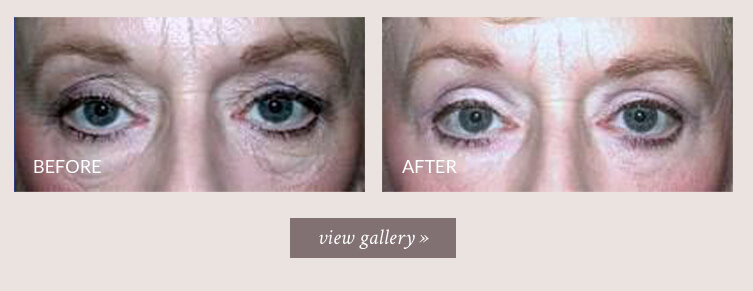
* Individual results may vary.
Frequently asked questions about laser resurfacing
How long does laser resurfacing take to heal?
Between 5 and 14 days, according to depth: Fraxel 5 to 6 days, fractional CO2 6 to 8 days, Erbium 6 days to 2 weeks depending on the depth of the peel, and fully ablative CO2 7 to 14 days. Pinkness continues fading for several weeks after the surface has healed.
Is laser resurfacing painful?
Not during treatment, because anesthesia is matched to depth — topical and local for light treatment, IV sedation for moderate, general anesthesia for deep ablative work. Afterward the skin feels like a bad sunburn for the first few days.
How long do laser resurfacing results last?
The improvement in texture, pigmentation, and collagen is durable for years. It does not stop the ageing process, and continued sun exposure will undo it faster than anything else.
How many laser resurfacing sessions will I need?
Ablative treatment is generally a single decisive session. Non-ablative fractional treatment such as Fraxel is usually a series, since each session achieves less.
Does laser resurfacing tighten skin?
Modestly, through collagen contraction and remodelling. It does not substitute for a lift. If the concern is jowls or a heavy neck, resurfacing is the wrong procedure.
Can laser resurfacing treat acne scars?
Yes. Both ablative and fractional non-ablative treatment improve acne scarring by stimulating new collagen. Deeper or more numerous scars generally need deeper treatment or more sessions.
Can I have laser resurfacing on darker skin?
Fitzpatrick IV is treated with caution using conservative settings. Fitzpatrick V and VI are rarely treated here, because the risk of post-inflammatory hyperpigmentation is high enough that alternatives are usually the better recommendation. A recent tan is a reason to postpone regardless of baseline skin type.
How much does laser resurfacing cost in Seattle?
At our practice, $3,000 for a single area to $6,000 for the full face. Financing is available through PatientFi.
What is the difference between CO2 and Fraxel?
CO2 is ablative — it removes the surface layer, achieving more correction with 6 to 14 days of downtime depending on whether it is fractional or fully ablative. Fraxel is non-ablative and fractional — it heats the dermis without removing the surface, with 5 to 6 days of downtime and less correction per session.
What is the difference between CO2 and Erbium?
Both are ablative. Erbium deposits less residual heat in the surrounding tissue and its depth is more finely adjustable, which makes it useful where precise control matters. CO2 produces more thermal collagen contraction.
When can I wear makeup after laser resurfacing?
Once the skin surface is fully intact — generally after the peeling phase is complete. Makeup can then cover the residual pinkness.
Can laser resurfacing be combined with a facelift?
Yes, and it commonly is. A facelift repositions descended tissue; the laser treats the skin covering it. Performing them together consolidates the recovery.
Does insurance cover laser resurfacing?
Not when performed for cosmetic reasons.
What can I not do after laser resurfacing?
Unprotected sun exposure is the principal restriction, and it is the one that most affects the result. Also avoid picking at peeling skin, active-ingredient skincare until cleared, and strenuous exercise while the surface is healing.
Next steps
A consultation establishes two things: whether skin quality is actually your dominant concern, and if so, what depth of treatment your skin needs and can tolerate. Those two answers determine everything else, including how many days you should plan to be out of circulation.
Naficy Plastic Surgery & Rejuvenation Center is located in Bellevue, Washington, and serves patients from Seattle, the Eastside, and throughout the Pacific Northwest.
Request a consultation · Ask a question · Out of town patients
Medically reviewed by Sam Naficy, MD, FACS, board-certified by the American Board of Facial Plastic and Reconstructive Surgery.