Revision Rhinoplasty
Revision rhinoplasty corrects an unsatisfactory result from previous nasal surgery. It is a reconstruction problem rather than a reduction problem — most revision cases require adding cartilage back to a nose from which too much was removed. Sam Naficy, MD, FACS performs 50 to 75 revision rhinoplasty procedures each year in Bellevue, Washington, and co-authored the textbook chapters on cartilage grafts, bone grafts, and structural support in Principles of Nasal Reconstruction. Surgery takes 2 to 4 hours, and revision is generally undertaken no sooner than 12 months after the previous operation.
What is revision rhinoplasty?
Revision rhinoplasty — also called secondary rhinoplasty — is surgery to correct the result of an earlier rhinoplasty. Patients seek it for two distinct reasons, and the distinction matters because the operations differ.
The first operation did not go far enough. A partial hump remains, the nose is still too large, or the tip was left insufficiently refined. These are generally the more straightforward revisions.
The first operation created a new problem. Polybeak deformity, alar retraction, saddle deformity, pinched nostrils, a hanging columella, asymmetry, or obstructed breathing. These are harder, and they share a common cause: too much structure was removed and not enough was rebuilt.
This is why revision rhinoplasty is fundamentally different work from primary rhinoplasty. A primary rhinoplasty mostly reduces and reshapes existing anatomy. A revision usually has to replace anatomy that is gone, working through scar tissue, with a diminished supply of the patient's own cartilage. In revision rhinoplasty a very small change in the right location often makes a large difference.
How long should you wait before revision rhinoplasty?
Generally at least 12 months after the previous operation. There are two reasons, and both matter.
The first is that you cannot judge a rhinoplasty result before then. Swelling in the nasal tip resolves over 12 to 18 months, and longer in thick skin. A nose that looks bulbous at four months is frequently acceptable at fourteen. Operating early risks correcting a problem that would have resolved on its own.
The second is that tissue needs to recover. Immediately after surgery the nose is scarred, inflamed, and poorly vascularized. Operating through that tissue is technically harder and heals less predictably. At a year the scar has matured and softened.
There are exceptions — a displaced graft, an obvious mechanical problem, or significant airway obstruction may warrant earlier intervention. But for aesthetic concerns, waiting is not a delay tactic. It produces a better operation.
Who is a good candidate for revision rhinoplasty?
- At least 12 months have passed since your previous nasal surgery
- You can identify specifically what bothers you about the current result
- You are in good general health, with no uncontrolled medical conditions
- You understand that revision aims at meaningful improvement rather than perfection, and that a nose already operated on has limits a virgin nose does not
- You are prepared for the possibility that cartilage will need to be harvested from the ear or rib
Who is not a good candidate?
- You are still within the first year after surgery, absent a mechanical or functional problem.
- You cannot articulate what is wrong. Diffuse dissatisfaction with an objectively reasonable result does not respond well to further surgery.
- You have had multiple prior revisions with escalating dissatisfaction. This pattern warrants careful evaluation before any further operation is considered.
- You use nicotine in any form. Complete cessation is required for at least three weeks before and three weeks after surgery. This matters more in revision than in primary surgery, because scarred tissue has a compromised blood supply already.
- Uncontrolled hypertension, poorly controlled diabetes, or a bleeding disorder.
Problems corrected by revision rhinoplasty
The example below is a patient who developed a polybeak deformity after an earlier rhinoplasty performed years before. Her nose had a beak-like fullness in profile and a round, full tip. She underwent revision with a septal cartilage graft to restore contour.
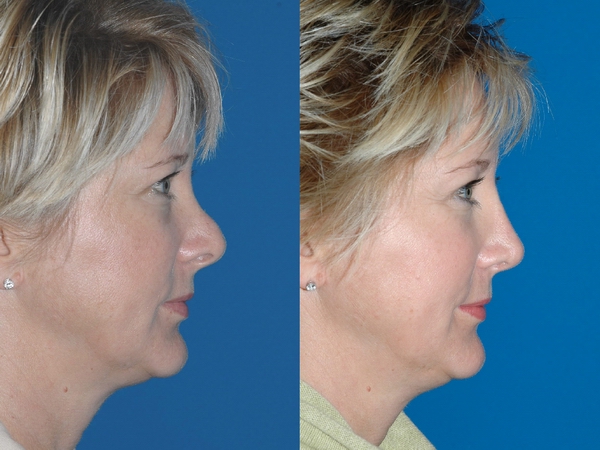
Revision rhinoplasty using septal cartilage graft by Seattle facial plastic surgeon Dr. Sam Naficy. * Individual results may vary.
Revision rhinoplasty for polybeak deformity
A polybeak deformity — also called polly beak, parrot beak, or supratip deformity — gives a parrot-like shape to the profile. There is hump-like fullness and heaviness just above the tip, and the upper bridge appears scooped. Polybeak noses can also have breathing problems.
It is typically the result of previous surgery in which too much of the bridge was removed. When the bridge is over-reduced, particularly in a patient with thicker skin, the excess skin sags and gathers over the tip. Inadequate tip support compounds the problem.
A polybeak deformity is treated by adding cartilage — not removing it — to rebuild and support the bridge and tip. Grafts typically come from the septum or rib. Rib provides more dramatic correction because of its strength and availability; septal cartilage is available in smaller quantities and is less structurally strong. The skin then contracts to accommodate the new framework, and the supratip fullness improves.
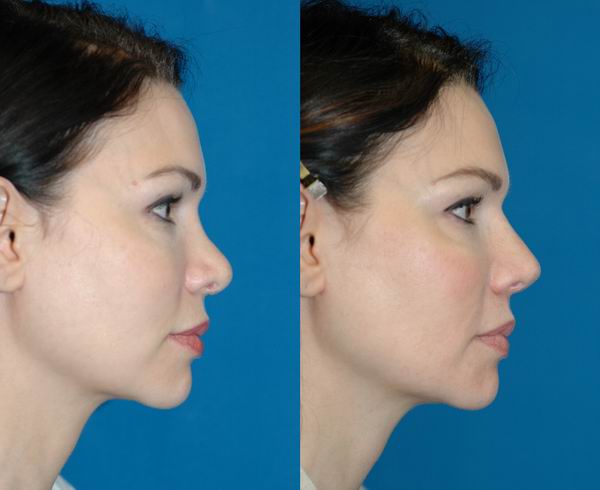
Revision rhinoplasty for polybeak deformity using rib cartilage graft by Seattle facial plastic surgeon Dr. Sam Naficy. * Individual results may vary.
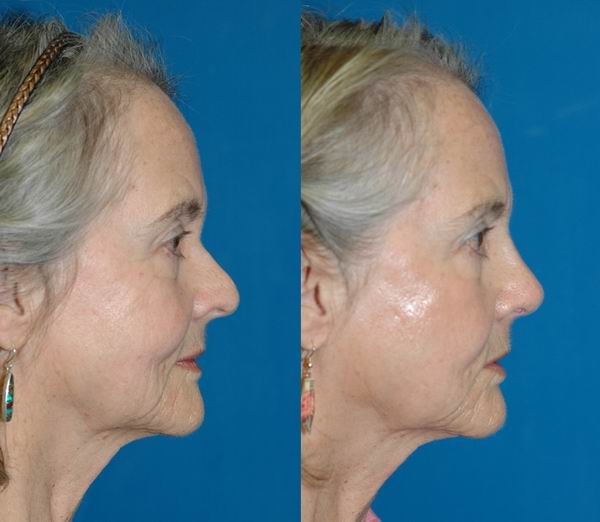
Revision rhinoplasty for polybeak deformity using rib cartilage graft by Seattle facial plastic surgeon Dr. Sam Naficy. * Individual results may vary.
Revision rhinoplasty for alar retraction
Alar retraction is present when the nostril rims are pulled upward due to inadequate support, exposing excessive nostril show. It typically results from removal of too much cartilage, or failure to add support to the nostril rims during the original rhinoplasty.
Correction almost always requires cartilage grafting to rebuild support along the nostril margins. The graft may come from the septum, the ear, or the rib depending on how much is needed and what remains available.
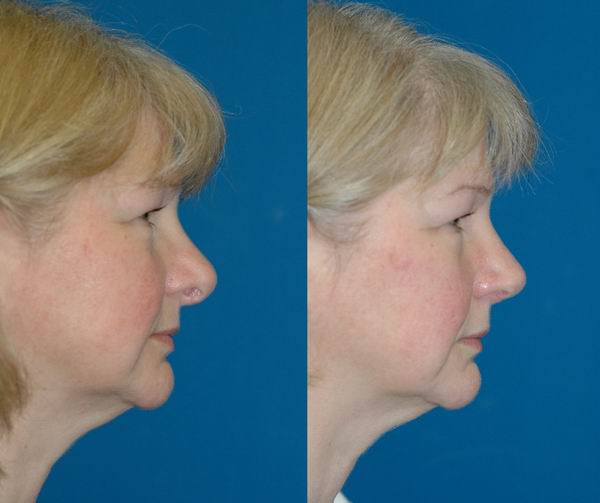
Revision rhinoplasty for alar retraction using septal cartilage and rib cartilage graft by Seattle facial plastic surgeon Dr. Sam Naficy. * Individual results may vary.
Revision rhinoplasty for a crooked nose
A crooked, asymmetric, or twisted nose is a common revision problem, and often appears more pronounced in photographs or when smiling. A crooked nose typically presents two different profiles — the right and left views do not match. The bridge, the tip, the nostrils, or all three may be involved, and breathing problems frequently accompany the cosmetic ones.
Most crooked noses also have a deviated septum, and correcting the septum is essential. Think of the septum as the foundation the rest of the nose sits on: if the foundation is crooked, the nose usually is too. Some twisted noses result from removal of excessive cartilage during the original surgery, leaving the nose unstable so that it leans and twists during healing.
Treatment begins with straightening the septum, followed by a combination of trimming, suture contouring, and cartilage grafting to reshape the tip and bridge. Where the nasal bones are also crooked, osteotomies — controlled repositioning of the nasal bones — are required. Complete symmetry is not achievable in any face; substantial improvement is.
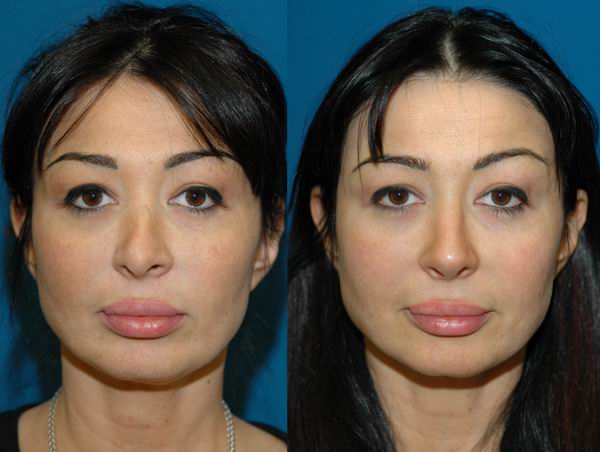
Revision rhinoplasty for crooked nose by Seattle facial plastic surgeon Dr. Sam Naficy. * Individual results may vary.
Revision rhinoplasty for saddle deformity
A saddle-nose deformity occurs when the cartilage supporting the middle of the bridge — the area known as the middle vault — is inadequate, causing the mid-bridge to collapse or settle. It results from over-aggressive reduction of the bridge combined with failure to support the middle vault during the original surgery. It can also follow injury or fracture, particularly where the septum was damaged.
Correction almost always requires cartilage grafting to rebuild the bridge, typically using septal or rib cartilage. Saddle deformities are among the revision problems where rib cartilage is most often necessary, because the volume and structural strength required exceed what the septum can supply.
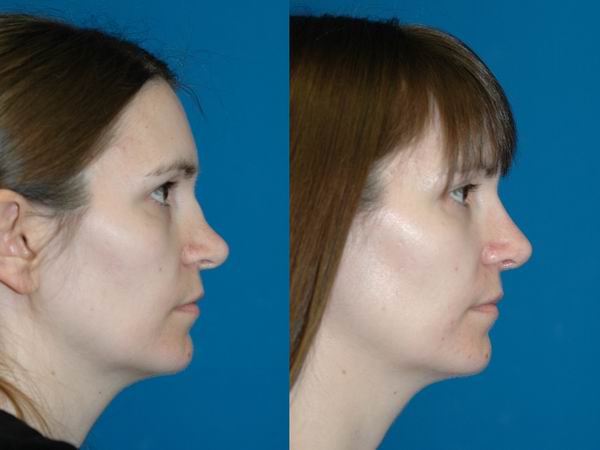
Revision rhinoplasty for saddle deformity of nose using rib cartilage by Seattle facial plastic surgeon Dr. Sam Naficy. * Individual results may vary.
Revision rhinoplasty for a hanging columella
A hanging columella is present when the central strip of tissue between the nostrils droops excessively, producing too much nostril show on profile. It is sometimes seen together with alar retraction, and the combination makes the nostril opening appear unusually large.
Correction requires cartilage grafting from the septum or rib to support and straighten the columella.
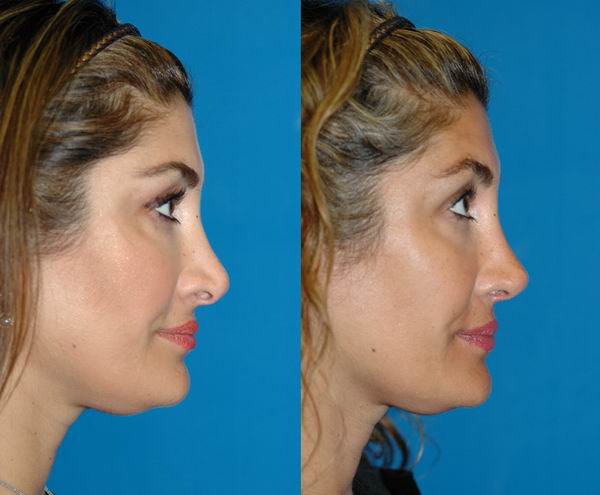
Revision rhinoplasty for hanging columella using septal cartilage by Seattle facial plastic surgeon Dr. Sam Naficy. * Individual results may vary.
Revision rhinoplasty for pinched nostrils
Pinched nostrils appear as two deep vertical shadows on either side of the tip, giving the tip a pinched look and breaking the continuity between tip and nostrils. They are usually caused by excessive cartilage removal during the original rhinoplasty, leaving the weakened nostril walls to collapse.
Correction requires cartilage grafting from the septum, ear, or rib to rebuild support in the nostril walls.
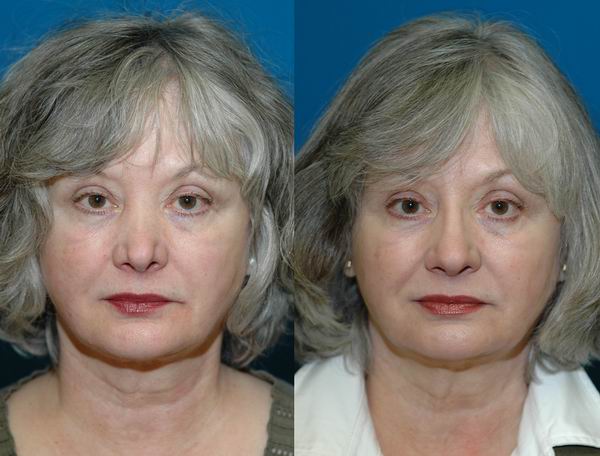
Revision rhinoplasty for pinched nostrils using rib cartilage by Seattle facial plastic surgeon Dr. Sam Naficy. * Individual results may vary.
Revision surgery for nasal valve collapse
Nasal valve collapse — also called nasal valve stenosis — is a structural problem of the side walls of the nose. When the valves are weakened, the side walls cave inward on deep inspiration, obstructing the airway.
The cause is inadequate structural support: either not enough cartilage in the side walls, or cartilage that is not shaped to hold the passage open. In revision cases this follows removal of too much cartilage during the original operation, which leaves the side walls unable to bear the weight of the overlying skin. Patients with thick skin are more prone to it, because heavier skin requires stronger cartilage support.
Some patients are anatomically predisposed. The most common predisposition is cephalic malposition of the alar cartilages — the cartilages that should be supporting the side walls sit in the wrong position and must be surgically repositioned to do their job.
Repair requires grafting cartilage to support the areas of weakness. Grafts usually come from the septum, though ear or rib may be used. Where nasal obstruction is documented, part of this work may be covered by insurance.
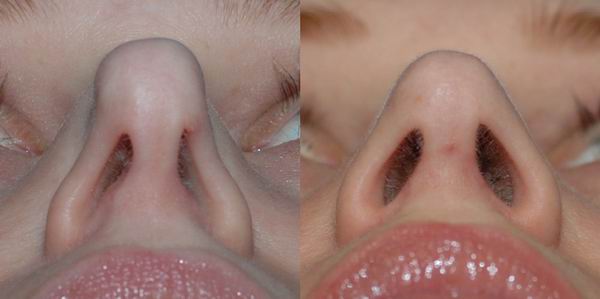
Revision surgery for nasal valve collapse using ear cartilage by Seattle facial plastic surgeon Dr. Sam Naficy. * Individual results may vary.
Rhinoplasty in patients with thick skin
Patients with thick, and sometimes oily, skin often get underwhelming results if the surgeon applies the techniques used for thin or average skin. Some feel their nose looks heavier after surgery than before.
The reason is that thick skin conceals the definition of the underlying cartilage — it drapes over contour rather than revealing it. Many thick-skinned patients also have weaker nasal cartilage, which compounds the problem. Improving the thick-skinned nose depends on three things:
- Keeping the structure of the nose strong rather than reducing it
- Adding cartilage grafts to create definition the skin can drape over
- Where appropriate, thinning the fatty tissue beneath the skin of the nose
Thick skin also takes longer to show its result. Where an average nose settles at 12 months, a thick-skinned nose may continue refining well beyond that.
Cartilage graft options in revision rhinoplasty
Most revision rhinoplasty involves rebuilding, supporting, or modifying nasal cartilage, and for that purpose cartilage is added to the nose. There are three sources of the patient's own cartilage and one source of donor cartilage.
| Graft source | Where it comes from | Character and quantity | Typically used for | Trade-offs |
|---|---|---|---|---|
| Septal cartilage | The nasal septum, from inside the nose | Straight, firm, easy to shape. Quantity is limited, and in revision cases much of it has often been taken at the first operation | The preferred first choice where enough remains — spreader grafts, columellar struts, tip grafts | No second surgical site and no additional scar. Frequently unavailable in revision patients, which is the usual reason another source is needed |
| Ear (conchal) cartilage | The bowl of the ear, through a small incision hidden behind it | Naturally curved and more flexible than septal cartilage. Modest quantity | Alar rim and alar batten grafts, and rebuilding the lower lateral cartilages, where a natural curve is an advantage | Adds a second site with a well-hidden incision. The shape of the ear is not changed and the ear does not fold or alter position. Not suited to grafts that must be perfectly straight |
| Rib (costal) cartilage | The lower rib cage, through a small chest incision | Strong and available in the largest quantity of any source | Major structural reconstruction — saddle nose deformity, a severely short nose, and cases needing substantial rebuilding of support | Chest soreness for the first days and a small chest scar. Rib cartilage can warp over time, which is managed by carving technique and graft selection |
| MTF donor cartilage | Processed human donor rib cartilage, supplied by a tissue bank | Strong, and available in quantity comparable to the patient's own rib | Cases needing substantial cartilage where the patient prefers to avoid a chest incision | Avoids a second surgical site entirely, with no chest soreness and no chest scar. Carries an added material cost, and is processed rather than living tissue |
Septal, ear, and rib grafts are the patient's own living tissue. MTF donor cartilage is processed human tissue that avoids a second surgical site entirely, at an added material cost.
A note on synthetic implants. Some surgeons may use synthetic implants for revision rhinoplasty. We do not consider implants optimal for the nose. Published research has shown higher infection rates with implants.
How is revision rhinoplasty performed?
Revision rhinoplasty takes 2 to 4 hours, depending on complexity and whether cartilage must be harvested from the ear or rib. It is performed under general anesthesia or IV sedation.
The open approach is used in most revision cases. Direct visualization matters more here than in primary surgery, because the surgeon is working through scar tissue, in anatomy that has already been altered, and placing grafts that must sit precisely to do their job.
- Exposure. The skin is elevated off the framework through a small columellar incision joined to incisions inside the nostrils.
- Assessment. What remains of the original framework is evaluated directly — frequently the single most important step, because what was done previously is often not what the patient was told.
- Scar release. Scar tissue is released so that structures can be repositioned.
- Graft harvest. Septal cartilage is taken where available; otherwise ear or rib.
- Reconstruction. Grafts are shaped and secured to rebuild support, restore contour, and correct deformity.
- Airway. Septal deviation and nasal valve collapse are corrected where present.
- Closure and splinting. An external splint is worn for 5 to 7 days. No packing is placed inside the nose.
What is revision rhinoplasty recovery like?
Most patients return to work at about one week, once the splint is removed. Where rib cartilage is harvested, chest soreness adds discomfort for a few weeks but does not usually delay return to work. Final results take longer to appear than after a primary rhinoplasty.
| Time after surgery | What to expect |
|---|---|
| Days 1–3 | External splint in place. Swelling and any bruising around the eyes peak around day 3. No packing, so you can breathe through your nose. If rib cartilage was harvested, the chest is sore. Rest with the head elevated. |
| Days 4–7 | Bruising fades. The splint and external sutures are removed between days 5 and 7. |
| Week 1–2 | Most patients return to work and social activity. Residual bruising is usually easy to cover. |
| Weeks 3–6 | Obvious swelling settles. Light exercise resumes with clearance. Chest soreness from rib harvest resolves. Glasses kept off the bridge or supported until cleared. |
| Months 2–6 | The nose looks normal to others. Grafted areas remain firm and continue to soften. |
| Months 6–24 | Final refinement. Revision results take longer to settle than primary results — scarred tissue holds swelling longer, and thick skin longer still. The result is assessed at 18 to 24 months. |
Patients travelling from out of the area remain locally for about one week. See Out of Town Patients.
What are the risks of revision rhinoplasty?
Revision rhinoplasty carries the risks of primary rhinoplasty, with several added by the fact that the nose has been operated on before.
More common, and usually temporary: swelling that persists longer than after primary surgery, bruising, nasal congestion during healing, numbness of the tip, and firmness at graft sites.
Less common:
- Graft warping or shifting. Rib cartilage in particular can curve over time, though technique reduces this. A graft that moves may need repositioning.
- Graft resorption. Some grafted cartilage is reabsorbed over time, which can partially reduce the correction.
- Compromised skin healing. Previously operated skin has a diminished blood supply, which raises the risk of healing problems — markedly so in smokers.
- Persistent asymmetry or irregularity. A nose that has been operated on has less predictable healing than one that has not.
- Donor site problems. Soreness, scar, and rarely contour change at the ear or chest.
- Infection — uncommon, and less common with the patient's own cartilage than with implants.
Realistic expectations matter more here than anywhere else in facial surgery. A nose that has been operated on once, or several times, has a finite amount of tissue and a compromised blood supply. The goal of revision is meaningful improvement, not a result indistinguishable from a nose that was never operated on. Some patients require more than one revision to reach a stable result, and that possibility should be discussed before surgery rather than after.
How much does revision rhinoplasty cost?
At Naficy Plastic Surgery, revision rhinoplasty ranges from $20,000 to $40,000. Revision is priced above primary rhinoplasty because the operations differ: longer operative time, cartilage harvest from a second site, grafting, and work through scarred tissue.
Cost depends on the complexity of the deformity, the graft source required, whether airway correction is included, and operative and anesthesia time. Fees are itemized in writing at consultation, covering surgeon, anesthesia, facility, and follow-up care. Financing is available through PatientFi.
Where nasal obstruction is documented, the functional portion of the surgery may be covered in part by insurance and is billed separately.
Fees & payment policies · Financing
Why choose a revision rhinoplasty specialist?
Revision rhinoplasty is a different discipline from primary rhinoplasty. Instead of reducing anatomy, the surgeon is rebuilding it — which requires grafting, structural support, and experience with what previous operations tend to destroy. Many excellent primary rhinoplasty surgeons do not take on complex revisions.
Dr. Naficy performs 50 to 75 revision rhinoplasty procedures each year, within a total rhinoplasty volume of 150 to 180 annually. For context, the American Society of Plastic Surgeons reports 48,423 rhinoplasty procedures of all kinds performed by its 9,000+ member surgeons in 2024 — an average of approximately five to six per surgeon per year.
His practice has been devoted exclusively to facial plastic surgery for 25 years. He is certified by the American Board of Facial Plastic and Reconstructive Surgery (ABFPRS), graduated first in his class from the University of Washington School of Medicine, and completed both his residency and fellowship at the University of Michigan. He has been recognized as a top doctor by Seattle Magazine. Patients travel nationally and internationally for revision surgery here.
Published work on nasal reconstruction and grafting:
- Co-author of seven chapters in Principles of Nasal Reconstruction (Springer, 2nd ed.) — including Structural Support, Cartilage Grafts, Bone Grafts, Refinement Techniques, and Complications and Management. View on Springer
- Naficy S, Baker SR. Lengthening the short nose. Arch Otolaryngol Head Neck Surg. 1998;124(7):809–13 — an algorithm for the five principal grafting techniques used to lengthen a nose shortened by previous surgery. PMID 9677119
Those chapter titles are the subject matter of revision rhinoplasty. Cartilage grafts, bone grafts, structural support, and the management of complications are precisely what a revision requires.
When choosing a revision surgeon, ask how many revisions they perform each year, what graft material they use and why, whether they are prepared to harvest rib cartilage if it is needed, and ask to see before-and-after photographs of revision patients — not primary patients.
About Dr. Sam Naficy, MD, FACS
What type of anesthesia is used?
Revision rhinoplasty is performed under general anesthesia or IV sedation, administered by a dedicated anesthesia provider who will discuss which is appropriate for your health status and the planned procedure. With either, heart rate, blood pressure, breathing, and oxygen levels are monitored continuously.
General anesthesia means you are completely asleep, with an intravenous line and a breathing tube. IV sedation, also called monitored anesthesia care, delivers sedation and pain medication through an IV while the surgeon places numbing medication in the surgical area. Where rib cartilage is being harvested, general anesthesia is typically used.
Surgery is performed in our on-site surgery center, which is Medicare-certified and Washington State–accredited. Our anesthesia team has more than 50 years of combined experience, and all providers also hold appointments at the University of Washington or other regional medical centers.
Anesthesia guidelines [21kb PDF] · Post-operative care instructions [18kb PDF]
Revision rhinoplasty before and after photos
Here you will find representative before and after images of revision and complex secondary rhinoplasty procedures performed by Dr. Sam Naficy. Click any thumbnail to enter the slide show. The text accompanying each photograph describes the details of the procedures performed.
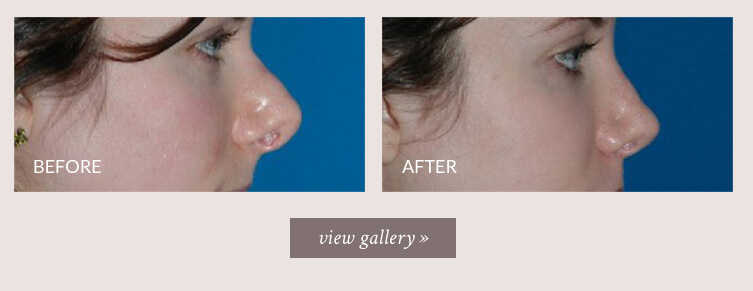
* Individual results may vary.
Frequently asked questions
How long should I wait before revision rhinoplasty?
Generally at least 12 months after your previous nasal surgery. Tip swelling takes 12 to 18 months to resolve, and scar tissue needs time to mature and soften. Exceptions exist for mechanical problems or significant airway obstruction.
Can my original surgeon do the revision?
Sometimes, and there is no obligation either way. What matters is revision experience specifically, and whether the surgeon is equipped to harvest and graft rib cartilage if that is what your nose needs. Many surgeons who perform excellent primary rhinoplasty do not routinely take on complex revisions.
Will I need rib cartilage?
Not always. Septal cartilage is the first choice where it remains available, and ear cartilage suffices for tip and rim grafts. Rib cartilage or MTF donor cartilage is required when large amounts of strong cartilage are needed — rebuilding a bridge, lengthening a shortened nose, or correcting a saddle deformity. This is assessed at consultation, though the final determination is sometimes made during surgery.
Where is the rib scar?
Just over an inch on the chest. In women it is placed in the inframammary fold, where it is concealed.
Is revision rhinoplasty more painful than the first operation?
The nose itself is comparable. Where rib cartilage is harvested, the chest is sore for a few weeks and is generally the more uncomfortable of the two sites.
How many revisions can a nose tolerate?
There is no fixed number, but each operation removes tissue, adds scar, and reduces blood supply. This is the reason not to operate too early or too often, and the reason to choose the surgeon for the next operation carefully rather than quickly.
Will insurance cover revision rhinoplasty?
The cosmetic portion is not covered. Where nasal obstruction is documented — from septal deviation or nasal valve collapse — the functional portion may be covered in part and is billed separately.
Can filler fix my previous rhinoplasty result?
Filler can camouflage a small contour irregularity or add height where the bridge was over-reduced, and is occasionally a reasonable alternative to surgery. It cannot correct structural problems such as alar retraction, valve collapse, or a twisted framework, and injecting filler into a previously operated nose carries a rare but serious risk of vascular occlusion.
How long until I know the final result?
Longer than after a primary rhinoplasty. Assess at 18 to 24 months; scarred tissue holds swelling longer, and thick skin longer still.
I am interested. What do I do next?
If you are considering revision rhinoplasty, we encourage you to complete the Surgical Consultation Intake Form. Bringing your operative report from the previous surgery, and photographs of your nose before that surgery, is genuinely useful — knowing what was done previously changes what is possible now.
Dr. Naficy will evaluate your nose, tell you whether you are a suitable candidate, discuss which graft material is likely to be needed, and inform you of the potential risks. You will also have a chance to view before and after albums of revision patients with problems similar to yours.
Naficy Plastic Surgery & Rejuvenation Center — 1110 112th Ave. NE, Suite 150, Bellevue, WA 98004 · (425) 450-0880. Serving Bellevue, Seattle, and the greater Puget Sound region, with patients travelling nationally and internationally.
This page is for general education and does not constitute medical advice. Individual results vary. Written and medically reviewed by Sam Naficy, MD, FACS. Last reviewed August 2026.
What does “board certified” actually mean in facial plastic surgery?
Board certification tells you what a surgeon was trained and examined in. On its own, the phrase “board certified” does not say in which field. Certification exists across many specialties, and a certificate in another specialty is a genuine credential in that specialty. It is simply not the same thing as certification in facial plastic surgery. So the useful follow-up question is always: certified by which board, and in what?
For facial plastic surgery there are two boards to look for, and both publish free public tools that let you verify a surgeon yourself in under a minute.
| Board | What it certifies | Verify a surgeon |
|---|---|---|
| American Board of Facial Plastic and Reconstructive Surgery (ABFPRS) | Facial plastic and reconstructive surgery specifically. Certification requires that the surgeon already hold certification from an American Board of Medical Specialties board in either otolaryngology–head and neck surgery or plastic surgery, pass a two-day examination, and submit for peer review operative reports from a minimum of 100 facial plastic surgery procedures. | ABFPRS Physician Finder |
| American Board of Plastic Surgery (ABPS) | Plastic surgery of the entire body, including the face. ABPS is a member board of the American Board of Medical Specialties. | ABPS Verify Certification |
Why the ABFPRS requirement matters
The detail worth understanding is that ABFPRS certification cannot be the only board a surgeon holds. It is granted on top of an existing ABMS certification in one of the two surgical specialties whose residency training covers facial plastic surgery. An ABFPRS diplomate is double boarded by definition. Those two qualifying pathways — otolaryngology–head and neck surgery, and plastic surgery — are both represented at this practice, and both of our facial surgeons hold certification from two boards rather than one. The 100-case peer review is also specific: the operative reports submitted must be facial plastic surgery, not surgery generally.
What to ask, and how to check
- Which board certified you, and in what specialty? Not simply “are you board certified.”
- Is that board a member of the American Board of Medical Specialties? Boards exist with similar-sounding names that are not ABMS member boards.
- Where do you hold hospital operating privileges, and for this procedure? Hospital privileges are granted by peer review against training.
- How many of these do you perform each year? Certification is a floor, not a measure of current volume.
- Verify it yourself. Both boards above let you search by surgeon name. The ABFPRS states that its website is a primary source of verification.
The surgeons at this practice, and how to verify them
| Surgeon | Board certification | Residency pathway |
|---|---|---|
| Sam Naficy, MD, FACS | American Board of Facial Plastic and Reconstructive Surgery American Board of Otolaryngology – Head and Neck Surgery |
Otolaryngology – head and neck surgery, followed by facial plastic surgery fellowship at the University of Michigan |
| Keith Hurvitz, MD, FACS | American Board of Plastic Surgery American Board of Otolaryngology – Head and Neck Surgery |
Otolaryngology – head and neck surgery residency at USC, followed by a general plastic surgery residency at UC Irvine |
Each of these certifications can be confirmed through the verification links above, or with the certifying boards directly. We would encourage you to check ours, and to check the credentials of any other surgeon you consult.