Voluma & Volux
Juvéderm Voluma XC and Volux XC are the two firmest fillers in the Juvéderm range, built for structure rather than fine lines. Voluma lifts the cheeks and midface; Volux defines the jawline. Both last up to 24 months, both are hyaluronic acid, and both can be dissolved. Naficy Rejuvenation Center in Bellevue, Washington has been ranked by Allergan, year after year, as the highest-volume single-location provider in Washington State. Fillers are $750 to $990 per syringe.
These two products are covered together because they do the same kind of work — rebuilding facial structure — in adjacent parts of the face, and are frequently used in the same treatment. For the full Juvéderm range see Juvéderm; to compare against other brands see the facial fillers overview.
Voluma vs. Volux — what is the difference?
| Juvéderm Voluma XC | Juvéderm Volux XC | |
|---|---|---|
| Designed for | Cheeks and midface | Jawline and jaw angle |
| What it does | Restores lift and projection to a flattened cheek | Defines and sharpens the jawline border |
| Firmness | Firm | The firmest in the range — built to resist the movement and muscle forces of the lower face |
| Duration | Up to 24 months | Up to 24 months |
| Also used for | Chin projection, temples | Chin projection, pre-jowl hollows |
| Technology | Both use Vycross cross-linking, which produces a smoother gel that holds shape and causes less swelling than older formulations | |
| Reversible | Yes — both dissolve with hyaluronidase | |
The simplest way to hold the distinction: Voluma rebuilds the upper structure, Volux rebuilds the lower border. They are frequently used together, because restoring the cheek without addressing a soft jawline can leave the face looking top-heavy.

Voluma naturally rejuvenates the face by replacing the volume that our face loses with age
What does Voluma treat?
The midface is usually the first area to lose volume, and it drives several complaints that patients describe differently:
- Flat or hollow cheeks, and loss of the natural high point of the cheek
- A tired appearance that persists regardless of sleep
- Shadowing under the eye — often caused by the cheek falling away beneath the lid rather than by the lid itself
- Deepening nasolabial folds, which soften when the support above them is restored
- Chin projection, where a modest change is wanted
Treating the cheek frequently improves the under-eye and the folds at the same time, which is why it is often the highest-value area to treat first.
What does Volux treat?
- A soft or undefined jawline lacking a crisp border between face and neck
- Loss of definition at the jaw angle, which widens and blurs with age
- Pre-jowl hollows — the dips just in front of the jowl that make the jawline look scalloped
- Chin projection and shape
An important limit: Volux defines a jawline; it does not lift one. If the problem is jowling and loose skin along the jaw, filler will add weight to tissue that has already descended. That needs a facelift or neck lift. And where the chin genuinely lacks skeletal projection, a chin implant is permanent and often better value than filler repeated every two years.
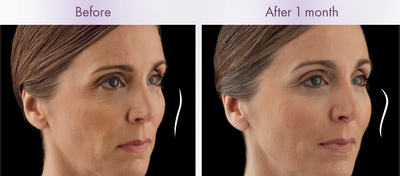
A total of 3.5 syringes of Voluma was injected into the cheek area. * Individual results may vary.
How much do Voluma and Volux cost?
Fillers at Naficy Rejuvenation Center are $750 to $990 per syringe. Voluma and Volux sit at the upper end of that range, since they are the longest-lasting products in the family.
How many syringes? Cheeks typically need two, one per side. A jawline commonly takes two or more, depending on how much definition is being built. Because these products last up to two years, the annualised cost compares favourably with shorter-lived fillers.
Non-surgical pricing · Current specials · Financing
How long do Voluma and Volux last?
Up to 24 months for both — the longest of any hyaluronic acid filler. Two reasons: the Vycross formulation is more resistant to breakdown, and both products are placed deep, often on bone, where there is less movement to degrade them.
Many patients top up at 12 to 18 months rather than waiting for the effect to disappear entirely, which usually requires less product than starting again.
Are Voluma and Volux safe?
Both are hyaluronic acid, a substance the body produces naturally, so allergic reaction is rare and no allergy testing is required. Both are FDA-approved — Voluma for midface volume, Volux for jawline definition.
The meaningful safety point is that both are reversible. If the result is not what you wanted, or if a complication occurs, hyaluronidase dissolves them within a day or two. That is not true of Radiesse, Sculptra or Bellafill.
Common and temporary: swelling, bruising, tenderness, and firmness in the first days.
Less common: asymmetry, palpable or visible product, migration, nodules, and infection.
Rare and serious: vascular occlusion, where filler enters or compresses a blood vessel. Both products are placed deep in areas with significant vasculature, which is why anatomical knowledge and injector experience matter more here than product choice, and why hyaluronidase is kept immediately available.
Does it hurt, and what is the recovery?
Both are XC products containing lidocaine, and topical numbing is used. Because they are placed deep, most patients find them more comfortable than lip treatment.
Expect swelling and possible bruising for a few days. Most patients are presentable the following day. Avoid strenuous exercise for 24 hours, sleep elevated, and use ice. Judge the settled result at two weeks.
Who is a good candidate?
- Flattened or hollow cheeks, or a soft, undefined jawline
- Volume loss and loss of structure, rather than fine lines or loose skin
- Someone who wants a visible result immediately, and values reversibility
- Patients who have lost facial volume through weight loss, including on GLP-1 medications
Not a good candidate if the issue is jowling and descent rather than volume, if you have significant skin laxity along the jaw, if what you need is skeletal projection best served by a chin implant, or if you are pregnant or breastfeeding.
What is combined with Voluma and Volux?
With each other — the most common pairing, rebuilding upper structure and lower border together.
With Botox: structure from filler, movement from Botox. Masseter Botox also narrows a wide lower face, which complements jawline definition.
With softer fillers: Volbella or Juvéderm Ultra for lips and fine lines once the structure is set.
With Sculptra: Sculptra rebuilds collagen globally over months; Voluma and Volux shape specific structures immediately.
Who injects Voluma and Volux here?
Five injectors, including Jill Kandora, PA-C, a National Speaker and Trainer for Allergan Aesthetics, the manufacturer of both products. The practice has been ranked by Allergan, year after year, as the highest-volume single-location provider in Washington State, and performs more than 10,000 filler treatments a year, with a board-certified plastic surgeon on site.
Voluma before and after photos
Before and after photographs of Voluma treatment at Naficy Rejuvenation Center. Individual results vary.
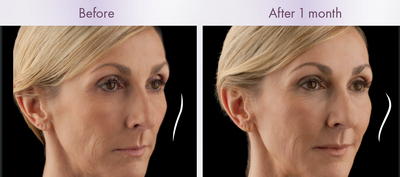
A total of 4.8 syringes of Voluma was injected into the cheek area. * Individual results may vary.
Frequently asked questions
What is the difference between Voluma and Volux?
Voluma is formulated for the cheeks and midface; Volux is firmer still and formulated for the jawline. Both are Juvéderm Vycross products lasting up to 24 months, and both are reversible.
How much does Voluma cost in Seattle?
At our practice, fillers are $750 to $990 per syringe, with Voluma and Volux at the upper end. Cheeks typically require two syringes.
How long does Voluma last?
Up to 24 months — the longest of the hyaluronic acid fillers, alongside Volux.
How many syringes of Voluma do I need for cheeks?
Usually two, one per side. More where volume loss is significant.
Can Voluma be dissolved?
Yes, with hyaluronidase, usually within a day or two. We offer dissolving including for filler placed elsewhere.
Does Voluma help under-eye hollows?
Often, indirectly. Restoring the cheek rebuilds the platform beneath the lower eyelid and reduces the shadow. Direct under-eye treatment uses a much softer product such as Volbella.
Is Volux better than a chin implant?
Different things. Volux shapes and defines using gel that lasts up to two years. A chin implant is permanent skeletal projection. For significant projection the implant is usually better value; for definition and contouring, Volux.
Will jawline filler fix my jowls?
No. Filler defines a jawline but does not lift descended tissue, and adding volume to a jowl makes it heavier. Jowling needs a facelift.
Is Voluma safe?
Yes, with an extensive safety record. It is FDA-approved, allergy is rare, and it is reversible. The serious risk is vascular occlusion, which is rare and technique-dependent.
Next steps
A consultation establishes whether your concern is volume, structure, or descent — because only the first two respond to these products. Where it is descent, we will tell you so rather than sell you filler that will not fix it.
Naficy Rejuvenation Center is located in Bellevue, Washington, and serves patients from Seattle, the Eastside, and throughout the Pacific Northwest.
Schedule an appointment · Ask a question · Compare all fillers
Medically reviewed by Sam Naficy, MD, FACS, board-certified by the American Board of Facial Plastic and Reconstructive Surgery.