Hair Restoration
Non-surgical hair restoration reactivates hair follicles that have become thin and miniaturized but are still alive. At Naficy Plastic Surgery and Rejuvenation Center in Bellevue we perform 200 to 250 hair restoration treatments a year, using platelet rich plasma (PRP) drawn from your own blood, combined with growth factors such as PDGF or ACell, and supported by prescription topical therapy. We do not perform hair transplants.
Hair loss is typically hereditary, which means that the genes whose role is to keep hair follicles going gradually shut down. The result is less hair, and shorter, finer hairs in the affected areas of the scalp.
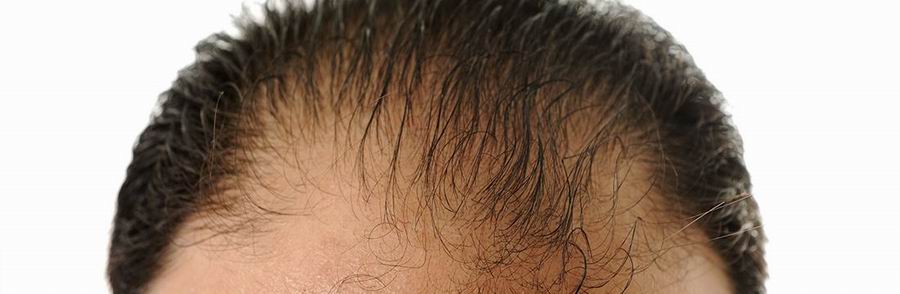
For decades, hair restoration options were limited to surgical hair transplants and medical therapy such as Rogaine and Propecia. Regenerative treatments using PRP and growth factors such as Ariessence (PDGF) or ACell (extracellular matrix) slow hair loss and increase hair growth by stimulating inactive hair follicle stem cells.
Which hair restoration options are available at our Bellevue office?
| Option | What it involves | Typical course | Fee |
|---|---|---|---|
| PRP or PRF with microneedling and PDGF Most common approach |
Blood draw, microneedling of the scalp, and injection of PRP or PRF with the Ariessence PDGF | Often a single treatment | $2,500 |
| PRP or PRF with microneedling and ACell | Blood draw, microneedling of the scalp, and injection of PRP or PRF with ACell extracellular matrix | Often a single treatment | $2,500 |
| Ariessence (PDGF) | Growth factor treatment, also used for skin rejuvenation | Varies | $900 |
| PRP or PRF alone | PRP injections, with or without microneedling | Typically a series of 6 | See fee schedule |
| Naficy Hair Serum Prescription topical |
Daily topical serum, used alone or alongside treatment | Ongoing daily use | $175 |
For hair restoration, PRP is typically combined with microneedling and PDGF for maximal benefit. Because the combination varies by patient, the total is confirmed at your consultation. Full pricing is published on our non-surgical fee schedule.
What are PRP and PRF?
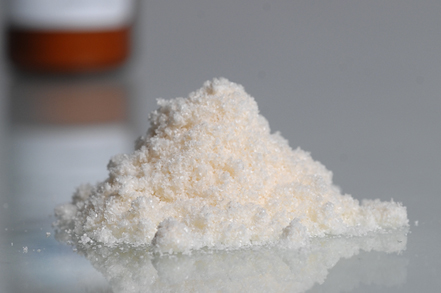
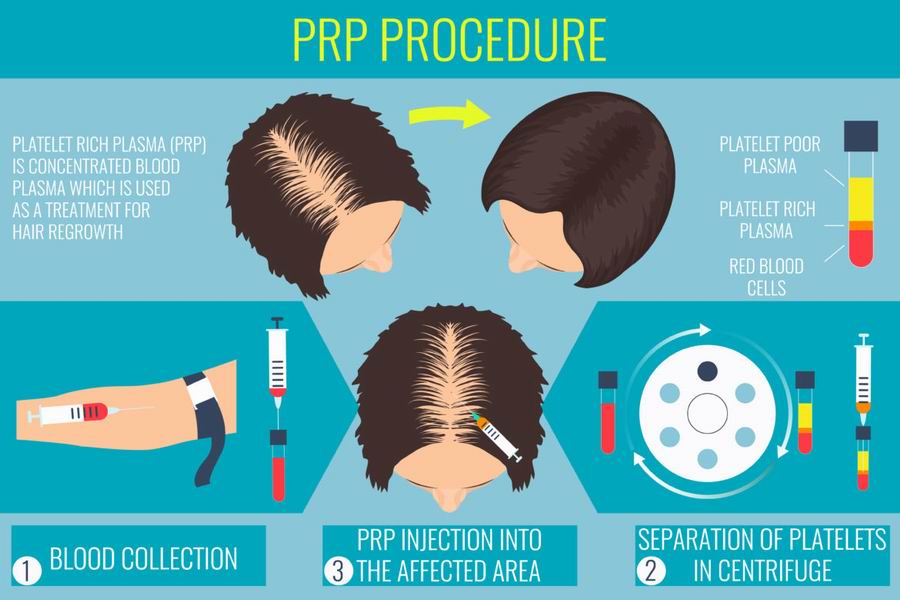
PRP stands for Platelet Rich Plasma, a concentration of platelets derived from your own blood. Platelets are a rich source of proteins called growth factors, which stimulate stem cell activity and tissue repair. Because PRP comes from your own body, there is no risk of allergic reaction or rejection. PRF stands for Platelet Rich Fibrin which is a more stable matrix and releases the growth more gradually over time.
Can PRP and PRF alone be used for hair restoration?
Yes, but it is not our usual recommendation. PRP or PRF injections alone, with or without microneedling, do stimulate hair growth, but the degree and duration of that stimulation is not nearly as great as when PRP and PRF are combined with PDGF or ACell extracellular matrix. Using PRP or PRF on its own typically requires a series of six injections, as opposed to a single PDGF or ACell treatment.
What are growth factors such as PDGF and ACell?
Growth factors are biological signals that stimulate cells to grow and regenerate. PDGF and ACell are powerful tools in hair restoration, and when injected into the scalp they activate dormant follicular stem cells for up to 18 to 24 months.
Both PDGF and ACell have a broad range of other medical and surgical applications, but neither is FDA approved specifically for the treatment of hair loss.
Why combine PRP/PRF with PDGF or ACell?
The combined regenerative effect of PRP/PRF with either PDGF or ACell is considerably greater than either component alone. The treatment starts with a small blood sample, from which the PRP is separated and concentrated. The scalp is numbed, and the PRP is combined with the growth factor and injected into the areas of thinning.
Recovery is quick, with no open wounds, sutures, staples, or dressings. A variable amount of scalp discomfort and swelling may be present for one to two days.
When will I see results?
New hair growth is seen as early as one month, but typically within four to six months, and the hair continues to thicken over a period of 12 to 18 months. Significant improvement can follow a single treatment, though a series may be recommended to maximize growth. Men usually see results within a few months, with full benefit at about a year to 18 months. Results often take longer to become visible in women, since longer hair can hide the newly regrown shorter hairs.
Who is a good candidate for PRP hair restoration?
PRP with PDGF or ACell restores hair quality and quantity in men and women with thinning hair, and can help prevent further shedding. It is also an option for patients who have had surgical hair restoration elsewhere and wish to increase density without more surgery, and for patients who want to maintain their hair without taking oral medication such as Propecia or Rogaine.
Who is not a candidate, and what should they do instead?
PRP and growth factors work on existing hair follicles that have become miniaturized but are still alive. They cannot bring back follicles that have died. Patients with advanced hair loss and a completely smooth scalp, with no fine hairs remaining, are unlikely to benefit.
Whether a particular patient will respond is not fully predictable, which is why we assess the scalp directly before recommending treatment.
We do not perform hair transplants at Naficy Plastic Surgery. A hair transplant moves follicles from an area of dense growth to an area where follicles are gone, and it remains the appropriate option for patients whose hair loss is advanced enough that no living follicles remain in the thinning area. If your consultation shows that a transplant is the better answer for you, we will tell you so rather than treat you with something that will not work.
How long do results last?
Longevity varies from patient to patient but has been shown to be in the range of years. The number of sessions can vary from one to several depending on the situation. Patients with more advanced thinning may benefit from additional treatments at 12 to 18 month intervals to build on the initial result.
What does hair restoration cost?
Hair restoration fees depend on the combination of treatments used and the size of the area being treated.
| Treatment | Fee |
|---|---|
| PRP/PRF with ACell or PDGF | $2,500 |
| PRP/PRF with Ariessence (PDGF) | $2,500 |
| Naficy Hair Serum | $175 |
| Naficy Hair Serum with Finasteride | $175 |
What about minoxidil?
Minoxidil is an effective topical treatment for hair loss in men and women, and works even better when combined with PRP/PRF and PDGF or ACell. Its exact mechanism is not fully understood, but it appears to open the blood vessels in the scalp to deliver more oxygen-rich blood to the follicles. Minoxidil also increases follicle size, producing thicker, stronger hairs, and shortens the resting (telogen) phase so hair spends more time in the growth (anagen) phase. Minoxidil is included at 5%, its highest effective concentration, in both Naficy Hair Serums.
What about finasteride?
Finasteride treats male pattern baldness (androgenic alopecia). It slows hair loss and provides roughly 30% improvement after six months of treatment by reducing scalp and serum levels of DHT (dihydrotestosterone). Lowering scalp DHT helps maintain or increase existing hair.
Finasteride is not appropriate for women of child-bearing potential. Women past child-bearing years may be candidates for a finasteride-containing formula, and this is a decision made individually at consultation rather than by gender alone.
What about latanoprost?
Latanoprost is related to bimatoprost, the eyelash drug better known as Latisse. Like bimatoprost it produces thicker, longer, darker lashes, and it is also effective applied topically on the scalp. After 24 weeks there are significant differences in hair density, along with increased hair pigmentation and thickness. Latanoprost is effective in both men and women and appears to work synergistically with minoxidil, which is why it is included in both Naficy Hair Serums.
What about biotin?
Biotin, a B vitamin, plays a role in the synthesis of keratin, the protein that makes up the hair strand. Biotin is effective as a topical agent, and is included in both Naficy Hair Serums.
What are the Naficy Hair Serums?
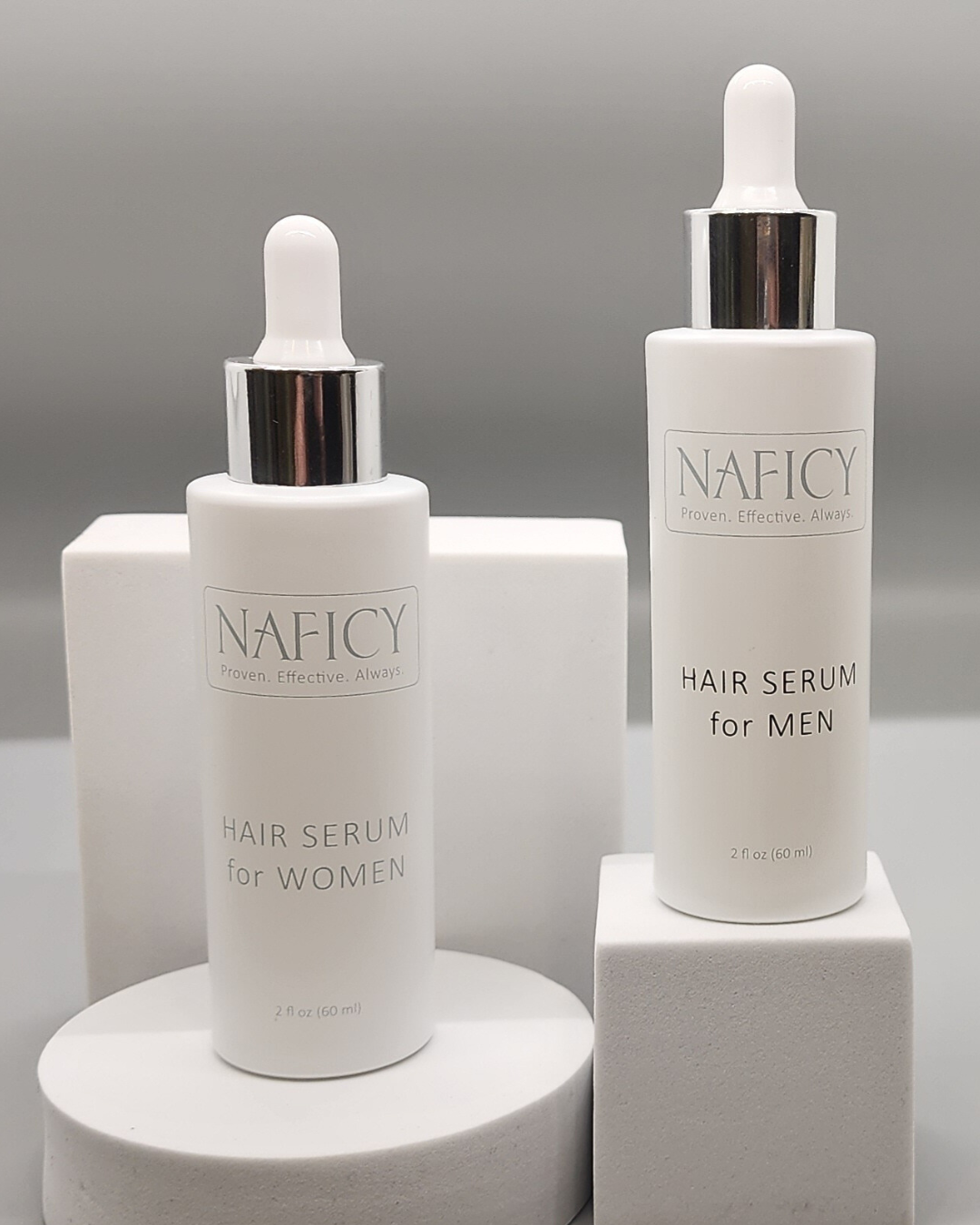
We formulate two prescription topical serums for daily use, each 2 fl oz (60 ml) and $175. They can be used on their own or alongside PRP treatment. Most patients notice an improvement in hair quality, with less shedding and thicker, darker hairs, within 12 weeks.
| Serum | Bottle label | Active ingredients | Price |
|---|---|---|---|
| Naficy Hair Serum | Hair Serum for Women | Minoxidil 5%, Latanoprost 0.005%, Biotin 0.2% | $175 |
| Naficy Hair Serum with Finasteride | Hair Serum for Men | Minoxidil 5%, Latanoprost 0.005%, Finasteride 0.1%, Biotin 0.2% | $175 |
Coat the affected areas of the scalp and rub in until absorbed, once daily. Both serums are available at our Bellevue office and through the Naficy online store.
Frequently asked questions about hair restoration
Are PRP and PRF safe?
PRP and PRF are prepared from your own blood, so there is no risk of allergic reaction or rejection. The blood draw and injection are performed in our Bellevue office.
Is there any downtime?
Very little. There are no open wounds, sutures, staples, or dressings. Some scalp discomfort and swelling may be present for one to two days.
Does hair restoration work for women?
Yes. PRP with growth factors treats thinning hair in both men and women. Results often take longer to become visible in women because longer hair can conceal newly regrown shorter hairs.
How many treatments will I need?
This varies from one to several depending on the degree of thinning and how your scalp responds. Patients with more advanced thinning may benefit from repeat treatment at 12 to 18 month intervals.
Do I have to keep using the serum?
The serums are designed for ongoing daily use. Hair loss is a progressive, hereditary process, so maintaining the result requires continued treatment.
Do you perform hair transplants?
No. We offer non-surgical hair restoration only. If your evaluation shows that a transplant is the better option, we will tell you.
Schedule a hair restoration consultation in Bellevue
Hair restoration begins with an evaluation of your scalp to determine whether living follicles remain in the thinning areas, since that is what determines whether these treatments can work for you. Schedule your visit or ask us a question.