Breast Augmentation
Breast augmentation uses a silicone gel or saline implant to increase breast size and improve breast shape. At Naficy Plastic Surgery & Rejuvenation Center in Bellevue, the procedure is performed by Keith Hurvitz, MD, FACS, a plastic surgeon certified by both the American Board of Plastic Surgery and the American Board of Otolaryngology who has practiced since 2007. Surgery takes about 1.5 hours under anesthesia in the practice’s on-site, Medicare-certified ambulatory surgery center. Most patients return to desk work within a week and to full exercise at about six to eight weeks. The fee is $10,000 to $15,000, which includes the implants, the operating room and anesthesia. Dr. Hurvitz uses only smooth Allergan Natrelle implants — he does not use the BIOCELL textured implants recalled in 2019 — and his capsular contracture rate is under 5%.
What is breast augmentation?
Breast augmentation, also called augmentation mammoplasty, is surgery that places an implant behind the breast tissue or behind the chest muscle to increase breast volume and change breast shape. It is one of the most commonly performed cosmetic operations in the United States, accounting for roughly 15% of cosmetic surgical procedures, with more than 300,000 performed annually.
Women choose augmentation for different reasons: breasts that never developed to the size they wanted, volume lost after pregnancy, breastfeeding or weight loss, or a noticeable difference in size between the two sides. Augmentation adds volume. It does not lift a breast that has descended, and it does not remove skin — a distinction that matters a great deal when deciding what operation you actually need.
What happens at a breast augmentation consultation?
You meet with Dr. Hurvitz and a patient care coordinator. The conversation starts with what you want the result to look like — some patients want a change no one else would identify, others want an obvious one — and how that fits your frame, your activity level and your clothing.
Dr. Hurvitz measures the width of your natural breast, the amount of breast tissue you have, the quality and elasticity of your skin, and the position of your nipple relative to the fold beneath the breast. Those measurements narrow the range of implants that will actually work on your body. You can then try on different sizes and shapes to see how they read on your frame before anything is decided.
Under U.S. Food and Drug Administration requirements in place since October 2021, breast implants may only be sold to providers who review a Patient Decision Checklist with the patient before surgery. You initial each section of that checklist and the implanting surgeon signs it. You will also receive a boxed warning about implant risks and a patient device card recording the make, model and serial number of your implants.
Silicone or saline — which breast implant is right for me?
Dr. Hurvitz uses Allergan Natrelle implants in two forms: smooth round Natrelle INSPIRA SoftTouch silicone gel implants, often called “gummy bear” implants for their cohesive gel, and smooth round Natrelle saline implants. Both shells are smooth. He does not use textured implants.
| Silicone gel (Natrelle INSPIRA SoftTouch) | Saline (Natrelle smooth round) | |
|---|---|---|
| Feel | Closer to natural breast tissue; the cohesive gel holds its shape | Firmer; feels more like a water balloon, particularly with little natural tissue over it |
| Visible rippling | Less common | More common, especially in thin patients or above-muscle placement |
| Minimum FDA-approved age for augmentation | 22 | 18 |
| If it ruptures | Often no symptoms at all — “silent rupture.” Requires imaging to detect | Obvious. The breast deflates over hours to days as saline is absorbed |
| Routine rupture screening | Recommended — ultrasound or MRI | Not needed; rupture is self-evident |
| Incision length | Longer — the implant is pre-filled | Shorter — filled after placement through a smaller opening |
| Adjustable at surgery | No | Fill volume can be adjusted within a range |
Most patients at this practice choose silicone gel, largely for feel and reduced rippling. Saline remains a reasonable choice for patients who prefer a saltwater fill, who want the smallest possible incision, or who are between 18 and 22 and not yet eligible for silicone.
How is implant size and profile chosen?
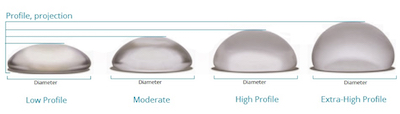
Implants of the same volume come in different profiles. A low-profile implant of a given volume is wider and projects less; a high-profile implant of the same volume is narrower and projects more. Profile is not a style preference in isolation — it is constrained by the width of your own breast. An implant significantly wider than your natural breast will sit into the armpit or cross toward the midline, and one significantly narrower will leave the outer breast unfilled.
Dr. Hurvitz starts from your measured breast width, then works with how much volume increase you want and the look you are after to arrive at a profile. Implant volume is measured in cubic centimeters, not cup sizes; cup size varies too much between manufacturers to be a useful surgical target.
Where is the incision placed?
| Incision | Location | Notes |
|---|---|---|
| Inframammary | In the crease where the breast meets the chest wall | The most commonly used approach. Gives direct access to the implant pocket, accommodates any implant size, and can be reused if you ever need revision surgery. The scar sits in the fold. |
| Periareolar | At the border between the areola and the surrounding skin | The scar blends into the color change at the areolar edge. The opening limits how large a pre-filled silicone implant can be passed through it. Associated with higher rates of capsular contracture and nipple/areolar distortion. |
| Transaxillary | In the armpit | Leaves no scar on the breast itself, but the scar is visible when the arm is raised, and it cannot be reused for later revision — a second incision would be needed. Dr. Hurvitz does not use this approach. |
All surgical scars are permanent. They typically appear pink and firm for the first several months, then soften and fade over a year to eighteen months. How a scar ultimately looks depends substantially on individual healing.
Should implants go above or below the muscle?
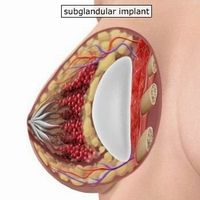
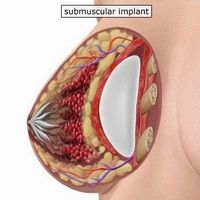
| Submuscular (partially below the pectoralis) — dual plane | Subglandular (above the muscle) | |
|---|---|---|
| Upper breast contour | Muscle adds coverage over the top of the implant, producing a more gradual slope | The implant edge is closer to the skin and can be more visible |
| Rippling | Less visible | More visible, particularly in thin patients and with saline |
| Mammogram imaging | Generally easier to image around | More breast tissue may be obscured |
| Animation | The implant can move visibly when the chest muscle contracts | No animation |
| Early recovery | More initial soreness — the muscle is released | Typically less muscle soreness |
Dr. Hurvitz recommends partial submuscular placement for most patients, primarily for the natural upper-pole contour and the reduced rippling. Animation — visible implant movement with chest muscle contraction — is the principal trade-off and is worth discussing directly if you lift heavily or compete athletically.
What does the FDA require you to be told before breast implant surgery?
In October 2021 the FDA imposed labeling requirements on all breast implants sold in the United States. Every implant now carries a boxed warning stating, among other things, that:
- “Breast implants are not considered lifetime devices. The longer people have them, the greater the chances are that they will develop complications, some of which will require more surgery.”
- Breast implants have been associated with breast implant-associated anaplastic large cell lymphoma (BIA-ALCL), a cancer of the immune system that occurs more commonly with textured implants than smooth ones, and from which some patients have died.
- Patients with breast implants have reported systemic symptoms including joint pain, muscle aches, confusion, chronic fatigue and autoimmune disease.
Manufacturer labeling further warns that if implants are later removed and not replaced, the breast may be left with dimpling, puckering, wrinkling or other permanent cosmetic changes, and that additional unplanned surgery over a lifetime with implants is likely rather than unlikely.
The FDA reaffirmed this guidance for patients in February 2025. None of it is a reason to avoid breast augmentation. It is the information you are entitled to have before deciding, and a surgeon who leaves it out is not doing you a favor.
What are the risks of breast augmentation?
Capsular contracture
The body forms a capsule of scar tissue around any implant. In some patients that capsule tightens, which can make the breast feel firm, change its shape, ride it upward, or become painful. It is graded Baker I through IV; grades III and IV are the ones that typically warrant surgery. There is no FDA-approved device or drug to prevent it.
Allergan’s own core study of primary augmentation patients reported Baker grade III or IV capsular contracture in 19% of patients through ten years. Dr. Hurvitz’s capsular contracture rate in his own practice is under 5%. These two figures are not measured the same way — the manufacturer study followed a defined cohort for a full ten years — and we publish both so you can see the range rather than only the more favorable number.
Rupture
A saline implant that ruptures deflates visibly within hours to days, and the saline is harmlessly absorbed. A silicone gel implant can rupture with no symptoms at all, which is why imaging is recommended. In Allergan’s ten-year core study, rupture was identified in 9.3% of patients in the MRI-screened group.
Reoperation
This is the risk most often left off practice websites. In Allergan’s core study, 36% of primary augmentation patients underwent reoperation within ten years — for capsular contracture, size change, implant malposition, rupture, or cosmetic revision. Plan for breast implants as a relationship with a device that will need attention over decades, not as a single operation.
Other risks
- Infection, which can require implant removal
- Bleeding or hematoma, which may require a return to the operating room
- Changes in nipple and breast sensation, which can be permanent
- Implant malposition, asymmetry, or visible rippling
- Difficulty with breastfeeding in some patients
- BIA-ALCL, a lymphoma associated primarily with textured implants
- Squamous cell carcinoma and other lymphomas arising in the capsule — rare, and the subject of an FDA safety communication in March 2023
- Anesthetic risk, and the general risks of any surgical procedure
How long do breast implants last, and how do I check for rupture?
There is no fixed expiration date, and the widely repeated claim that implants must be replaced every ten years is not accurate. What is accurate is the FDA’s position that implants are not lifetime devices and that complication risk accumulates with time.
For silicone gel implants, the FDA recommends that asymptomatic patients have a first ultrasound or MRI at 5 to 6 years after surgery, then repeat imaging every 2 to 3 years thereafter. Ultrasound is an acceptable alternative to MRI for screening. Dr. Hurvitz follows this schedule and recommends routine screening to all of his breast implant patients. Saline implants do not require screening, since rupture is self-evident.
What is breast implant illness, and how is it handled here?
Breast implant illness, or BII, is the term patients use for a cluster of systemic symptoms reported after implant surgery — fatigue, joint and muscle pain, brain fog, memory difficulty, rash, hair loss and others. The FDA acknowledges these reports directly and includes systemic symptoms in the required boxed warning.
What is not established is causation. BII is not currently a formal medical diagnosis, there is no blood test for it, and the research has not demonstrated a mechanism linking implants to these symptoms. Some patients report that symptoms improve after implant removal; others do not. Both outcomes occur.
Dr. Hurvitz sees patients for BII concerns regularly and routinely performs capsulectomy with implant removal or exchange. He does not treat these patients as though the symptoms were imagined, and he does not promise that surgery will resolve them. If you are considering explant, you should also know what the manufacturer labeling states plainly: removing implants without replacing them can leave permanent dimpling, puckering, wrinkling or loss of breast shape, and additional surgery is sometimes needed to address that.
If you have implants placed elsewhere and are experiencing symptoms, you do not need to have been Dr. Hurvitz’s patient to be seen.
What about the 2019 implant recall and BIA-ALCL?
Dr. Hurvitz does not use BIOCELL textured implants, the devices involved in the July 2019 recall. He uses smooth implants exclusively.
The voluntary worldwide recall of Allergan BIOCELL textured implants followed evidence linking them to breast implant-associated anaplastic large cell lymphoma. Points worth understanding:
- BIA-ALCL is a lymphoma — a cancer of the immune system — not breast cancer.
- It is associated far more strongly with textured implant surfaces than with smooth ones.
- The recalled devices represented a small share of implants used in the United States.
- Diagnosis typically occurs years after surgery, often around eight to nine years, and usually presents as delayed swelling or fluid around the implant.
- Treatment is usually removal of the implant and the surrounding capsule, and outcomes are generally good when it is caught early.
- The FDA does not recommend implant removal in patients without symptoms, including those who have textured implants.
If you have textured implants placed elsewhere and are concerned, a consultation to review your device records and examine you is reasonable — but the FDA position remains that asymptomatic patients do not need them removed.
What is recovery from breast augmentation like?
| Time after surgery | What to expect |
|---|---|
| Day of surgery | Home the same day. Chest tightness and soreness, most noticeable with submuscular placement. A responsible adult must drive you and stay with you overnight. |
| Days 1–3 | Peak soreness. Prescribed pain medication as needed. Short walks encouraged from the first day. Supportive bra worn continuously. |
| Days 4–7 | Discomfort noticeably decreasing; many patients transition off prescription pain medication. Light activity and stretching. Most return to non-strenuous desk work near the end of this week. |
| Weeks 2–3 | Swelling subsiding. Implants still sitting high — this is normal and not the final result. Walking encouraged. |
| Weeks 3–4 | Light cardio resumed. |
| Week 6 | Chest muscle strengthening and heavier lifting generally resumed after this point, on Dr. Hurvitz’s clearance. |
| Weeks 6–12 | Implants settle into position and the breast softens — commonly described as “drop and fluff.” Full unrestricted training at about six to eight weeks. |
| 6 months | Shape considered settled. Scars still maturing. |
| 12–18 months | Scars reach final appearance. |
| 5–6 years | First recommended rupture screening for silicone implants, then every 2–3 years. |
Who is a good candidate for breast augmentation?
- Physically healthy, at a stable weight, and not currently pregnant or breastfeeding
- At least 18 for saline implants, or 22 for silicone gel implants
- Bothered by breast size or by volume lost after pregnancy or weight change
- Enough skin and tissue quality, or a willingness to combine augmentation with a lift if not
- A non-smoker, or willing to stop well in advance of surgery and stay off nicotine through healing
- Understands that implants are not lifetime devices and that further surgery is likely at some point
- Wants this for their own reasons, with a specific and achievable result in mind
Who is not a good candidate?
This section matters as much as the one above, and some patients who ask about augmentation are better served by a different operation or by no operation.
- Anyone who wants implants alone to correct significant sagging. If the nipple has descended below the fold beneath the breast, an implant makes a larger sagging breast, not a lifted one. The right operation is a lift, sometimes with an implant.
- Active smokers unwilling to stop. Nicotine constricts the small vessels that supply healing tissue and materially raises the risk of wound breakdown and infection.
- Patients whose weight is still changing significantly, or who are planning pregnancy in the near future. Both will change the result.
- Anyone with an untreated breast lump, an abnormal mammogram or an unexplained finding. That gets worked up first, without exception.
- Patients who are not prepared for future surgery. If the prospect of a reoperation years from now is unacceptable to you, implants are the wrong device.
- Anyone seeking augmentation to satisfy someone else, or who is preoccupied with a perceived defect out of proportion to what is visible. Surgery does not address either situation.
- Patients wanting an implant far wider than their own chest. Anatomy sets an outer limit, and exceeding it produces implants that sit into the armpit, meet in the middle, or thin the tissue over them.
Where a different procedure would serve you better — a breast lift, fat grafting, or revision of existing implants — Dr. Hurvitz will tell you that at the consultation rather than after.
I have very little breast tissue. Can I still have implants?

Yes. Patients with minimal natural breast tissue are among the most common candidates for augmentation, and the results can be excellent. What changes is the margin for error. With little tissue covering the device, implant edges and rippling are more likely to show, which makes submuscular placement, silicone gel rather than saline, and a carefully matched implant width more important rather than less.


My breasts sag. Can a large implant substitute for a lift?

No. A large implant fills loose skin to a limited degree, and in mild cases that is enough. Beyond that, an implant placed into a breast that has genuinely descended produces a heavier breast that sags further and sooner, because the same skin envelope is now carrying more weight.
The measurement that matters is where the nipple sits relative to the inframammary fold. Above it, augmentation alone may be reasonable. At or below it, a lift is indicated — sometimes with an implant, sometimes without one.
Be cautious of any surgeon who tells you a big enough implant will fix real sagging. It is a common piece of bad advice, and the revision surgery that follows is more involved than doing the correct operation the first time.

How much does breast augmentation cost in Bellevue?
| Primary breast augmentation | $10,000 – $15,000 |
| Included in that fee | Implants, operating room / facility fee, anesthesia, and Dr. Hurvitz’s surgical fee |
| Billed separately | Pre-operative medical clearance or laboratory work ordered outside the practice, prescription medications, and any additional procedure performed at the same time, such as a breast lift |
| Insurance | Cosmetic breast augmentation is not covered by health insurance |
Where you fall in that range depends chiefly on implant type and whether anything is combined with the augmentation. You receive an exact written quote after your consultation, once the surgical plan is set. See fees and payment policies and financing options for details, and general pricing and purchasing terms.
Why choose Dr. Hurvitz for breast augmentation?
- Certified by two American boards. Keith Hurvitz, MD, FACS is certified by the American Board of Plastic Surgery and the American Board of Otolaryngology — Head and Neck Surgery, and is a Fellow of the American College of Surgeons.
- Practicing since 2007. He completed a plastic surgery residency at the University of California Irvine Medical Center after a residency in otolaryngology–head and neck surgery at LAC/USC Medical Center, and earned his medical degree from the University of Southern California with highest distinction.
- Volume. He has performed more than 1,000 breast augmentation and breast implant revision procedures over his career.
- A published complication rate. His capsular contracture rate is under 5%, against 19% at ten years in the manufacturer’s own core study.
- Smooth implants only. He does not use BIOCELL or other textured devices.
- He performs explant and capsulectomy, including for patients with breast implant illness concerns whose original surgery was done elsewhere.
Where is the surgery performed?
Breast augmentation is an outpatient procedure performed in the practice’s on-site ambulatory surgery center at 1110 112th Ave. NE in Bellevue. The facility is Medicare-certified and Washington State accredited, with two fully equipped operating rooms and a dedicated anesthesia team. You go home the same day.
Operating in an accredited facility attached to the practice, rather than renting time elsewhere, means the same nursing and anesthesia team works with Dr. Hurvitz on every case. Your anesthesia plan is reviewed with you before the day of surgery.
Breast augmentation before and after photos

Photographs show actual patients of the practice and are published with consent. Results vary from patient to patient; no result shown should be taken as what you will achieve.
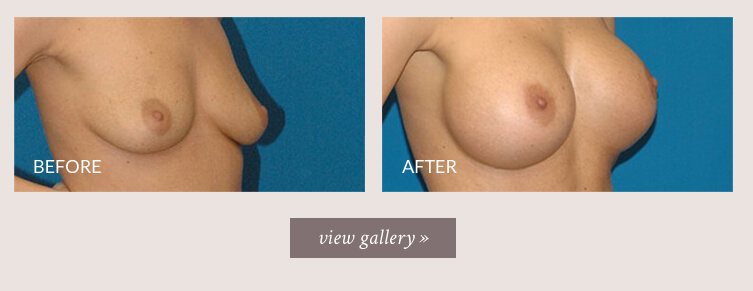
View the full breast augmentation photo gallery.
Breast augmentation FAQ
How long does breast augmentation surgery take?
About 1.5 hours for a primary augmentation. Add time if a lift or another procedure is performed at the same time.
How painful is breast augmentation?
Soreness peaks in the first two to three days and is usually described as tightness or pressure across the chest rather than sharp pain. Submuscular placement is more uncomfortable early because the muscle is released. Most patients are off prescription pain medication in a day or two after surgery.
When can I go back to work?
Most patients return to non-strenuous desk work about a week after surgery. Physically demanding work takes longer and should be discussed specifically.
When can I exercise or lift weights again?
Walking and light stretching within days. Cardio at three to four weeks. Chest strengthening and heavy lifting generally after six weeks, with clearance. Full unrestricted training around six to eight weeks.
When can I sleep on my stomach or side?
Sleep on your back initially. Most patients are cleared to sleep on their side at around two to four weeks and on their stomach once the implants have settled, typically after eight weeks.
Will I be able to breastfeed after breast implants?
Many women with implants breastfeed successfully. Breastfeeding difficulty is a recognized risk, and a periareolar incision carries somewhat more potential to affect milk ducts than an inframammary one. Tell Dr. Hurvitz at consultation if future breastfeeding matters to you — it can influence incision choice.
Do breast implants interfere with mammograms?
Implants can obscure some breast tissue on a standard mammogram. Tell the imaging center you have implants when you book, so additional displacement views can be taken. Submuscular placement generally allows more tissue to be imaged than subglandular.
How long do breast implants last?
There is no set lifespan, and they do not automatically need replacing at ten years. The FDA is explicit that implants are not lifetime devices and that complication risk rises the longer they are in place.
How will I know if a silicone implant has ruptured?
Often you will not — that is why it is called silent rupture. The FDA recommends ultrasound or MRI at 5 to 6 years after surgery, then every 2 to 3 years. A saline rupture is obvious because the breast deflates.
What is capsular contracture, and how likely is it?
Scar tissue around the implant tightening enough to firm up, distort or hurt the breast. The manufacturer’s ten-year core study reported it in 19% of primary augmentation patients at Baker grade III or IV. Dr. Hurvitz’s rate in his own practice is under 5%.
Can I have my implants removed later?
Yes, and Dr. Hurvitz performs explant with capsulectomy routinely. Be aware that removal without replacement can leave permanent changes to breast shape — dimpling, puckering or wrinkling — and some patients need an additional procedure such as a lift to address it.
Can I go larger later if I change my mind?
Yes, through an implant exchange, usually via the original inframammary incision. It is a second operation with its own cost and recovery, so it is worth taking the sizing conversation seriously the first time.
Will my implants look obviously fake?
That depends on implant volume relative to your frame, profile choice and placement, not on implants as such. An implant matched to your breast width and placed under the muscle reads very differently from one substantially wider than your chest.
What is the minimum age for breast implants?
The FDA has approved saline implants for breast augmentation in women 18 and older, and silicone gel implants in women 22 and older. Both are approved for breast reconstruction at any age.
Does insurance cover breast augmentation?
No. Cosmetic breast augmentation is not a covered benefit. Financing is available.
What happens to my results if I gain or lose weight, or get pregnant?
The implant does not change, but the breast tissue around it does. Significant weight change or pregnancy and breastfeeding can alter breast volume and skin quality, and some patients ultimately want a revision or a lift afterward. If you are planning a pregnancy soon, waiting is usually the better call.
I had my implants placed by another surgeon. Will Dr. Hurvitz see me?
Yes. A substantial portion of his breast practice is revision and explant work on implants placed elsewhere. Bring your implant device card or operative report if you have them.
Next steps
To discuss breast augmentation with Dr. Hurvitz, schedule a consultation at our Bellevue office, or complete the Surgical Consultation Intake Form in advance so your visit can focus on your plan rather than paperwork. If you have a question first, you can ask it here.
Naficy Plastic Surgery & Rejuvenation Center · 1110 112th Ave. NE, Suite 150, Bellevue, WA 98004 · (425) 450-0880
Medically reviewed by Keith Hurvitz, MD, FACS, board-certified plastic surgeon. Last reviewed August 2026.
Regulatory and outcome data cited on this page come from the U.S. Food and Drug Administration and from Allergan’s published core study of Natrelle silicone-filled breast implants. This page is for general education and is not a substitute for a consultation. Individual results vary.