Botox Treatment
Botox relaxes the specific muscles that fold the skin into dynamic wrinkles — frown lines, forehead lines, and crow's feet. Results appear over 3 to 7 days and last about 3 to 4 months. Naficy Rejuvenation Center in Bellevue, Washington has been ranked by Allergan, year after year, as the highest-volume single-location BOTOX Cosmetic provider in Washington State, and performs more than 10,000 neuromodulator treatments each year. Botox is $16 per unit, or $13.20 per unit through the Botox Bank. A typical treatment is 40 to 50 units.
Why volume and training matter with Botox
Botox is the most commonly performed cosmetic procedure in the world and the one with the widest variation in results, because the outcome depends almost entirely on the injector's understanding of facial anatomy: which muscle, how deep, how many units, and — most importantly — which muscles to leave alone.
Three things distinguish this practice, and each is verifiable rather than an adjective:
- Volume. Ranked by Allergan, year after year, as the highest-volume single-location BOTOX Cosmetic provider in Washington State. More than 10,000 neuromodulator treatments are performed here annually.
- National trainers on staff. Two of our five injectors train other injectors nationally. Jill Kandora, PA-C is a National Speaker and Trainer for Allergan Aesthetics, the manufacturer of Botox and Juvederm. Lorin Bates, RN, BSN is a GAIN trainer for Galderma, the manufacturer of Dysport, Restylane, and Sculptra.
- A board-certified plastic surgeon on site. Unlike medspas and skin clinics operating without an on-site physician, treatments here are performed within a surgical practice led by Sam Naficy, MD, FACS, board-certified by the American Board of Facial Plastic and Reconstructive Surgery.
What is Botox?
Botox is a purified protein that temporarily blocks the nerve signal telling a muscle to contract. Injected in very small quantities into a specific muscle, it relaxes that muscle, and the skin overlying it stops being folded.
It does not fill anything, and it does not add volume. That is a different category of product entirely — see facial fillers.
Which wrinkles does Botox treat?
There are two kinds of facial lines, and the distinction determines which treatment will work.
| Dynamic wrinkles | Static wrinkles | |
|---|---|---|
| What they are | Lines that appear when you make an expression | Lines visible when your face is at rest |
| Cause | Repeated muscle contraction folding the skin | Loss of collagen, volume, and skin elasticity over time |
| Treatment | Botox — relaxes the muscle doing the folding | Filler, laser resurfacing, or surgery |
Long-standing dynamic wrinkles gradually etch into static ones. Treated early enough, Botox prevents that transition; treated late, it softens the line but will not erase a crease already set into the skin. This is why the two are frequently combined.
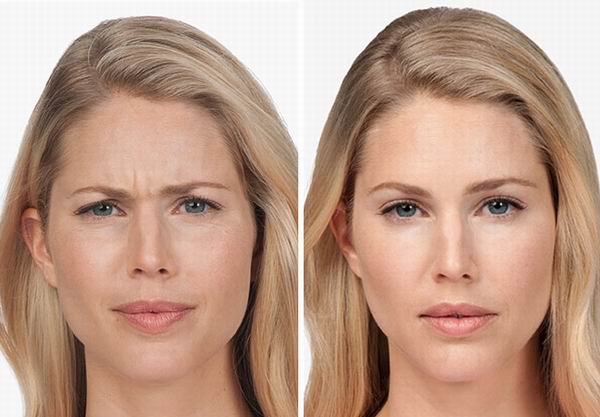
Before & After Botox injection. * Individual results may vary.
What areas can Botox treat?
- Frown lines (glabella) — the vertical "11s" between the eyebrows, and the most commonly requested area
- Forehead lines — the horizontal lines that appear on raising the brows
- Crow's feet — the lines fanning from the outer corners of the eyes
- Bunny lines — the lines across the bridge of the nose on scrunching
- Brow lift — selectively relaxing the muscles that pull the brow down, allowing it to sit higher
- Gummy smile — softening the muscle that raises the upper lip excessively
- Lip flip — relaxing the muscle around the mouth so the upper lip rolls slightly outward
- Chin dimpling — smoothing the pebbled or orange-peel texture of the chin
- Neck bands (platysmal bands) — softening the vertical cords of the neck
- Masseter — slimming a square jawline and treating clenching, described below
How much does Botox cost?
| Price | Notes | |
|---|---|---|
| Botox, per unit | $16 | Charged by the unit, so you pay for exactly what you receive |
| Botox Bank — 125 units | $1,650 | A $350 saving, bringing the cost to $13.20 per unit |
| Typical treatment | 40–50 units | Varies with age and muscle strength; see below |
A note on comparing prices. Practices quote Botox either per unit or per area, and per-area pricing conceals how much product you actually receive. A cheap "per area" price frequently means fewer units, which is why the result fades early. Per-unit pricing is directly comparable between practices; per-area pricing is not.
The Botox Bank is a prepaid block of 125 units drawn down across visits, which suits patients treating several areas or maintaining results year-round.
Non-surgical pricing · Financing
How many units of Botox will I need?
A typical treatment is 40 to 50 units, but the honest answer is that it depends on your age and the strength of your muscles. A patient in their late twenties with fine dynamic lines needs materially less than a patient in their fifties with strong, well-developed muscles and established creases. Men generally require more than women, because the muscles are larger.
Because we charge by the unit rather than by the area, there is no incentive to under-dose to hit a price point, and no reason to over-dose either. The dose is assessed at the appointment and adjusted at your two-week follow-up if needed.
Botox vs. Dysport — what is the difference?
We stock both. They are both botulinum toxin type A and work by the same mechanism; the practical differences are modest.
| Botox | Dysport | |
|---|---|---|
| Manufacturer | Allergan Aesthetics | Galderma |
| Onset | Typically 3–7 days | Often slightly faster, around 2–5 days |
| Spread | More localised to the injection point | Diffuses slightly more, which can suit broad areas such as the forehead |
| Units | Not interchangeable — Dysport units are not equivalent to Botox units, so unit prices cannot be compared directly between the two | |
| Duration | Broadly comparable, around 3 to 4 months for both | |
Most patients do well on either. Your injector will recommend based on the area being treated and how you have responded previously.
Will Botox make me look fake or frozen?
Not when it is dosed and placed correctly, and this is the single most common concern patients raise.
The frozen appearance comes from over-treating — too many units, or treating muscles that should have been left working. The forehead is the usual culprit: the muscle that raises the brow is the only one doing that job, so relaxing it completely produces a heavy, immobile brow.
The objective is a face that still moves and expresses, with the lines softened rather than erased. Under-correcting on the first visit and adding at the two-week follow-up is far safer than over-correcting, because Botox cannot be reversed — it has to wear off.
How long does Botox last?
About 3 to 4 months for most patients. It does not stop abruptly; muscle movement returns gradually, and the lines reappear as it does.
Duration varies with dose, the area treated, muscle strength, metabolism, and exercise level — very athletic patients often metabolise it somewhat faster. Patients who treat consistently over years frequently find they need less over time, as the muscles weaken with disuse.
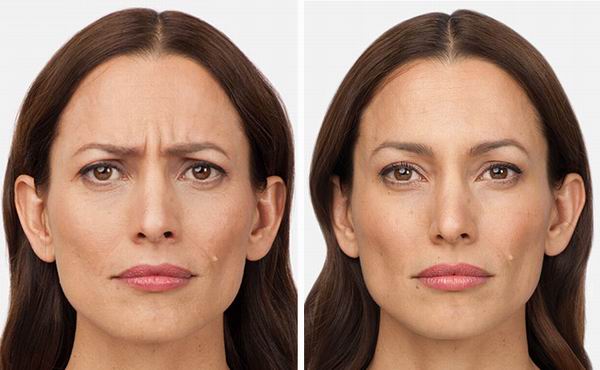
Before & After Botox injection for frown lines. * Individual results may vary.
Who is a good candidate for Botox?
- Dynamic wrinkles — lines that appear or deepen with expression
- Early lines you would rather prevent from etching in permanently
- A square jawline from masseter hypertrophy, or jaw clenching and grinding
- Excessive underarm sweating
- Chronic migraine
- Realistic expectations, and an understanding that Botox treats muscle movement rather than volume loss or skin quality
Who should not have Botox?
- Pregnancy or breastfeeding.
- Neuromuscular disorders such as myasthenia gravis, Lambert-Eaton syndrome, or ALS.
- Known allergy to botulinum toxin or to any component of the formulation.
- Active infection at the intended injection site.
- Your concern is volume loss or loose skin. Botox will not correct hollow cheeks, deep folds at rest, or descended tissue. Those need filler, fat grafting, or surgery.
- Certain medications, including some antibiotics, can potentiate the effect — disclose everything you take.
Can Botox slim a square jawline?
Yes. The masseter is the chewing muscle at the angle of the jaw, and in some patients — often those who clench or grind — it becomes enlarged, widening the lower face and producing a square, heavy jawline.
Injecting the masseter relaxes it, and over the following weeks the muscle reduces in bulk, narrowing the lower face. The effect builds over 4 to 8 weeks rather than appearing immediately, and it usually lasts longer than facial Botox — often 4 to 6 months.
It also treats the underlying problem: patients who clench or grind their teeth frequently report reduced jaw tension, fewer headaches, and less tooth wear.
An important distinction: if your lower face is full because of buccal fat or body weight rather than masseter bulk, masseter Botox will not change it. That assessment matters — see buccal fat removal, where we are equally direct about who is not a candidate.
Can Botox be used for migraines?
Yes. Botox is FDA-approved for the prevention of chronic migraine — defined as headache on 15 or more days per month — and is administered as a set series of injections across the forehead, temples, back of the head, neck, and shoulders, repeated approximately every 12 weeks.
We do not bill insurance for this treatment. Migraine Botox is often covered when performed elsewhere under a neurologist, so if insurance coverage is your priority, that is the route to pursue. Patients treat here because of the injector experience and because they are often already being treated cosmetically.
Can Botox be used for excessive sweating?
Yes. Botox is FDA-approved for severe primary axillary hyperhidrosis — excessive underarm sweating — and works by blocking the nerve signal that activates the sweat glands. Results typically last 4 to 6 months, frequently longer than facial Botox.
We do not bill insurance for this treatment. For a permanent alternative that does not require repeating, see miraDry.
Does Botox hurt?
Very little. The needle is extremely fine and the injections are quick — most patients describe a brief pinch or sting. Topical numbing or ice can be used for sensitive areas or anxious patients. No anesthesia is required and there is no recovery period.
What is the recovery after Botox?
There is essentially none. You can return to normal activity immediately. Small raised bumps at the injection sites settle within about 20 minutes, and mild redness or occasional small bruises resolve within a few days.
For the first 4 hours: stay upright, avoid rubbing or massaging the treated areas, and avoid strenuous exercise. This reduces the chance of the product migrating to a muscle that was not the target.
| Time after treatment | What to expect |
|---|---|
| Immediately | Small bumps at the injection points, settling within about 20 minutes. Return to normal activity. |
| Days 1–2 | No visible change yet. Occasional small bruise. |
| Days 3–7 | The effect appears and builds. Movement in the treated muscles reduces. |
| Days 10–14 | Full effect. This is when the result should be assessed, and when any adjustment is made. |
| Months 3–4 | Movement gradually returns. Time to re-treat. |
What are the risks of Botox?
Common and short-lived: small bumps at the injection sites, mild redness, occasional bruising, and a mild headache after treatment.
Less common:
- Eyelid or brow droop (ptosis) — where product affects a muscle that was not the target. Temporary, resolving as the Botox wears off, and the reason placement and post-treatment instructions matter.
- Asymmetry, usually correctable at the two-week follow-up.
- A heavy or flat-feeling brow from over-treating the forehead.
- An unnatural or "spocked" brow from uneven relaxation, adjustable at follow-up.
- Dry eye or excessive tearing when treating around the eyes.
- Difficulty swallowing or neck weakness — rare, associated with neck injections.
- Allergic reaction — rare.
Botox cannot be reversed once injected, unlike hyaluronic acid filler. Unwanted effects resolve by wearing off, which is precisely why conservative initial dosing with a two-week review is the safer approach.
What can be combined with Botox?
With fillers: the most common pairing. Botox treats movement, filler treats volume. Most patients need both, and they address different lines.
With laser resurfacing: Botox for movement, laser for surface texture and pigmentation.
With Sculptra: Botox for dynamic lines, Sculptra to rebuild collagen and restore volume gradually.
With surgery: Botox is frequently maintained alongside a facelift or brow lift, since surgery repositions tissue but does not stop the muscles that create expression lines.
Botox before and after photos
Before and after photographs of Botox treatment at Naficy Rejuvenation Center. Individual results vary.
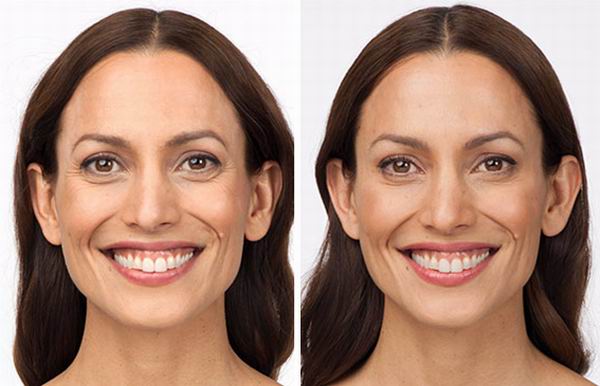
Before & After Botox injection for crows feet. * Individual results may vary.
Frequently asked questions about Botox
How much does Botox cost in Seattle?
At our practice, $16 per unit, or $13.20 per unit through the Botox Bank — a prepaid 125-unit block that saves $350. A typical treatment of 40 to 50 units is therefore about $640 to $800 at standard pricing. Be cautious comparing against per-area pricing elsewhere, which does not reveal how many units you receive.
How many units of Botox do I need?
A typical treatment is 40 to 50 units, though it depends on your age and how strong your muscles are. Men usually need more than women.
How long does Botox take to work?
The effect begins at 3 to 7 days and is complete at 10 to 14 days. Dysport is often marginally faster.
How long does Botox last?
About 3 to 4 months. Masseter and underarm sweating treatments generally last longer, around 4 to 6 months.
Does Botox hurt?
Minimally — a brief pinch. The needle is very fine and no anesthesia is needed, though topical numbing or ice is available.
Is there downtime after Botox?
No. Return to normal activity immediately. Stay upright and avoid rubbing the area or strenuous exercise for the first 4 hours.
What is the difference between Botox and filler?
Botox relaxes muscles to soften lines caused by movement. Filler adds volume to restore areas that have hollowed or to lift folds present at rest. They treat different problems and are frequently used together.
What is the difference between Botox and Dysport?
Both are botulinum toxin type A. Dysport often takes effect slightly faster and spreads a little more, which can suit broad areas. Their units are not equivalent, so per-unit prices cannot be compared directly between the two. Duration is similar.
Will Botox make me look frozen?
Not when dosed correctly. A frozen look comes from over-treatment or from relaxing muscles that should have been left working. We dose conservatively and review at two weeks, because Botox cannot be reversed — adding more is easy, removing it is not.
At what age should I start Botox?
There is no correct age. The relevant question is whether you have dynamic lines you want softened or prevented from etching in. Some patients begin in their late twenties for prevention; many begin in their thirties or forties once lines start persisting at rest.
Can Botox lift my eyebrows?
Modestly. Selectively relaxing the muscles that pull the brow downward lets the elevating muscles sit the brow slightly higher. For a substantial or lasting change, a brow lift is the procedure.
Can Botox slim my jawline?
If the width comes from an enlarged masseter muscle, yes — the effect builds over 4 to 8 weeks and lasts 4 to 6 months. If it comes from buccal fat or body weight, no.
Does Botox help with teeth grinding?
Yes. Relaxing the masseter reduces clenching force, and patients frequently report less jaw tension, fewer headaches, and reduced tooth wear.
Does insurance cover Botox for migraines or sweating?
We do not bill insurance for either, although both are FDA-approved indications. Migraine Botox is often covered when administered by a neurologist, so pursue that route if coverage is the priority.
Can Botox be reversed?
No. Unlike hyaluronic acid filler, which can be dissolved, Botox must wear off. This is the reason for conservative dosing and a two-week review.
Who performs Botox injections at your practice?
Five injectors, two of whom are national trainers — Jill Kandora, PA-C for Allergan Aesthetics, and Lorin Bates, RN, BSN for Galderma. All treatments take place within a surgical practice with a board-certified plastic surgeon on site.
Can I have Botox while pregnant or breastfeeding?
No. Botox is not administered during pregnancy or breastfeeding.
Next steps
Botox is quick and low-commitment, but the result depends entirely on who is holding the syringe and how well they read your anatomy. A consultation assesses which muscles are creating your lines, what dose is appropriate for your muscle strength, and whether some of what is bothering you is volume or skin quality rather than movement — which Botox will not fix.
Naficy Rejuvenation Center is located in Bellevue, Washington, and serves patients from Seattle, the Eastside, and throughout the Pacific Northwest.
Schedule an appointment · You can also text us 24/7 at (425) 450-0880 · Ask a question
Medically reviewed by Sam Naficy, MD, FACS, board-certified by the American Board of Facial Plastic and Reconstructive Surgery.