Otoplasty
Otoplasty, also called ear pinning or ear reshaping surgery, corrects ears that stick out too far from the head. The ear cartilage is reshaped and secured through incisions hidden behind the ear, so there is no visible scar. At Naficy Plastic Surgery and Rejuvenation Center in Bellevue, Dr. Sam Naficy performs 25 to 30 otoplasties a year, on children from age 7 and on adults. The results are permanent. Fees start at $7,500.
Ears that protrude can draw attention away from the rest of the face. Children with prominent ears are often teased at school, and adults frequently avoid hairstyles that expose the ears. Otoplasty repositions the ears closer to the head and rebuilds the natural folds of the ear so they look normal rather than obviously operated on.
What can otoplasty achieve?
The ear cartilage can be molded and secured into a more natural, aesthetically pleasing contour through hidden incisions behind the ear. The goal is ears that sit closer to the head and look unremarkable, not ears that look pinned. The results of otoplasty are permanent.

Otoplasty by Dr. Sam Naficy * Individual results may vary.

Otoplasty by Dr. Sam Naficy * Individual results may vary.
Is my child old enough for otoplasty?
Dr. Naficy performs otoplasty on children aged 7 and older. By this age the ear has reached most of its adult size, so a correction made now will still look right as the child grows. Just as importantly, a child of 7 or older can take part in the decision and can reliably follow the instructions that protect the result during healing.
Waiting until the child is ready matters more than operating early. An otoplasty performed on a child who does not want it, or who cannot follow post-operative instructions, is harder on everyone and puts the result at risk.

Otoplasty by Dr. Sam Naficy * Individual results may vary.
Can adults have otoplasty?
Yes. Many otoplasty patients are adults who were bothered by their ears as children and never had them corrected. The surgery is the same, and because the cartilage is more set in adults, the correction tends to be very stable.

Otoplasty by Dr. Sam Naficy * Individual results may vary.
What are the different otoplasty techniques?
Prominent ears are not all prominent for the same reason. Some ears lack a properly formed antihelical fold, some have a conchal bowl that is simply too deep, and many have both. The technique has to match the cause, which is why no single method is right for every ear.
| Technique | How it works | Advantages | Limitations |
|---|---|---|---|
| Suture technique (cartilage-sparing) |
Sutures fold the cartilage to recreate the antihelical fold, or draw the conchal bowl closer to the head. No cartilage is removed. | Preserves the cartilage entirely. No cut edges, so no risk of visible ridges or sharp contours. Adjustable during surgery. The most natural-looking result in a flexible ear. | Depends on the cartilage being pliable enough to hold the new fold. In a stiff ear the correction sits under constant tension, which is the usual reason ears gradually spring back. |
| Cartilage-scoring (anterior scoring) |
The front surface of the cartilage is lightly scored so it bends away from the scored side, creating the fold without forcing it. | Works where suture technique alone would fail. Removes the tension from the correction, so the result is stable in stiff cartilage. | Requires judgement and restraint. Over-scoring can produce visible ridges or an irregular contour. Not reversible once the cartilage is cut. |
| Cartilage excision (conchal reduction) |
A strip of cartilage is removed from an overly deep conchal bowl so the ear can sit closer to the head. | The only approach that addresses a genuinely oversized conchal bowl. Fold surgery alone will not correct this cause of prominence. | More invasive. Over-resection can narrow the opening of the ear canal or pull the ear too tightly against the head. |
| Incisionless otoplasty (percutaneous suture) |
Sutures are passed through small needle punctures and tightened to fold the cartilage. No skin incision is made. | No skin incision and a quicker recovery. Well suited to a young patient with soft, flexible cartilage and a well-defined problem. | Only suitable for soft, pliable ears, without trues excess of conchal cartilage. The cartilage cannot be removed, so it cannot correct a deep conchal bowl or a stiff ear. Higher rate of relapse, and sutures can occasionally be felt or work their way out. |
| Infant ear molding (splinting, not offered here) |
A moulding device shapes the newborn ear while the cartilage is still soft from maternal hormones. | Avoids surgery altogether when it works. | Must begin within the first few weeks of life. Once that window closes the cartilage stiffens and surgery becomes the only option. We do not offer infant ear molding. |
Comparison of otoplasty techniques. The right choice depends on the cause of prominence and the stiffness of the cartilage.
Which technique does Dr. Naficy use?
Dr. Naficy tailors the technique to the individual ear rather than applying one method to everyone. Most ears are reshaped using sutures that recreate the natural antihelical fold without removing cartilage. Where the cartilage is particularly stiff, or the ear is very prominent, the cartilage itself is also reshaped so it will hold the new position without tension. Removal of cartilage from the conchal bowl is done selectively and conservativley when needed.
The reason for this distinction matters. Relying only on cartilage cutting can create sharp edges and unnatural contours. Relying only on sutures in a stiff ear puts the correction under constant tension, which is how ears gradually spring back. Choosing between them, ear by ear, is what produces a natural shape that lasts.
In selected cases — typically a younger patient with soft, flexible cartilage and a well-defined antihelical problem — Dr. Naficy performs incisionless otoplasty, in which the cartilage is folded with percutaneous sutures and no skin incision is made. It is not suitable for every ear, and it is not offered when the cartilage is stiff or the conchal bowl is the main cause of prominence, because those ears need cartilage work that an incisionless approach cannot deliver.
Absorbable or permanent sutures: does the choice matter?
In a cartilage-sparing otoplasty the sutures are what hold the new fold, so the material matters more than patients expect. The question is whether the correction should be held permanently by the suture, or held long enough for scar tissue to take over. This is one of the genuinely unsettled questions in otoplasty.
Dr. Naficy uses both absorbable PDS and permanent braided polyester sutures (Ethibond and Ticron), selected case by case.
| Suture | What it is | What holds the correction | Advantages | Limitations |
|---|---|---|---|---|
| PDS (absorbable monofilament) |
A smooth absorbable suture. It holds meaningful strength for roughly six weeks and is fully absorbed at around six months. | The scar tissue that forms around the suture while it is intact. | Leaves no permanent material behind, so there is nothing that can extrude, be felt, or form a granuloma years later. Particularly appealing in a young child who has decades ahead. | If the fibrosis has not matured by the time the suture weakens, the ear can drift back. Some published series report higher recurrence than with permanent sutures. |
| Ethibond and Ticron (braided polyester, permanent) |
Braided polyester sutures that remain in place indefinitely. | The suture itself, permanently. | Excellent knot security and tensile strength, and braided polyester is gentle on cartilage rather than cutting through it. The result does not depend on scar tissue maturing on schedule, so relapse rates are generally lower. | A permanent implant can occasionally become palpable, extrude through the skin, or form a granuloma. Braided material is more prone to this than monofilament, which is why knots are buried carefully on the back surface of the cartilage. |
Comparison of suture materials used in cartilage-sparing otoplasty.
The published evidence does not clearly favour one over the other. Some series report results with PDS comparable to permanent sutures; others report higher recurrence. Anyone claiming the question is settled is overstating it. What is clear is that a stiff ear asks more of a suture than a pliable one, and that is the kind of judgement made at the operating table rather than in advance.
Can otoplasty be done on just one ear?
Yes, if only one ear is prominent and the other ear is more or less normal in projection and angle, then a one-sided otoplasty can be performed.

One-sided Otoplasty by Dr. Sam Naficy * Individual results may vary.
What type of anesthesia is used?
This varies by patient and is decided together with your anesthesia provider based on your health status, your age, and the extent of the procedure. Some otoplasty patients are best served by general anesthesia, others by IV sedation. With either, your heart rate, blood pressure, breathing and oxygen levels are monitored continuously.
General anesthesia means you are completely asleep for surgery, with an intravenous line and a breathing tube. Numbing medication is also placed during surgery by your surgeon.
IV sedation, also called monitored anesthesia care or MAC, delivers sedation and pain medication through an intravenous line while your surgeon places numbing medication at the start of the procedure.
Will there be a visible scar?
The incisions are placed behind the ear, in the crease where the ear meets the head. Once healed they are hidden from view in normal circumstances, including when the hair is worn short or tied back.
Who is not a good candidate for otoplasty?
Otoplasty is not appropriate for every situation, and there are three cases where we will tell you so directly:
- Children younger than 7. The ear has not finished growing and the child is generally not yet able to participate in the decision or follow the instructions that protect the result.
- A child who does not want the surgery. Otoplasty is elective. When the motivation belongs to the parent rather than the child, it is better to wait.
- Anyone expecting perfectly matched ears. Normal ears are not symmetric, and neither are surgically corrected ears. The goal is two ears that look natural and balanced, not identical.
Are the results permanent?
Yes. Once the ear cartilage has been reshaped and secured, the correction is permanent. Otoplasty does not need to be repeated as a child grows, which is one reason it is worth waiting until the ear has reached close to adult size before operating.
Does otoplasty affect hearing?
No. Otoplasty reshapes the cartilage of the outer ear. It does not involve the ear canal, the eardrum, or the middle ear, and it does not change hearing.
What does otoplasty cost?
Otoplasty fees start at $7,500. The final quote depends on the degree of correction required and whether one or both ears are treated, and is confirmed at your consultation. Our fees and payment policies and financing options are published in full. Otoplasty for prominent ears is considered cosmetic in nature, since the shape of the outer ear has no functional impact on hearing. It is therefore not covered by insurance.
What is recovery like after otoplasty?
Otoplasty is an outpatient procedure, and recovery is more straightforward than most families expect. Because the incisions sit behind the ear and the skin closes with absorbable sutures, there are no stitches to remove and nothing visible on the front of the ear while healing.
The single most important part of recovery is keeping gentle compression on the ears for the first two weeks. That is what protects the new fold while the tissues settle around it.
| When | What happens |
|---|---|
| Day of surgery | A bulky compression dressing is applied around the head and worn overnight. This is the dressing patients go home in. |
| Day 1 | The bulky dressing comes off. From this point a gentle compression headband, an ace wrap, or simply a beanie hat is worn instead. |
| First 24 hours | Most of the discomfort occurs here and then settles quickly. After the first day, Tylenol alone is typically enough. |
| Around day 3 | Swelling reaches its peak, then begins to subside. |
| Days 1 to 5 | The headband, wrap or beanie is worn as much as possible. This is the period that most protects the correction. |
| Day 5 | Back to school or work. Long hair or a beanie hat makes this easy, and most patients return without drawing attention. |
| Through 2 weeks | The headband is worn at night, for a minimum of two weeks in total. |
| 2 weeks | Swimming in a pool is permitted. |
| 3 to 4 weeks | Contact sports are cleared. |
Typical otoplasty recovery timeline. Individual recovery may vary.
The dressing you go home with
Surgery finishes with a bulky compression dressing wrapped around the head. It looks dramatic and it is meant to — its job is to hold the ears gently and evenly overnight while the initial swelling occurs. It comes off the following day, and nothing that bulky is needed again.

Dressing worn immediately after otoplasty - removed the following day
What replaces it
After the bulky dressing is removed, a gentle compression headband, an ace wrap, or a beanie hat takes over. It should be worn as much as possible for the first four to five days, and then at night for a minimum of two weeks in total. There are no restrictions on sleeping position, but a patient who tosses and turns is better off wearing an ace wrap at night through those first two weeks.
Discomfort, swelling and bruising
Most of the discomfort is confined to the first 24 hours and settles quickly after that. Tylenol alone is typically sufficient from the first day onward. Swelling peaks at around day three and then steadily improves. By day seven the ears already look close to their new position, though some swelling remains.
Getting back to normal
Five days away from school or work is more than enough. Returning is easier than patients expect, particularly for girls with long hair or boys willing to wear a beanie hat, and most go back without anyone commenting. Swimming in a pool is permitted at two weeks. Contact sports are best delayed until three to four weeks, since a direct blow to the ear is the one thing that can disturb the correction while it is still settling.

Before and 7 days after otoplasty, * Individual results may vary.
Why choose a facial plastic surgeon for otoplasty?
Most plastic surgeons perform ear surgery, but very few limit their practice to the face. The majority spend the bulk of their time on liposuction, breast procedures, and body contouring.
Dr. Naficy’s practice is devoted exclusively to rhinoplasty and facial plastic surgery. He performs 25 to 30 otoplasties a year and has been recognized in Seattle Magazine’s Top Doctors list, and patients travel both nationally and internationally for his expertise. For a procedure measured in millimetres of cartilage position, that focus is the difference between an ear that looks natural and one that looks corrected.
Otoplasty photo gallery
You may wish to browse representative before and after otoplasty photographs. All ear plastic surgery procedures shown were performed by Dr. Sam Naficy.
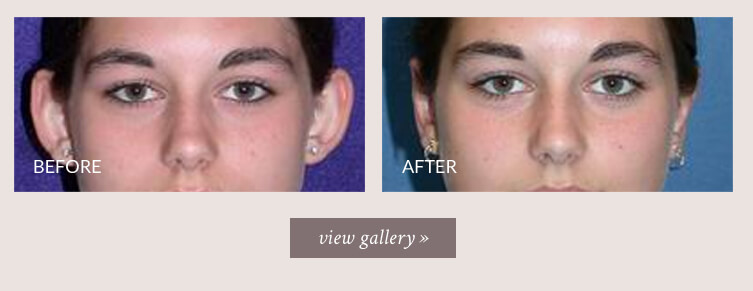
* Individual results may vary.
What does “board certified” actually mean in facial plastic surgery?
Board certification tells you what a surgeon was trained and examined in. On its own, the phrase “board certified” does not say in which field. Certification exists across many specialties, and a certificate in another specialty is a genuine credential in that specialty. It is simply not the same thing as certification in facial plastic surgery. So the useful follow-up question is always: certified by which board, and in what?
For facial plastic surgery there are two boards to look for, and both publish free public tools that let you verify a surgeon yourself in under a minute.
| Board | What it certifies | Verify a surgeon |
|---|---|---|
| American Board of Facial Plastic and Reconstructive Surgery (ABFPRS) | Facial plastic and reconstructive surgery specifically. Certification requires that the surgeon already hold certification from an American Board of Medical Specialties board in either otolaryngology–head and neck surgery or plastic surgery, pass a two-day examination, and submit for peer review operative reports from a minimum of 100 facial plastic surgery procedures. | ABFPRS Physician Finder |
| American Board of Plastic Surgery (ABPS) | Plastic surgery of the entire body, including the face. ABPS is a member board of the American Board of Medical Specialties. | ABPS Verify Certification |
Why the ABFPRS requirement matters
The detail worth understanding is that ABFPRS certification cannot be the only board a surgeon holds. It is granted on top of an existing ABMS certification in one of the two surgical specialties whose residency training covers facial plastic surgery. An ABFPRS diplomate is double boarded by definition. Those two qualifying pathways — otolaryngology–head and neck surgery, and plastic surgery — are both represented at this practice, and both of our facial surgeons hold certification from two boards rather than one. The 100-case peer review is also specific: the operative reports submitted must be facial plastic surgery, not surgery generally.
What to ask, and how to check
- Which board certified you, and in what specialty? Not simply “are you board certified.”
- Is that board a member of the American Board of Medical Specialties? Boards exist with similar-sounding names that are not ABMS member boards.
- Where do you hold hospital operating privileges, and for this procedure? Hospital privileges are granted by peer review against training.
- How many of these do you perform each year? Certification is a floor, not a measure of current volume.
- Verify it yourself. Both boards above let you search by surgeon name. The ABFPRS states that its website is a primary source of verification.
The surgeons at this practice, and how to verify them
| Surgeon | Board certification | Residency pathway |
|---|---|---|
| Sam Naficy, MD, FACS | American Board of Facial Plastic and Reconstructive Surgery American Board of Otolaryngology – Head and Neck Surgery |
Otolaryngology – head and neck surgery, followed by facial plastic surgery fellowship at the University of Michigan |
| Keith Hurvitz, MD, FACS | American Board of Plastic Surgery American Board of Otolaryngology – Head and Neck Surgery |
Otolaryngology – head and neck surgery residency at USC, followed by a general plastic surgery residency at UC Irvine |
Each of these certifications can be confirmed through the verification links above, or with the certifying boards directly. We would encourage you to check ours, and to check the credentials of any other surgeon you consult.
Schedule an otoplasty consultation in Bellevue
An otoplasty consultation begins with examining the ears to determine what is causing the prominence, since the correction differs depending on whether the antihelical fold is underdeveloped, the conchal bowl is overly deep, or both. Schedule your visit or ask us a question.