Chin Implant
A chin implant balances a weak or under-projected chin against the rest of the face. It is among the shortest operations in facial plastic surgery — about 30 minutes — and among the most transformative relative to its size, because chin projection affects how the nose, jawline, and neck all read. Sam Naficy, MD, FACS performs 60 to 80 chin augmentation procedures each year in Bellevue, Washington. Most patients return to work in about a week.
What is a chin implant?
Chin augmentation places a solid implant over the front of the chin bone, through a small incision hidden in the crease beneath the chin. The implant sits directly on bone, beneath the soft tissue, and becomes fixed in position as the body forms a capsule around it.
Chin implants produce some of the most dramatic and gratifying results in facial plastic surgery. They are also the procedure most often not considered by the people who would benefit most, because a weak chin is difficult to see in yourself. Most people examine their nose in the mirror. Very few examine their profile.
How a weak chin changes the whole face
Chin projection is a reference point. When it is deficient, several other features are misread as the problem:
- The nose looks too large. A normally sized nose appears over-projected when there is no chin to balance it. A significant number of patients who come in convinced they need rhinoplasty need chin augmentation, or both.
- The jawline looks weak and poorly defined along its whole length, not just at the front.
- The neck looks full. A recessed chin shortens the distance between chin and neck, blunting the angle and making a normal amount of neck fullness look like a double chin.
- The lower face looks short, throwing off the vertical proportions of the face.
- The profile reads as weak or bird-like, an impression that has nothing to do with the actual size of any other feature.
This is why chin augmentation is so often combined with other procedures — not to sell more surgery, but because the chin is frequently the reason the other feature looks wrong.
Chin implant vs. sliding genioplasty
There are two ways to bring a chin forward. Both work; they differ substantially in invasiveness and risk.
| Chin implant | Sliding genioplasty | |
|---|---|---|
| What is done | A solid implant is placed over the front of the chin bone | The lower jawbone is cut and the front segment slid forward, then fixed with plates and screws. It does NOT add new volume to the jaw but takes from one place to add to another |
| Invasiveness | Soft tissue only; the bone is not cut | The jawbone is divided — a considerably larger operation |
| Operative time | About 30 minutes | Substantially longer |
| Risk profile | Lower | Higher, including greater risk of nerve injury |
| Reversibility | The implant can be removed or exchanged | Not readily reversible |
| Vertical change | Limited — primarily forward projection | Can lengthen or shorten the chin vertically as well |
| Used here | Preferred in nearly all cases | Not Dr. Naficy's preferred technique |
Sliding genioplasty has a place, particularly where the chin needs vertical repositioning or where the deficiency is severe and skeletal. For the great majority of patients seeking better chin projection, an implant achieves the same visible result through a far smaller operation, and can be adjusted or removed if it ever needs to be.
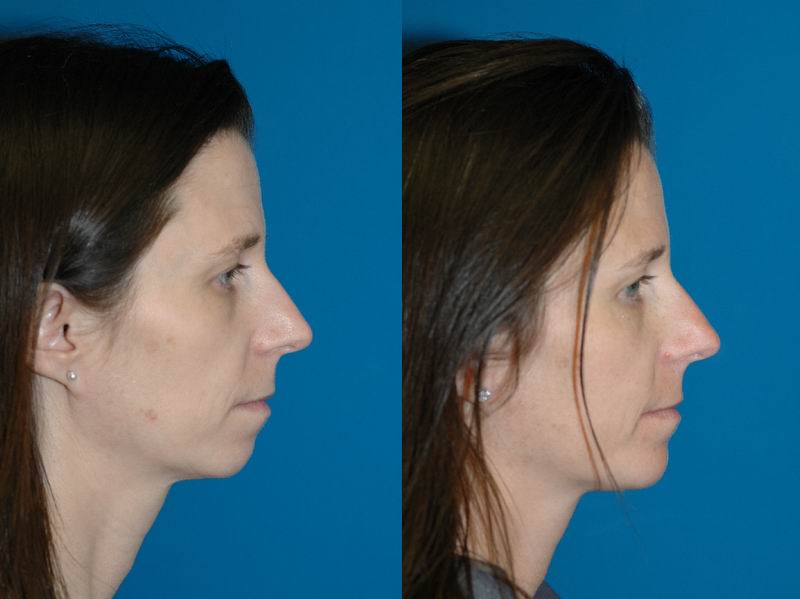
Chin implant by Dr. Sam Naficy. * Individual results may vary.
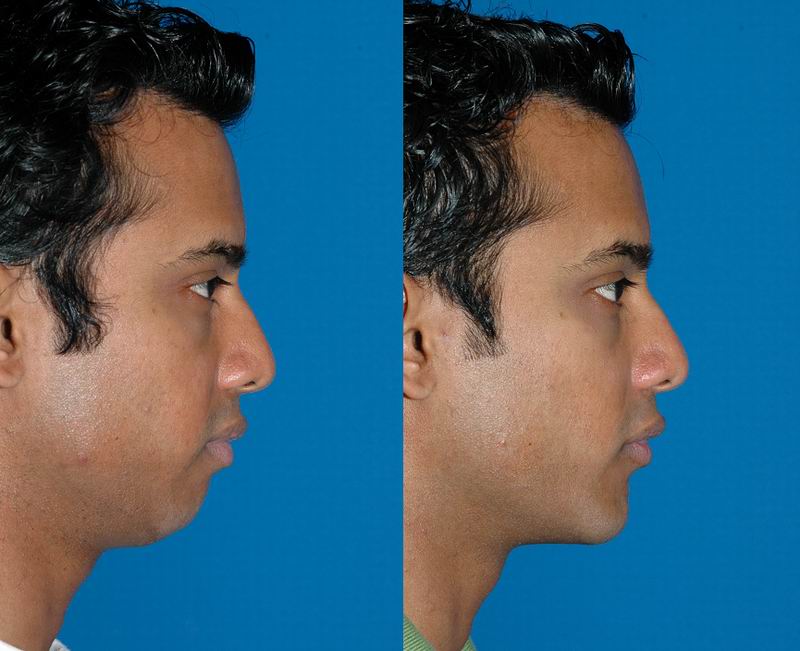
Chin implant by Dr. Sam Naficy. * Individual results may vary.
What material is used for chin implants?
Silastic — medical-grade silicone rubber — is the preferred material here, because of its long history of biocompatibility in the human body. Gore-Tex is also used for chin augmentation, but Silastic has the longer track record.
Because a chin implant rests directly on bone rather than in soft tissue, it feels like part of the bone itself once healed. Patients are generally unable to distinguish it by touch, and it cannot be seen. Silastic implants are stable over time and do not resorb, so the result is permanent — while remaining removable or exchangeable if that is ever wanted, which is not true of a genioplasty.
Implants come in a range of standard sizes and shapes, including extended designs that carry the augmentation back along the jawline rather than confining it to the front of the chin. Choosing the size is the substance of the planning: too small produces no visible change, too large looks unnatural and is the circumstance in which problems arise.
Where is the incision?
The incision is placed under the chin, in the natural crease that most people already have there. It is small, it heals inconspicuously, and it sits where nobody looks.
An implant can alternatively be placed through an incision inside the mouth, between the gum and the lip, which leaves no external scar at all. The submental route is preferred here for a specific reason: it is cleaner. The mouth carries a heavy bacterial load, and placing an implant through it means passing a permanent foreign body through a contaminated field. The under-chin incision avoids that entirely, and the scar it leaves is negligible.
Where a chin implant is combined with neck liposuction or a neck lift, the same small incision serves both procedures — so no additional incision is required at all.
Who is a good candidate for a chin implant?
- A chin that sits behind the plane of the lower lip in profile
- A nose that looks large, where the profile suggests the chin is the deficient feature
- A poorly defined jawline or a blunted angle between chin and neck
- Fullness under the chin that persists despite being at a normal weight
- Good general health, healthy dentition and bite, and realistic expectations
A simple profile check. In profile, a vertical line dropped from the lower lip should roughly touch the front of the chin in women, and reach it or slightly beyond in men. If your chin falls well behind that line, augmentation will change the balance of your face.
Who is not a good candidate?
- Your bite is significantly off. A malocclusion — where the jaws do not meet correctly — is a skeletal problem that an implant camouflages rather than corrects. Orthodontic or jaw surgery assessment comes first.
- The deficiency is severe and vertical as well as horizontal. This is where sliding genioplasty has a genuine advantage.
- Active dental infection or poor dental health, which must be resolved before placing an implant near the jaw.
- You use nicotine in any form. Complete cessation is required for at least three weeks before and after surgery.
- Uncontrolled hypertension, poorly controlled diabetes, or a bleeding disorder.
How is a chin implant placed?
Chin augmentation takes approximately 30 minutes and is performed under IV sedation or general anesthesia.
- Incision. A small incision is made in the natural crease beneath the chin.
- Pocket creation. A precise pocket is made directly on the bone. Sizing the pocket correctly matters — it must accommodate the implant without compressing it.
- Implant placement. The selected implant is positioned centrally on the bone and seated flush against it.
- Closure. The incision is closed in layers with fine sutures.
Where the procedure is combined with neck liposuction, a neck lift, or a facelift, the chin implant adds little time and usually requires no additional incision.
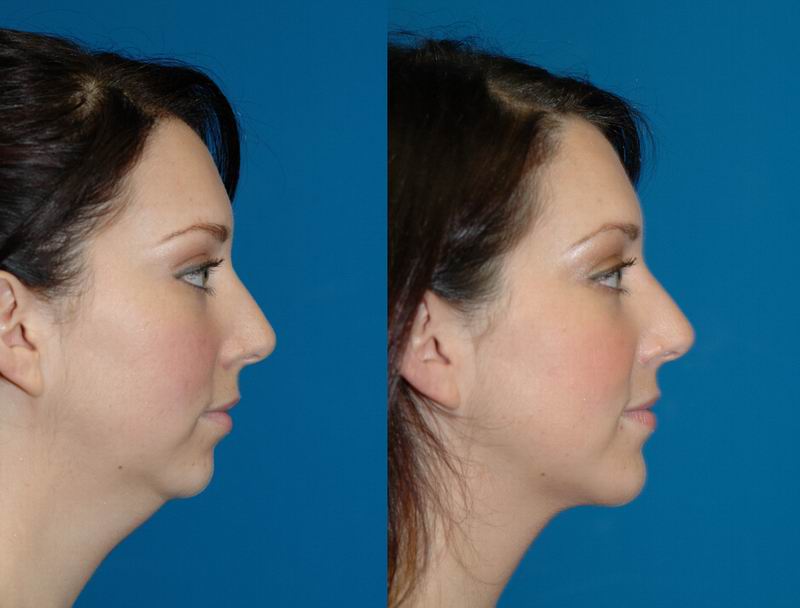
Chin implant and neck liposuction by Dr. Sam Naficy. * Individual results may vary.
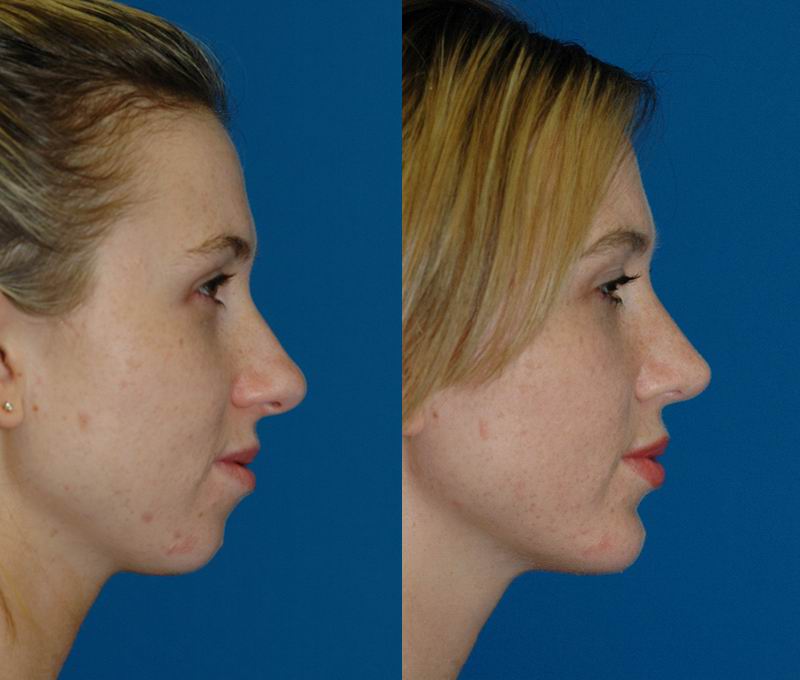
Chin implant and rhinoplasty by Sam Naficy, MD. * Individual results may vary.
What is recovery like after a chin implant?
Most patients return to work in about one week. Discomfort is generally mild, and the main early sensation is tightness and stiffness when speaking or smiling.
| Time after surgery | What to expect |
|---|---|
| Days 1–3 | Swelling and tightness across the chin and lower lip. A supportive dressing or tape may be worn. A soft diet is easier. Discomfort is usually managed with acetaminophen. |
| Days 4–7 | Swelling begins to settle. Speaking and smiling feel less restricted. Sutures are typically removed within the first week. |
| About one week | Most patients return to work. The chin still looks slightly over-projected from swelling — this settles. |
| Weeks 2–4 | Most swelling resolved and the new profile becomes apparent. Light exercise resumes with clearance. |
| Weeks 6–8 | Full activity cleared. Any residual stiffness in the lower lip continues to ease. |
| Months 3–12 | Final contour settles and the incision fades into the submental crease. |
Patients travelling from out of the area should plan to remain locally until sutures are removed. See Out of Town Patients.
Will I have numbness after a chin implant?
Numbness is not common after chin augmentation, but it does occur occasionally. When it does, it affects the skin of the chin, the lower lip, or both, and it is caused by temporary irritation of the nerve that supplies sensation to that area.
It typically resolves within 2 to 3 weeks. It is a temporary effect of swelling and handling around the nerve rather than an injury to it, and it does not affect the movement of the lip — only sensation.
What about bone resorption under the implant?
This question comes up in patient research, and it deserves a direct answer.
Bone remodelling beneath a chin implant is rare, and where it has occurred it is understood to result from technical factors rather than from the implant material itself — specifically, an oversized implant placed into a pocket that is too tight, so the implant presses continuously against the bone.
With standard implant sizes and a properly sized pocket, this should no longer be a problem. The pocket is made large enough that the implant sits against the bone without being compressed into it. That is why pocket dimension is treated as part of the operation rather than an afterthought.
Can fillers produce the same result as a chin implant?
Partially, and temporarily. Injectable filler can add modest projection to the chin and is a reasonable way to preview the change before committing to surgery — a genuinely useful role.
Its limits are volume and duration. Achieving implant-level projection with filler requires a large quantity, repeated indefinitely, and the cumulative cost over several years typically exceeds the one-time cost of an implant. Filler also sits in soft tissue rather than on bone, so it does not create the same crisp definition along the jawline.
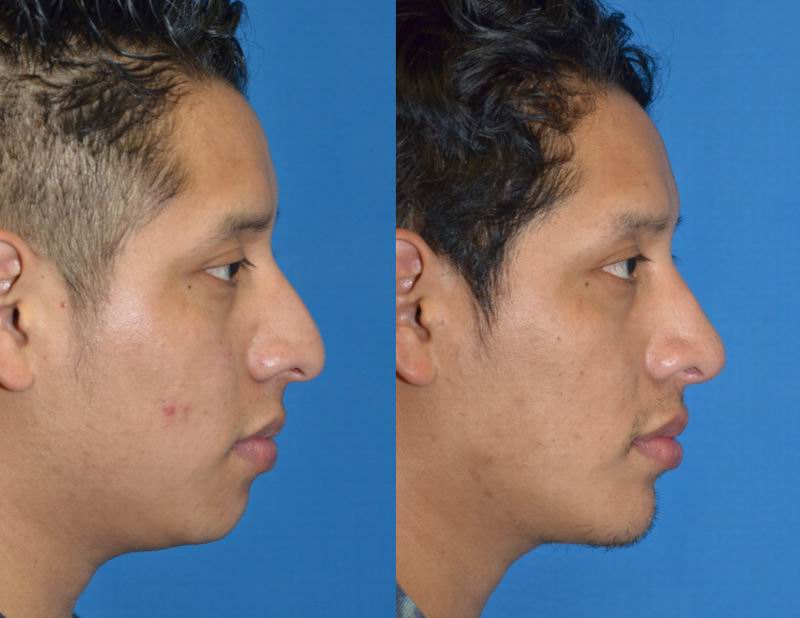
Chin implant and rhinoplasty by Sam Naficy, MD. * Individual results may vary.
Chin implant with neck liposuction
This is one of the most effective pairings in facial surgery, and the reason is geometric. A recessed chin shortens the distance from chin to neck and blunts the angle between them. Removing fullness under the chin with neck liposuction improves the neck; bringing the chin forward lengthens and sharpens the angle. Done together, each amplifies the other, and both are performed through the same small incision.
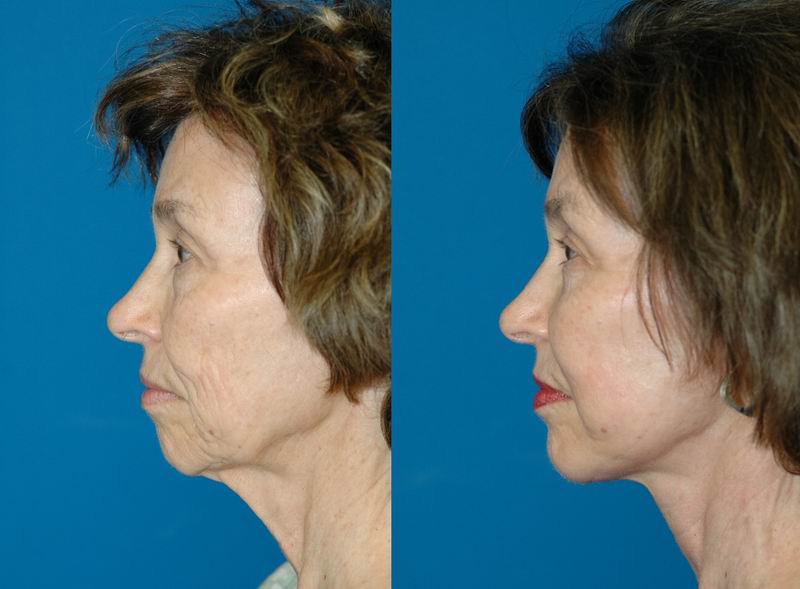
Chin implant, Face lift, and Fat grafting by Sam Naficy, MD. * Individual results may vary.
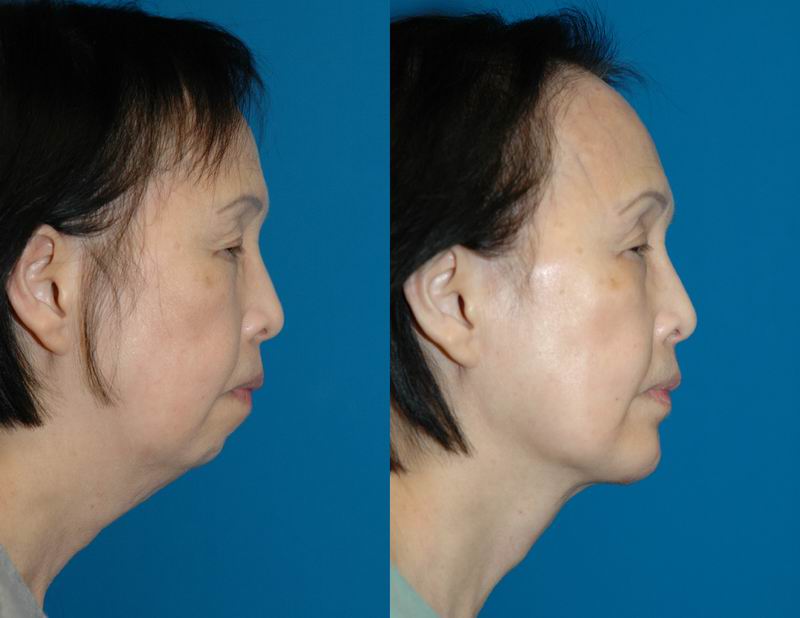
Chin implant in an Asian woman by Sam Naficy, MD. * Individual results may vary.
Chin implant with rhinoplasty
Nose and chin are read together in profile, and this is the pairing that most often surprises patients. Someone convinced their nose is too large may in fact have a nose of normal size and a chin that is set back — and reducing the nose alone would leave the imbalance only partly corrected while making the face look less strong.
Assessing chin projection is a routine part of every rhinoplasty consultation here. In some patients the right operation turns out to be a chin implant alone.
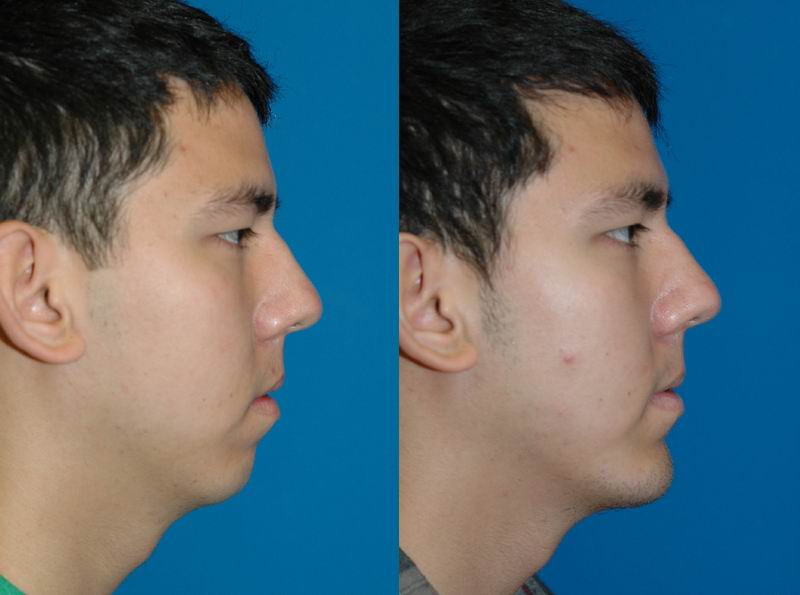
Chin implant in an Asian man by Sam Naficy, MD. * Individual results may vary.
Chin implant with a facelift or neck lift
A face and neck lift repositions descended tissue and sharpens the jawline, but it cannot change the underlying skeleton. Where chin projection is deficient, adding an implant gives the lifted tissue better bone structure to drape over, and produces a sharper jaw-to-neck angle than lifting alone can achieve. Patients with a weak chin get a disproportionate benefit from adding it, and it uses the same submental incision the neck work already requires.
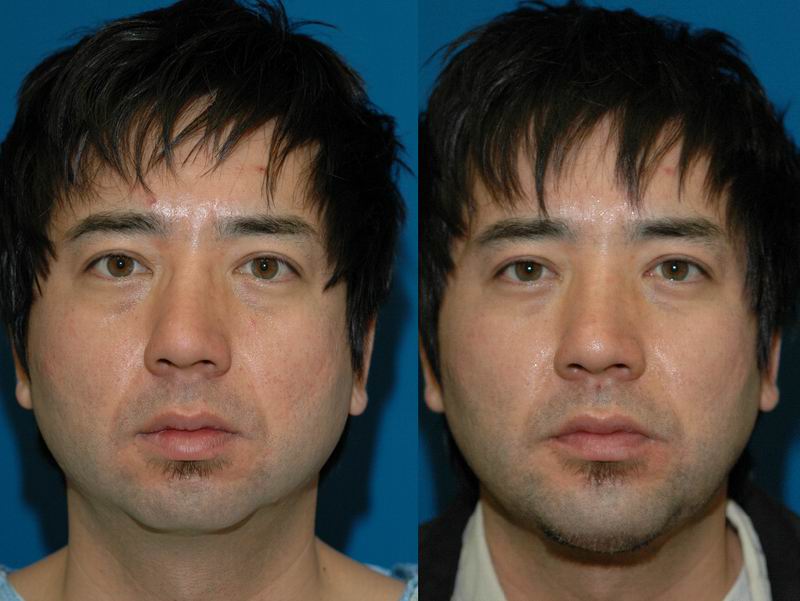
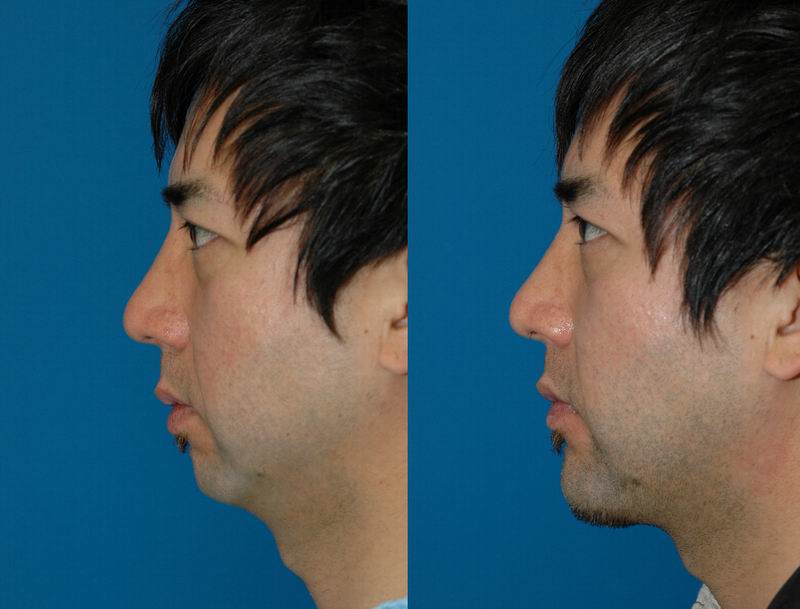
Chin implant in an Asian man by Sam Naficy, MD. * Individual results may vary.
Chin implants in Asian patients
Chin augmentation is frequently part of facial balancing in Asian patients, where a less projected chin is common and often accompanies a lower nasal bridge. As with Asian rhinoplasty, the goal is balance within the patient's own facial framework rather than conversion toward a Western profile. Implant size is chosen conservatively for that reason — the aim is proportion, not maximum projection.
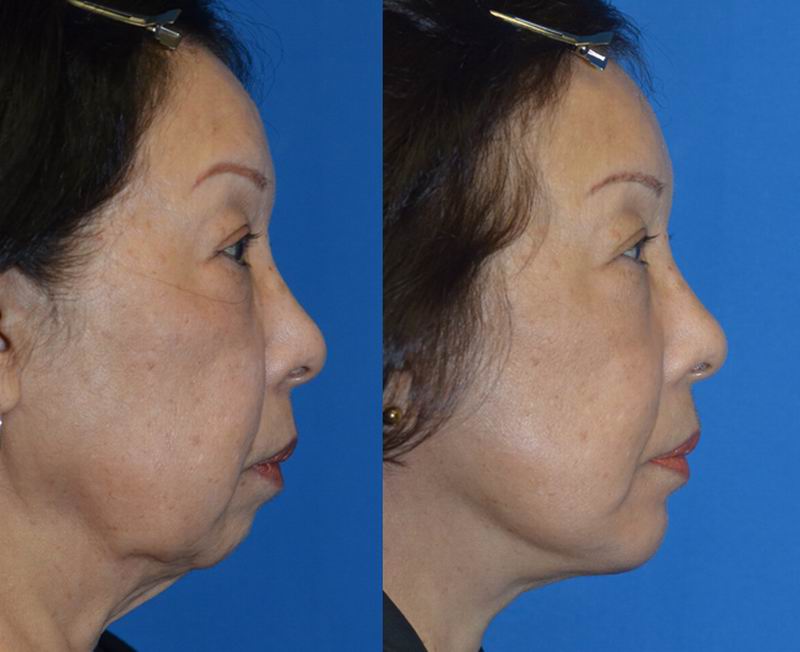
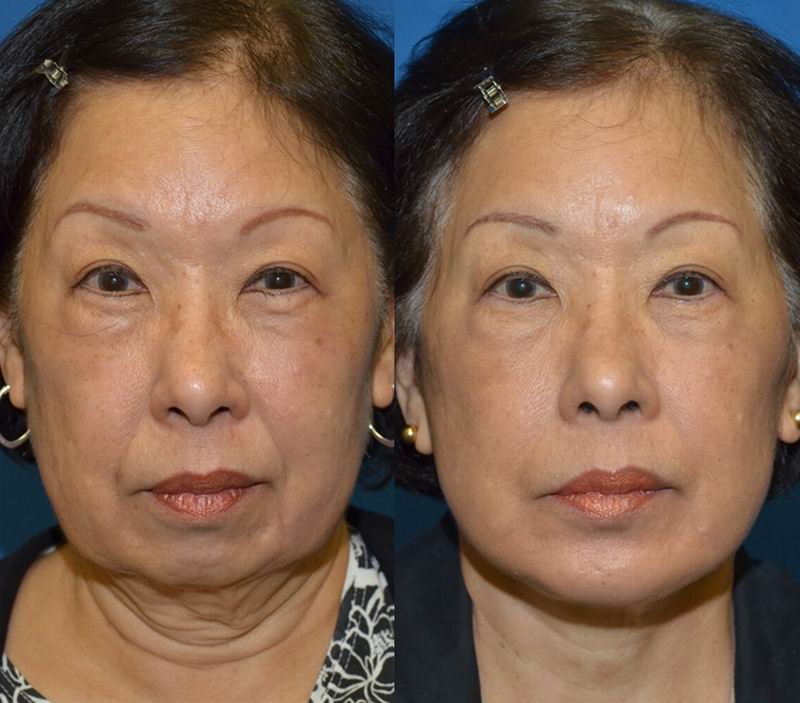
Chin implant and face lift in an Asian woman by Sam Naficy, MD. * Individual results may vary.
What are the risks of chin augmentation?
More common, and usually temporary: swelling and tightness across the chin, stiffness when speaking or smiling in the early weeks, and bruising.
Less common:
- Numbness of the chin or lower lip, typically resolving in 2 to 3 weeks.
- Asymmetry or an implant that sits slightly off centre, which may require repositioning.
- Implant shifting before the surrounding capsule forms.
- Infection. Uncommon, but because an implant is a foreign body, an infection that does not settle with antibiotics may require removal, with replacement after healing. This is part of the reason the submental incision is preferred over the intraoral route.
- Size dissatisfaction — too little or too much projection. Correctable by exchanging the implant, which is one of the practical advantages of an implant over a genioplasty.
- Bone remodelling beneath the implant. Rare, and associated with oversized implants in tight pockets.
Rare: hematoma, persistent nerve irritation, and scarring at the incision.
How much does a chin implant cost?
At Naficy Plastic Surgery, chin augmentation is $7,500. The surgeon's fee is the same whether the implant is placed on its own or added to another procedure.
Where it is combined with a facelift, neck lift, neck liposuction, or rhinoplasty, the total cost is lower than having the procedures separately — because operating room and anesthesia fees are shared rather than duplicated. For a patient already planning one of those operations, adding a chin implant is one of the highest-value decisions available.
Fees are itemized in writing at consultation, covering surgeon, anesthesia, facility, and follow-up care. Financing is available through PatientFi. Chin augmentation performed for cosmetic reasons is not covered by insurance.
Fees & payment policies · Financing
Why choose a facial plastic surgeon for chin augmentation?
Chin augmentation is a short operation in which almost everything depends on judgement made beforehand: whether the chin is genuinely the deficient feature, what size achieves balance rather than prominence, and whether the patient would be better served by addressing the nose, the neck, or the bite instead.
Dr. Naficy performs 60 to 80 chin augmentation procedures each year. His practice has been devoted exclusively to facial plastic surgery since 2000. He is certified by the American Board of Facial Plastic and Reconstructive Surgery (ABFPRS), graduated first in his class from the University of Washington School of Medicine, and completed both his residency and fellowship at the University of Michigan. Dr. Naficy has been recognized in Seattle Magazine's Top Doctors list.
About Dr. Sam Naficy, MD, FACS
What type of anesthesia is used?
Chin augmentation is performed under IV sedation or general anesthesia, administered by a dedicated anesthesia provider who will discuss which is appropriate for your health status and the planned procedure. Heart rate, blood pressure, breathing, and oxygen levels are monitored continuously.
Surgery is performed in our on-site surgery center, which is Medicare-certified and Washington State–accredited. Our anesthesia team has more than 50 years of combined experience, and all providers also hold appointments at the University of Washington or other regional medical centers.
Anesthesia guidelines [21kb PDF]
Chin augmentation before and after photos
Representative before and after images of chin augmentation performed by Dr. Sam Naficy. Some patients had more than one procedure; the caption accompanying each photograph describes the details.
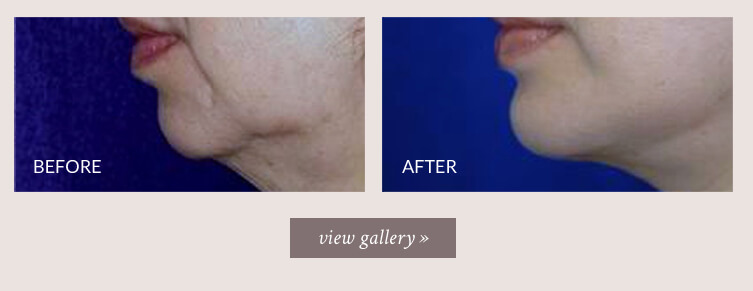
* Individual results may vary.
Frequently asked questions
Will the implant be visible or feel obvious?
No. It sits directly on bone beneath the soft tissue and becomes fixed as a capsule forms around it. Patients generally cannot distinguish it by touch, and it cannot be seen.
Can it be removed if I change my mind?
Yes, and it can also be exchanged for a different size. That reversibility is one of the practical advantages an implant has over a sliding genioplasty.
Where will the scar be?
In the natural crease under the chin, where it is not visible in normal view. If you are also having neck liposuction or a neck lift, the same incision serves both.
Do I need a chin implant or rhinoplasty?
Sometimes the nose looks large because the chin is set back. Both are assessed together in profile at consultation, and for some patients a chin implant alone produces the balance they were seeking from rhinoplasty.
Will it help my double chin?
Indirectly, yes. Bringing the chin forward lengthens and sharpens the angle between chin and neck. Combined with neck liposuction the effect is considerably greater than either alone.
How long does it last?
Permanently. Silastic implants are stable over time and do not resorb.
Will I be numb afterwards?
Not usually. Where numbness of the chin or lip does occur, it typically resolves within 2 to 3 weeks.
Can I eat normally afterwards?
A soft diet is more comfortable for the first few days, largely because of tightness rather than any restriction on chewing.
Is it covered by insurance?
No. Chin augmentation performed for cosmetic reasons is not covered.
I am interested. What do I do next?
If you are considering chin augmentation, we encourage you to complete the Surgical Consultation Intake Form. Profile photographs are particularly useful for this procedure. Dr. Naficy will assess chin projection against the rest of your profile, discuss whether the chin, the nose, the neck, or a combination is the feature to address, recommend an implant size, and inform you of the potential risks.
Naficy Plastic Surgery & Rejuvenation Center — 1110 112th Ave. NE, Suite 150, Bellevue, WA 98004 · (425) 450-0880. Serving Bellevue, Seattle, Kirkland, Redmond, Medina, Mercer Island, and the greater Puget Sound region.
This page is for general education and does not constitute medical advice. Individual results vary. Written and medically reviewed by Sam Naficy, MD, FACS. Last reviewed August 2026.
What does “board certified” actually mean in facial plastic surgery?
Board certification tells you what a surgeon was trained and examined in. On its own, the phrase “board certified” does not say in which field. Certification exists across many specialties, and a certificate in another specialty is a genuine credential in that specialty. It is simply not the same thing as certification in facial plastic surgery. So the useful follow-up question is always: certified by which board, and in what?
For facial plastic surgery there are two boards to look for, and both publish free public tools that let you verify a surgeon yourself in under a minute.
| Board | What it certifies | Verify a surgeon |
|---|---|---|
| American Board of Facial Plastic and Reconstructive Surgery (ABFPRS) | Facial plastic and reconstructive surgery specifically. Certification requires that the surgeon already hold certification from an American Board of Medical Specialties board in either otolaryngology–head and neck surgery or plastic surgery, pass a two-day examination, and submit for peer review operative reports from a minimum of 100 facial plastic surgery procedures. | ABFPRS Physician Finder |
| American Board of Plastic Surgery (ABPS) | Plastic surgery of the entire body, including the face. ABPS is a member board of the American Board of Medical Specialties. | ABPS Verify Certification |
Why the ABFPRS requirement matters
The detail worth understanding is that ABFPRS certification cannot be the only board a surgeon holds. It is granted on top of an existing ABMS certification in one of the two surgical specialties whose residency training covers facial plastic surgery. An ABFPRS diplomate is double boarded by definition. Those two qualifying pathways — otolaryngology–head and neck surgery, and plastic surgery — are both represented at this practice, and both of our facial surgeons hold certification from two boards rather than one. The 100-case peer review is also specific: the operative reports submitted must be facial plastic surgery, not surgery generally.
What to ask, and how to check
- Which board certified you, and in what specialty? Not simply “are you board certified.”
- Is that board a member of the American Board of Medical Specialties? Boards exist with similar-sounding names that are not ABMS member boards.
- Where do you hold hospital operating privileges, and for this procedure? Hospital privileges are granted by peer review against training.
- How many of these do you perform each year? Certification is a floor, not a measure of current volume.
- Verify it yourself. Both boards above let you search by surgeon name. The ABFPRS states that its website is a primary source of verification.
The surgeons at this practice, and how to verify them
| Surgeon | Board certification | Residency pathway |
|---|---|---|
| Sam Naficy, MD, FACS | American Board of Facial Plastic and Reconstructive Surgery American Board of Otolaryngology – Head and Neck Surgery |
Otolaryngology – head and neck surgery, followed by facial plastic surgery fellowship at the University of Michigan |
| Keith Hurvitz, MD, FACS | American Board of Plastic Surgery American Board of Otolaryngology – Head and Neck Surgery |
Otolaryngology – head and neck surgery residency at USC, followed by a general plastic surgery residency at UC Irvine |
Each of these certifications can be confirmed through the verification links above, or with the certifying boards directly. We would encourage you to check ours, and to check the credentials of any other surgeon you consult.