Breast Implant Revision
Breast implant revision is surgery to correct a problem with existing breast implants — capsular contracture, rupture, malposition, rippling, animation deformity, or simply a result the patient was never happy with. It also covers removing implants entirely, with or without replacement. At Naficy Plastic Surgery & Rejuvenation Center in Bellevue, revision is performed by Keith Hurvitz, MD, FACS, who is certified by both the American Board of Plastic Surgery and the American Board of Otolaryngology. He performs en bloc capsulectomy, implant plane changes, capsulorrhaphy and explant with or without a lift, and accepts patients whose original surgery was done elsewhere. Routine revision surgery starts at $15,000 including implants, operating room and anesthesia. Revision carries higher complication rates than first-time augmentation — the manufacturer’s own ten-year data reports capsular contracture in 29% of revision patients. Dr. Hurvitz’s own contracture recurrence rate after revision is well under 5%.
Why do patients need breast implant revision?
The most common reason patients come to Dr. Hurvitz for revision is straightforward: they are unhappy with the outcome of their previous surgery. Beyond that, revision is usually driven by one of the following.
| Problem | What is actually done about it |
|---|---|
| Capsular contracture | Capsulotomy, partial capsulectomy or total capsulectomy depending on how thick and firm the capsule is, usually with implant exchange |
| Implant rupture | Removal of the implant and the capsule, with exchange or explant |
| Bottoming out, lateral displacement, symmastia | Capsulorrhaphy — tightening the implant pocket, sometimes reinforced with mesh or matrix |
| Visible rippling or implant edges | Plane change, implant change, soft tissue coverage with matrix or mesh, or fat grafting |
| Animation deformity | Moving the implant from beneath the muscle to above it, sometimes with fat grafting to camouflage |
| Wanting a different size | Implant exchange, usually through the existing incision |
| Older saline implants | Exchange to modern cohesive silicone gel |
| Sagging after pregnancy or weight change | Implant exchange combined with a breast lift |
| Wanting implants out | Explant with capsulectomy, with or without a lift or fat grafting |
You do not need to have been Dr. Hurvitz’s patient to be seen for revision. Most revision patients had their original surgery elsewhere, including elsewhere in the Puget Sound area. Bring your implant device card or operative report if you have them.
What is capsular contracture, and how is it treated?
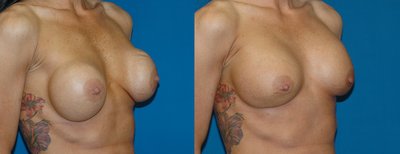
The body forms a capsule of scar tissue around any implant. That is normal and expected. In some patients the capsule thickens and tightens, which makes the breast feel firm, distorts its shape, rides the implant upward, or becomes painful. It is graded Baker I through IV, and grades III and IV are the ones that generally warrant surgery. There is no FDA-approved device or drug that prevents it.
How it is treated depends on the capsule itself, and that judgment is often made in the operating room.
| Procedure | What it involves | When it is appropriate |
|---|---|---|
| Capsulotomy | Cuts are made in the existing capsule so the pocket can expand. The capsule is not removed. | When the existing capsule is soft and supple. |
| Partial capsulectomy | A portion of the capsule is surgically removed. | When the capsule is thickened. How much is removed is often an intraoperative judgment call. |
| Total capsulectomy | The entire capsule is removed. | When the capsule is overly thick and firm. |
| En bloc capsulectomy | The implant and the capsule are removed together as a single intact unit, without opening the capsule. | Severe encapsulation around intact or ruptured implants, and rare diagnoses such as BIA-ALCL. See below. |
Allergan’s own ten-year core study reported Baker grade III or IV capsular contracture in 29% of revision-augmentation patients, against 19% of primary augmentation patients. Dr. Hurvitz does not track exact numbers, but contracture recurrence after his revision surgery is well under 5%. Those figures are not measured the same way — the manufacturer study followed a defined cohort for a full ten years — and both are published here so you can see the range rather than only the more favorable number.
What is an en bloc capsulectomy, and do you perform it?
Yes. Dr. Hurvitz routinely performs en bloc capsulectomies. This approach may be used in cases involving severe encapsulation around intact or ruptured breast implants, and in rare diagnoses such as anaplastic large cell lymphoma.
There is an important surgical trade-off that most pages do not explain. When a capsule becomes excessively scarred or calcified, removing it intact along with the implant requires a significantly larger breast incision, which poses risks to localized blood circulation and to sensation. Under those circumstances Dr. Hurvitz decompressively extracts the implant from within the capsule first, and then completely removes the capsule through a smaller, safer incision. Both methods achieve complete removal of the original implant and the entire tissue capsule. The difference is the size of the incision and the risk that comes with it — not whether the capsule comes out.
Two things are worth understanding before you request a specific technique:
- A calcified or scarred capsule does not inherently represent cancer. In most cases it is benign, and the calcification alone is not a reason for alarm.
- Sometimes a portion of the capsule should be left in place. If part of a benign capsule is extremely adherent to vital anatomy — a rib, or the muscles between the ribs — attempting to remove that portion can be unsafe. In those instances a portion may be deliberately left behind rather than damage the chest wall.
If a surgeon promises complete en bloc removal in every case regardless of what the capsule looks like, that promise is being made before anyone has seen the capsule.
How is implant malposition, bottoming out or symmastia corrected?
These are pocket problems rather than implant problems. The implant has settled too low (bottoming out), drifted toward the armpit (lateral malposition), or crossed toward the midline so the two pockets communicate (symmastia).
The repair is capsulorrhaphy — tightening the internal cavity of the implant capsule so the implant sits where it should. Dr. Hurvitz performs this with sutures, with cautery to heat and contract the capsule, or with both. In some cases the repair is reinforced with a biologic matrix or mesh.
What is animation deformity, and can it be fixed?
Animation deformity is visible movement or distortion of the implant when the chest muscle contracts. It is a recognized trade-off of placing implants beneath the pectoralis muscle, and it is more noticeable in patients who lift heavily or compete athletically.
Yes, it can be corrected. The usual approach is a plane change — moving the implant from beneath the muscle to above it. It can also be camouflaged with fat grafting. Dr. Hurvitz often performs implant plane changes, and the same approach is used for recurrent contracture and for some malposition problems.
Do mesh and acellular dermal matrix help in revision surgery?
Yes, and Dr. Hurvitz uses most of the available biologic matrices and meshes. They are used to support a repaired capsule, reinforce the lower pole, and add soft tissue coverage where the tissue is thin.
| Product | What it is | Practical note |
|---|---|---|
| AlloDerm | Human-derived dermis | Very expensive |
| Strattice | Porcine-derived dermis | Much more affordable in cosmetic surgery |
| GalaFLEX | Mesh made from the same class of material used to make absorbable sutures | Absorbs over time as tissue reinforces |
| DuraSorb | Mesh made from the same class of material used to make absorbable sutures | Absorbs over time as tissue reinforces |
All of these are useful in breast surgery. Whether any is indicated in your case is a decision that requires a full discussion with Dr. Hurvitz — they are not used routinely, and they add cost.
Changing implant size, and exchanging saline for silicone
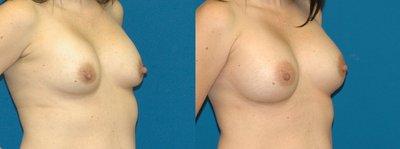
Size revision runs in both directions. Some patients want to go larger, often after losing breast volume with age, pregnancy or weight change. Others want to downsize, frequently because the original implants were larger than their tissue comfortably supports. Both are usually done through the existing inframammary incision.
Exchanging older saline implants for modern cohesive silicone gel is one of the most common revisions performed. Silicone gel implants were approved by the FDA for cosmetic breast augmentation in women 22 and older in November 2006, and today’s cohesive devices hold their shape better and feel closer to natural breast tissue than the saline implants many patients received years ago. Dr. Hurvitz uses smooth Allergan Natrelle implants exclusively and does not use textured devices.
Going larger is constrained by the same anatomy that constrains a first augmentation. An implant substantially wider than your natural breast will sit into the armpit, cross toward the midline, or thin the tissue over it — and in revision, that tissue has already been stretched once.
How is implant rupture found and treated?
A saline implant that ruptures deflates visibly over hours to days, and the saline is harmlessly absorbed. A silicone gel implant can rupture with no symptoms at all, which is why imaging is recommended.
For silicone gel implants, the FDA recommends that asymptomatic patients have a first ultrasound or MRI at 5 to 6 years after surgery, then repeat imaging every 2 to 3 years thereafter. Ultrasound is an acceptable alternative to MRI for screening. Dr. Hurvitz follows this schedule and recommends routine screening to all of his breast implant patients.
Treatment is removal of the ruptured implant along with the capsule, with either exchange or explant. In Allergan’s ten-year core study, rupture was identified in 5.4% of revision-augmentation patients in the MRI-screened group.
Breast implant removal without replacement (explant)
Some patients want their implants out and do not want new ones. Dr. Hurvitz performs explant with capsulectomy routinely, including for patients whose original surgery was performed elsewhere.
What matters most is understanding what the breast looks like afterward. Manufacturer labeling states this plainly: removing implants without replacing them can leave dimpling, puckering, wrinkling or other permanent cosmetic changes to the breast, and additional surgery is sometimes needed to address that. How much change you see depends on how much natural breast tissue you have, how large the implants were, how long they were in place, and your skin quality.
Two things can be done at the same time to address it:
- A breast lift. Every patient is different, but where it is appropriate Dr. Hurvitz performs explant and lift in a single stage rather than making you come back.
- Fat grafting to restore upper pole volume. Whether this is worth doing depends on the case.
What is required before explant surgery?
Age-appropriate mammograms are required before proceeding with any breast surgery. Additional testing may be requested depending on your history and physical examination.
Are the capsules sent for testing?
Yes. Breast tissue and capsules are routinely sent to pathology for examination — not only when something looks abnormal. This is how BIA-ALCL, squamous cell carcinoma in the capsule and other rare findings are identified.
Breast implant illness and explant
Breast implant illness, or BII, is the term patients use for a cluster of systemic symptoms reported after implant surgery — fatigue, joint and muscle pain, brain fog, memory difficulty, rash, hair loss and others. The FDA acknowledges these reports directly and includes systemic symptoms in the boxed warning required on all breast implants sold in the United States since October 2021.
What is not established is causation. BII is not currently a formal medical diagnosis, there is no blood test for it, and research has not demonstrated a mechanism linking implants to these symptoms.
Dr. Hurvitz sees patients for BII concerns regularly and performs capsulectomy with implant removal or exchange. On what surgery can be expected to do, his position is stated directly: “We cannot promise complete resolution of their symptoms. However, in our experience, patients desiring removal of their implants find significant relief after surgery.”
He does not treat these patients as though the symptoms were imagined, and he does not promise an outcome he cannot guarantee. If you are considering explant for this reason, the permanent changes to breast shape described above apply to you as they do to anyone else, and they should be part of the decision.
How is revision different from first-time breast augmentation?
It is riskier, and the manufacturer says so. Allergan’s patient labeling states that later surgeries to replace implants carry higher risks of complications than the first augmentation surgery, and that capsular contracture occurs more commonly in revision than in primary augmentation.
| Outcome through 10 years | Primary augmentation | Revision-augmentation |
|---|---|---|
| Reoperation | 36% | 46% |
| Capsular contracture, Baker grade III or IV | 19% | 29% |
| Implant removal | — | 32% |
| Rupture, MRI-screened group | 9.3% | 5.4% |
These are the manufacturer’s figures for its own devices, not an outside critic’s. They are published here because you should have them before deciding, and because a revision page that presents this surgery as routine is not telling you the truth about it.
Practically, revision is also harder surgery. The tissue planes have been operated on before, the blood supply has been disturbed once already, scar tissue has to be worked through, and the skin envelope has been stretched. Operative times are longer and more variable than for a first augmentation, which is why revision pricing is quoted after examination rather than from a list.
What are the risks of breast implant revision?
- Recurrent capsular contracture
- Infection, which can require implant removal
- Bleeding or hematoma, which may require a return to the operating room
- Changes in nipple and breast sensation, which can be permanent — a particular consideration with the larger incisions sometimes needed for intact capsule removal
- Compromised blood supply to the skin or nipple, more relevant in revision than in first-time surgery
- Persistent asymmetry or contour irregularity
- Permanent changes to breast shape after explant without replacement
- The need for further surgery
- Anesthetic risk, and the general risks of any surgical procedure
What is recovery from revision surgery like?
Recovery varies far more than it does after a first augmentation, because the operations vary far more. A straightforward implant exchange in an unscarred pocket recovers much like a primary augmentation. A total capsulectomy with pocket reconstruction and matrix reinforcement does not.
| Time after surgery | What to expect |
|---|---|
| Day of surgery | Home the same day. A responsible adult must drive you and stay with you overnight. |
| Days 1–3 | Peak soreness. Drains are sometimes used after extensive capsule work. Short walks encouraged from the first day. |
| Days 4–7 | Discomfort decreasing. Many patients return to non-strenuous desk work near the end of this week after a simple exchange; capsule work often takes longer. |
| Weeks 2–3 | Swelling subsiding. Supportive garment worn as directed. Walking. |
| Weeks 3–4 | Light cardio resumed. |
| Week 6 | Chest muscle strengthening and heavier lifting generally resumed after this point, on Dr. Hurvitz’s clearance. Pocket repairs may require longer. |
| Weeks 6–12 | Implants settle and the breast softens. Full unrestricted training at about six to eight weeks unless a pocket repair dictates otherwise. |
| 6 months | Shape considered settled. Scars still maturing. |
| 12–18 months | Scars reach final appearance. |
| 5–6 years | First recommended rupture screening for new silicone implants, then every 2–3 years. |
Who is a good candidate for breast implant revision?
- Has a specific, identifiable problem with existing implants — firmness, distortion, malposition, rippling, rupture, animation, or a size that no longer suits
- Physically healthy, at a stable weight, not currently pregnant or breastfeeding
- Current on age-appropriate mammography
- A non-smoker, or willing to stop well in advance and stay off nicotine through healing — more important in revision than in first-time surgery, because the blood supply has already been disturbed once
- Understands that revision carries higher complication rates than the original operation
- Wants implants removed and understands what the breast will look like afterward
Who is not a good candidate?
- Anyone with an untreated breast lump, an abnormal mammogram or an unexplained finding. That is worked up first, without exception.
- Active smokers unwilling to stop. Nicotine constricts the small vessels supplying healing tissue. In a breast that has been operated on before, that margin is already thinner.
- Patients expecting revision to be easier than the first operation. It is generally harder, longer and carries higher complication rates.
- Anyone who wants a guarantee that capsular contracture will not return. No surgeon and no device can offer that, and there is no FDA-approved way to prevent it.
- Patients seeking explant with the expectation of a specific medical outcome. Symptom relief is reported by many patients but cannot be promised.
- Patients requiring intact en bloc removal regardless of anatomy. Where a capsule is fused to a rib or intercostal muscle, insisting on complete removal risks damaging the chest wall.
- Patients whose weight is still changing significantly, or who plan pregnancy in the near future. Both will change the result.
Where a different procedure would serve you better — a breast lift alone, fat grafting, or a first-time breast augmentation — Dr. Hurvitz will tell you at the consultation rather than after.
How much does breast implant revision cost in Bellevue?
| Routine revision implant surgery | Starts at $15,000 |
| Included in that fee | All equipment, operating room and facility costs, and anesthesia |
| Why it varies | Revision pricing depends on the complexity of the case. A full in-person consultation determines the length of time surgery will require, which is what ultimately drives the price. |
| May add cost | Extensive capsule work, pocket reconstruction, biologic matrix or mesh, fat grafting, or a breast lift performed at the same time |
| Insurance | Cosmetic revision is not covered by health insurance. Coverage for reconstruction after mastectomy is a separate matter and should be discussed directly. |
You receive an exact written quote after your consultation, once the surgical plan is set. See fees and payment policies, financing options and general pricing and purchasing terms.
Does the implant warranty cover revision surgery?
Manufacturer warranties may offset part of the cost when revision is required for a covered device problem. For Allergan Natrelle implants, coverage is:
| Covered event | Implant replacement | Out-of-pocket financial assistance |
|---|---|---|
| Rupture | Lifetime, for both the affected implant and the opposite side | Up to $3,500 for 10 years |
| Capsular contracture, Baker grade III or IV | 10 years, for both the affected implant and the opposite side | Up to $2,000 for 2 years |
Our staff will help you file an Allergan warranty claim. Warranty terms are set by the manufacturer, change periodically, and vary by device and enrollment, so confirm current coverage for your specific implants with Allergan or with our office before assuming a cost will be offset. A warranty covers the device, not dissatisfaction with an aesthetic result.
If you do not know what implants you have, bring your device card or your original operative report. We can often trace the device from records.
Why choose Dr. Hurvitz for breast implant revision?
- Certified by two American boards. Keith Hurvitz, MD, FACS is certified by the American Board of Plastic Surgery and the American Board of Otolaryngology — Head and Neck Surgery, and is a Fellow of the American College of Surgeons.
- A substantial portion of his breast practice is revision and explant work on implants placed by other surgeons.
- Reconstructive background. He served as Director of Breast Reconstruction at the Todd Cancer Institute at Memorialcare Long Beach Medical Center and as Chief of Plastic Surgery there from 2012 to 2024.
- He performs en bloc capsulectomy, and explains directly when it is appropriate and when a different approach is safer.
- Recurrence rate. Capsular contracture recurrence after his revision surgery is well under 5%, against 29% at ten years in the manufacturer’s own core study of revision patients.
- Full range of revision technique — capsulotomy through total capsulectomy, implant plane change, capsulorrhaphy, biologic matrix and mesh reinforcement, fat grafting, and explant with or without a lift.
- Smooth implants only. He does not use BIOCELL or other textured devices.
Where is the surgery performed?
Breast implant revision is an outpatient procedure performed in the practice’s on-site ambulatory surgery center at 1110 112th Ave. NE in Bellevue. The facility is Medicare-certified and Washington State accredited, with two fully equipped operating rooms and a dedicated anesthesia team. You go home the same day.
Operating in an accredited facility attached to the practice means the same nursing and anesthesia team works with Dr. Hurvitz on every case. Your anesthesia plan is reviewed with you before the day of surgery.
Breast revision before and after photos
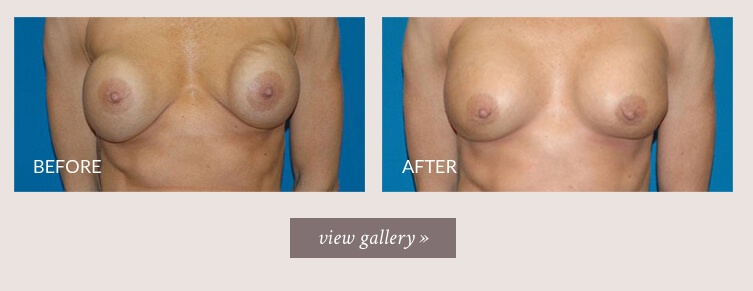
View the full breast revision photo gallery. Photographs show actual patients of the practice and are published with consent. Results vary from patient to patient; no result shown should be taken as what you will achieve.
Breast implant revision FAQ
Can Dr. Hurvitz revise implants placed by another surgeon?
Yes. Most revision patients had their original surgery elsewhere, including elsewhere in the Seattle and Bellevue area. There is no local exception — the practice welcomes patients from the community regardless of who operated first.
Does he perform en bloc capsulectomy?
Yes, routinely. It is used for severe encapsulation around intact or ruptured implants and for rare diagnoses such as BIA-ALCL. Where a capsule is heavily scarred or calcified, removing it intact would require a much larger incision with real risk to circulation and sensation; in those cases the implant is decompressed and removed first, then the entire capsule is removed through a smaller, safer incision. Both approaches remove the implant and the whole capsule.
Does a calcified capsule mean I have cancer?
In most cases, no. A calcified or scarred capsule is usually benign. Capsules are routinely sent to pathology for examination regardless.
Will the entire capsule always be removed?
Not always, and that is sometimes the correct decision. If part of a benign capsule is extremely adherent to a rib or to the muscles between the ribs, removing it can be unsafe. In those cases a portion may be deliberately left in place rather than risk damage to the chest wall.
How much does breast implant revision cost?
Routine revision implant surgery starts at $15,000, including all equipment, the operating room and anesthesia. Pricing varies widely with the complexity of the case, and an in-person consultation determines the surgical time required, which is what drives the final figure.
Will my implant warranty pay for revision?
It may offset part of the cost for a covered device problem such as rupture or, in some cases, capsular contracture. It does not cover dissatisfaction with an aesthetic result. Our staff will help you file the claim.
Will explant fix my breast implant illness symptoms?
Complete resolution of symptoms cannot be promised. In this practice’s experience, patients who want their implants removed find significant relief after surgery. Any surgeon who guarantees a specific outcome is overstating what is known.
What will my breasts look like after implants are removed?
That depends on how much natural breast tissue you have, how large the implants were, how long they were in place, and your skin quality. Manufacturer labeling is explicit that removal without replacement can leave permanent dimpling, puckering or wrinkling. A lift, fat grafting, or both can be performed to address it.
Can explant and a breast lift be done at the same time?
Often yes. Every patient is different, but where it is appropriate Dr. Hurvitz performs explant and lift in a single stage.
Do I need a mammogram before revision surgery?
Age-appropriate mammograms are required before proceeding with breast surgery. Other testing may be requested depending on your history and examination.
Are the implants and capsules tested after removal?
Yes. Breast tissue and capsules are routinely sent to pathology, not only when something looks abnormal.
Can capsular contracture come back after revision?
Yes. It is the most common reason for repeat revision, and there is no FDA-approved device or drug that prevents it. The manufacturer’s ten-year core study reported it in 29% of revision patients. Recurrence after Dr. Hurvitz’s revision surgery is well under 5%.
Can my implants be moved from under the muscle to over it?
Yes. Implant plane changes are performed often, and are used for animation deformity, recurrent contracture and some malposition problems.
What is capsulorrhaphy?
Tightening of the internal cavity of the implant capsule so the implant sits correctly. It is done with sutures, with cautery to contract the capsule, or with both. It is the repair for bottoming out, lateral displacement and symmastia.
Will mesh or acellular dermal matrix be used in my surgery?
Only if indicated. AlloDerm, Strattice, GalaFLEX and DuraSorb are all useful in breast surgery and Dr. Hurvitz uses most available matrices and meshes, but whether one is right for you requires a full discussion. They add cost.
How long before I can exercise after revision?
Light cardio at about three to four weeks, chest strengthening and heavy lifting generally after six weeks with clearance, and full unrestricted training at about six to eight weeks. Pocket repairs may require longer.
Can I go smaller instead of larger?
Yes. Downsizing is a common revision, and it is often combined with a lift, since a smaller implant leaves the existing skin envelope with less to fill.
Next steps
To discuss breast implant revision, explant or capsulectomy with Dr. Hurvitz, schedule a consultation at our Bellevue office, or complete the Surgical Consultation Intake Form in advance. Bring your implant device card or original operative report if you have them. If you have a question first, you can ask it here.
Naficy Plastic Surgery & Rejuvenation Center · 1110 112th Ave. NE, Suite 150, Bellevue, WA 98004 · (425) 450-0880
Medically reviewed by Keith Hurvitz, MD, FACS, board-certified plastic surgeon. Last reviewed August 2026.
Regulatory and outcome data cited on this page come from the U.S. Food and Drug Administration and from Allergan’s published core study of Natrelle silicone-filled breast implants. Warranty terms are set by the manufacturer and subject to change. This page is for general education and is not a substitute for a consultation. Individual results vary.