Breast Lift
A breast lift, or mastopexy, removes excess skin and repositions the breast tissue and nipple to a higher, firmer position. It does not add volume — that requires an implant or fat grafting. At Naficy Plastic Surgery & Rejuvenation Center in Bellevue, breast lifts are performed by Keith Hurvitz, MD, FACS, who is certified by both the American Board of Plastic Surgery and the American Board of Otolaryngology and has practiced since 2007. He uses all lift patterns — crescent, periareolar, vertical and Wise pattern — matched to how much skin needs to come out and how far the nipple has descended. Fees start at $5,000. Surgery is outpatient, most patients return to desk work within about a week, and full exercise resumes at roughly six to eight weeks.
What is a breast lift?
A breast lift is surgery that raises and reshapes a breast that has descended. The surgeon removes excess skin, tightens the remaining skin envelope, repositions the breast tissue, and moves the nipple and areola up to sit at the fullest part of the breast. The areola is usually made smaller at the same time, since it tends to stretch as the breast descends.
The single most useful thing to understand before your consultation is this: a lift changes position and shape. It does not change size. A lift will make a breast sit higher and look firmer, and it will often look slightly smaller afterward because the tissue is compacted rather than spread out. If you want more volume, particularly in the upper part of the breast, that requires an implant or fat grafting in addition to the lift.
Do I need a lift, an implant, or both?
This is the question most consultations turn on, and the answer is usually determined by one measurement: where the nipple sits relative to the inframammary fold, the crease underneath the breast.
| Your situation | Usually the right operation |
|---|---|
| Nipple sits above the fold; you want more volume | Breast augmentation alone |
| Nipple sits at or below the fold; you are happy with your size | Breast lift alone |
| Nipple sits at or below the fold; you also want more volume or upper fullness | Lift combined with an implant, or with fat grafting |
| Breasts are large, heavy and causing neck, back or shoulder symptoms | Breast reduction, which includes a lift |
| Mild descent, and you mainly want upper fullness | Augmentation alone may be enough — an implant fills a mildly loose envelope |
Be cautious of any surgeon who tells you a large enough implant will substitute for a lift when the breast has genuinely descended. It produces a heavier breast that sags further and sooner, because the same skin is now carrying more weight. The revision that follows is more involved than doing the correct operation the first time.
Which breast lift pattern is right for me?
Dr. Hurvitz uses all lift patterns, including the crescent lift. Which one is right for you depends on how much skin has to be removed and how far the nipple has to travel. More skin removal means a longer scar; there is no way around that trade-off, and a surgeon who uses one pattern for everyone is fitting the patient to the technique rather than the other way round.
| Pattern | Where the scar sits | Typically used when |
|---|---|---|
| Crescent | A crescent of skin removed above the areola only | Very minimal descent, often combined with an implant. Moves the nipple a short distance. |
| Periareolar (doughnut) | A circle around the areola | Mild descent. Also used to reduce areolar diameter. Limited skin removal. |
| Vertical (lollipop) | Around the areola, plus a vertical line down to the fold | Moderate descent. Reshapes the breast as well as removing skin. |
| Wise pattern (anchor) | Around the areola, vertically down, and horizontally along the fold | Significant descent and substantial excess skin. The most skin removal and the most control over shape. |
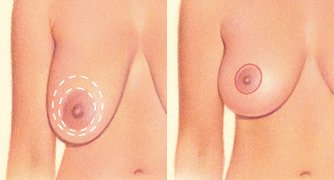
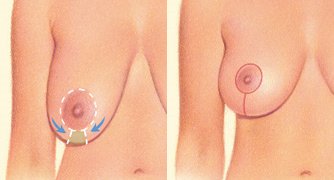
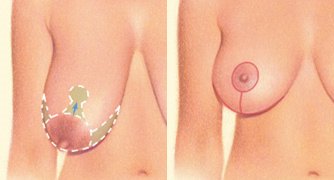
All surgical scars are permanent. They are typically pink and firm for the first several months, then soften and fade over roughly a year to eighteen months. Final scar appearance depends substantially on individual healing.
What is a pedicle, and why does it matter?
During a lift the nipple and areola are not detached. They stay connected to the breast by a pedicle — a column of tissue carrying the blood supply and the nerves. Keeping that pedicle healthy is what preserves nipple viability and, as far as possible, sensation.
Dr. Hurvitz uses both inferior pedicle and superior pedicle techniques, chosen according to the breast being operated on rather than by default. The pedicle choice affects how the breast is reshaped, how the blood supply is preserved, and where the resulting fullness sits.
Can a breast lift and implants be done at the same time?
Often, yes. Dr. Hurvitz will frequently perform the lift and the implant in the same operation, though whether that is appropriate depends on the patient and the case.
Combining them is a more demanding operation than either alone, because two things are being changed at once and they work against each other: the implant adds volume and pushes outward, while the lift tightens the envelope inward. Where the degree of descent, the skin quality or the amount of volume change makes a single-stage result unpredictable, staging the two operations is the safer path. That is a judgment made at consultation, not from a photograph.
If an implant is used, everything on the breast augmentation page applies as well — the FDA boxed warning, the Patient Decision Checklist, the rupture screening schedule, and the fact that implants are not lifetime devices.
Is internal support or mesh used in a breast lift?
Sometimes. Internal support materials can be used to reinforce the lower pole of the breast and help hold the reshaped tissue in position.
| Product | What it is | Practical note |
|---|---|---|
| AlloDerm | Human-derived dermis | Very expensive |
| Strattice | Porcine-derived dermis | Much more affordable in cosmetic surgery |
| GalaFLEX | Mesh made from the same class of material used for absorbable sutures | Absorbs over time as the tissue reinforces |
| DuraSorb | Mesh made from the same class of material used for absorbable sutures | Absorbs over time as the tissue reinforces |
Dr. Hurvitz uses all four. None is used routinely — whether one is indicated for you requires a full discussion, and they add cost.
How long does a breast lift last?
A lift produces a durable change, but it does not stop the process that caused the descent in the first place. Dr. Hurvitz puts it plainly: “We cannot stop aging or the effects of gravity. In addition, everyone ages differently.”
What that means practically is that the result is permanent in the sense that removed skin does not grow back, but the breast will continue to change. How quickly depends on your skin quality and elasticity, your breast size and weight, genetics, weight fluctuation, and whether you have further pregnancies. Larger, heavier breasts descend again sooner than smaller ones. Anyone who promises a permanently unchanging result is overstating what surgery can do.
For that reason, if you are planning a pregnancy in the near future, waiting is usually the better call. Pregnancy and breastfeeding change breast volume and skin quality, and many patients who lift beforehand end up wanting a revision afterward.
Will I lose nipple sensation? Can I still breastfeed?
On sensation, Dr. Hurvitz is direct: “There is always a risk of nipple sensation being affected with any type of breast surgery.” Sensation may be reduced, heightened, or patchy in the early months, and it usually settles over time — but change can be permanent, and no technique eliminates the risk.
Breastfeeding is often still possible after a lift, because the nipple stays attached to the breast by its pedicle and the ducts are largely preserved. It cannot be guaranteed. If future breastfeeding matters to you, say so at consultation — it is relevant to pattern and pedicle choice.
What are the risks of a breast lift?
- Permanent scarring, with length determined by the pattern used
- Changes in nipple and breast sensation, which can be permanent
- Delayed healing, particularly where the vertical and horizontal incisions meet in a Wise pattern
- Asymmetry in breast shape, nipple position or areolar size
- Partial or, rarely, complete loss of the nipple and areola from compromised blood supply — the risk that pedicle technique is designed to minimise
- Difficulty breastfeeding
- Bleeding or hematoma, which may require a return to the operating room
- Infection
- Recurrent descent over time
- The need for revision surgery
- Where an implant is used, all implant-specific risks including capsular contracture and rupture
- Anesthetic risk, and the general risks of any surgical procedure
Dr. Hurvitz does not currently track published complication rates specific to breast lift. Where a figure exists — his capsular contracture rate of under 5% in implant surgery — it is published on the relevant page rather than implied here.
What is recovery from a breast lift like?
| Time after surgery | What to expect |
|---|---|
| Day of surgery | Home the same day. A responsible adult must drive you and stay with you overnight. |
| Days 1–3 | Peak soreness, usually described as tightness rather than sharp pain. Short walks encouraged from the first day. Supportive bra worn continuously. |
| Days 4–7 | Discomfort noticeably decreasing. Most patients return to non-strenuous desk work near the end of this week. |
| Weeks 2–3 | Swelling subsiding. Breasts still sitting high and looking flattened on top — this is normal and not the final shape. Walking. |
| Weeks 3–4 | Light cardio resumed. |
| Week 6 | Chest strengthening and heavier lifting generally resumed after this point, on Dr. Hurvitz’s clearance. |
| Weeks 6–12 | Tissue softens and settles. Full unrestricted training at about six to eight weeks. |
| 3–6 months | Shape considered settled. Scars still maturing and often at their most noticeable. |
| 12–18 months | Scars reach final appearance. |
Who is a good candidate for a breast lift?
- The nipple has descended to or below the inframammary fold, or the breast has lost shape and firmness
- Physically healthy, at a stable weight, and not currently pregnant or breastfeeding
- Bothered by breast shape after pregnancy, breastfeeding, weight loss or aging
- Understands that a lift repositions rather than enlarges, and that added volume requires an implant or fat grafting
- Accepts permanent scarring in exchange for a change in shape
- A non-smoker, or willing to stop well in advance of surgery and stay off nicotine through healing
- Has finished having children, or accepts that a future pregnancy may undo the result
Who is not a good candidate?
- Anyone unwilling to accept a scar. Every lift leaves permanent scars, and the more skin that needs to come out, the longer they are. If the scar is unacceptable to you, a lift is the wrong operation regardless of how much the shape bothers you.
- Active smokers unwilling to stop. Nicotine constricts the small vessels supplying the pedicle. In an operation whose main serious risk is compromised nipple blood supply, this matters more than in most procedures.
- Patients planning pregnancy in the near future, or whose weight is still changing significantly. Both will alter the result.
- Anyone with an untreated breast lump, an abnormal mammogram or an unexplained finding. That is worked up first, without exception.
- Patients who want more volume and assume a lift provides it. It does not. That conversation should happen before surgery, not after.
- Anyone expecting the result never to change. Skin and gravity continue working, and everyone ages differently.
Where another procedure would serve you better — augmentation, reduction, fat grafting, or revision of existing implants — Dr. Hurvitz will tell you at the consultation rather than after.
How much does a breast lift cost in Bellevue?
| Breast lift | Starts at $5,000 (surgeon fee) |
| Why it varies | The pattern used, how much skin is removed, whether internal support is used, and whether an implant or fat grafting is performed at the same time |
| Lift with implants | Quoted together after examination; see the breast augmentation page for implant surgery fees |
| Insurance | A cosmetic breast lift is not covered by health insurance |
You receive an exact written quote after your consultation, once the surgical plan is set. See fees and payment policies, financing options and general pricing and purchasing terms.
Why choose Dr. Hurvitz for a breast lift?
- Certified by two American boards. Keith Hurvitz, MD, FACS is certified by the American Board of Plastic Surgery and the American Board of Otolaryngology — Head and Neck Surgery, and is a Fellow of the American College of Surgeons.
- Every lift pattern, not one default. Crescent, periareolar, vertical and Wise pattern, matched to the breast rather than to a preferred technique.
- Both pedicle techniques. Inferior and superior pedicle, chosen for the individual breast.
- Reconstructive background. He served as Director of Breast Reconstruction at the Todd Cancer Institute at Memorialcare Long Beach Medical Center and as Chief of Plastic Surgery there from 2012 to 2024.
- Single-stage where appropriate. He frequently performs lift and implant together rather than defaulting to two operations.
- Internal support available — AlloDerm, Strattice, GalaFLEX and DuraSorb — where the lower pole needs reinforcement.
- Practicing since 2007, with a substantial revision and explant practice, meaning he regularly sees the long-term results of breast surgery performed elsewhere.
Where is the surgery performed?
Breast lift surgery is an outpatient procedure performed in the practice’s on-site ambulatory surgery center at 1110 112th Ave. NE in Bellevue. The facility is Medicare-certified and Washington State accredited, with two fully equipped operating rooms and a dedicated anesthesia team. You go home the same day.
Operating in an accredited facility attached to the practice means the same nursing and anesthesia team works with Dr. Hurvitz on every case. Your anesthesia plan is reviewed with you before the day of surgery.
Breast lift before and after photos
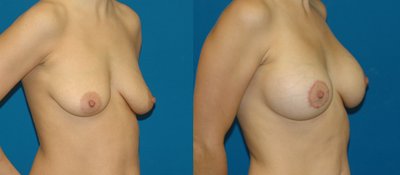
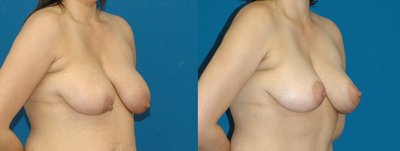
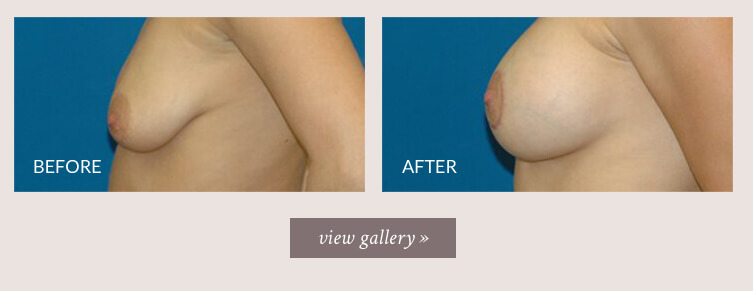
View the full breast lift photo gallery. Photographs show actual patients of the practice and are published with consent. Results vary from patient to patient; no result shown should be taken as what you will achieve.
Breast lift FAQ
Will a breast lift make my breasts bigger?
No. A lift repositions and reshapes the tissue you have. Many patients find their breasts look slightly smaller afterward because the tissue is compacted rather than spread out. Added volume requires an implant or fat grafting.
How do I know whether I need a lift or just implants?
The usual test is where your nipple sits relative to the crease under the breast. Above it, augmentation alone may be enough. At or below it, a lift is generally indicated, with or without an implant.
Can a large implant replace a lift?
Not for genuine descent. An implant fills a mildly loose envelope, but placed into a breast that has truly descended it creates a heavier breast that sags further and sooner.
Which lift pattern leaves the smallest scar?
The crescent and periareolar patterns leave the least scarring, but they also remove the least skin and move the nipple the shortest distance. Pattern is chosen by what the breast needs, not by scar preference alone.
How much does a breast lift cost?
Fees start at $5,000 and vary with the pattern used, the amount of skin removed, whether internal support is used, and whether an implant or fat grafting is performed at the same time. You receive an exact written quote after consultation.
Does insurance cover a breast lift?
Not for a cosmetic lift. Breast reduction is a separate procedure with a different insurance picture — see the breast reduction page.
Can a lift and implants be done in one operation?
Frequently, yes. Dr. Hurvitz often performs both at the same time, though some cases are safer staged. It depends on the degree of descent, skin quality and how much volume change is planned.
How long does a breast lift last?
Removed skin does not grow back, so the change is durable, but aging and gravity continue. Larger, heavier breasts descend again sooner. Everyone ages differently and no result is permanently unchanging.
Will I lose nipple sensation?
There is always a risk of nipple sensation being affected with any breast surgery. It is often temporary and settles over months, but change can be permanent.
Can I breastfeed after a breast lift?
Often yes, since the nipple remains attached to the breast by its pedicle and the ducts are largely preserved. It cannot be guaranteed. Tell Dr. Hurvitz at consultation if this matters to you.
When can I go back to work?
Most patients return to non-strenuous desk work about a week after surgery. Physically demanding work takes longer.
When can I exercise again?
Walking within days, light cardio at about three to four weeks, chest strengthening and heavy lifting after six weeks with clearance, and full unrestricted training at about six to eight weeks.
How visible will the scars be?
Scars are permanent. They are typically pink and firm for several months, then soften and fade over about a year to eighteen months. Wise pattern leaves the most scarring, crescent the least. Final appearance depends heavily on individual healing.
Should I wait until after I have children?
Usually yes. Pregnancy and breastfeeding change breast volume and skin quality, and many patients who lift beforehand want a revision afterward.
Will my areolas be made smaller?
Usually. Areolar diameter tends to stretch as the breast descends, and reducing it is a standard part of most lift patterns.
What if my breasts are different sizes?
Asymmetry is extremely common and is addressed as part of the plan — sometimes with different amounts of skin removal on each side, sometimes with different implant sizes where implants are used. Perfect symmetry is not achievable, and some difference will remain.
Can a breast lift correct sagging after weight loss?
Yes, and it is one of the more common reasons for the operation. If you have lost weight on a GLP-1 medication or through bariatric surgery, see also body contouring after weight loss, and expect Dr. Hurvitz to want your weight stable before operating.
Next steps
To discuss a breast lift with Dr. Hurvitz, schedule a consultation at our Bellevue office, or complete the Surgical Consultation Intake Form in advance so your visit can focus on your plan rather than paperwork. If you have a question first, you can ask it here.
Naficy Plastic Surgery & Rejuvenation Center · 1110 112th Ave. NE, Suite 150, Bellevue, WA 98004 · (425) 450-0880
Medically reviewed by Keith Hurvitz, MD, FACS, board-certified plastic surgeon. Last reviewed August 2026.
This page is for general education and is not a substitute for a consultation. Individual results vary.